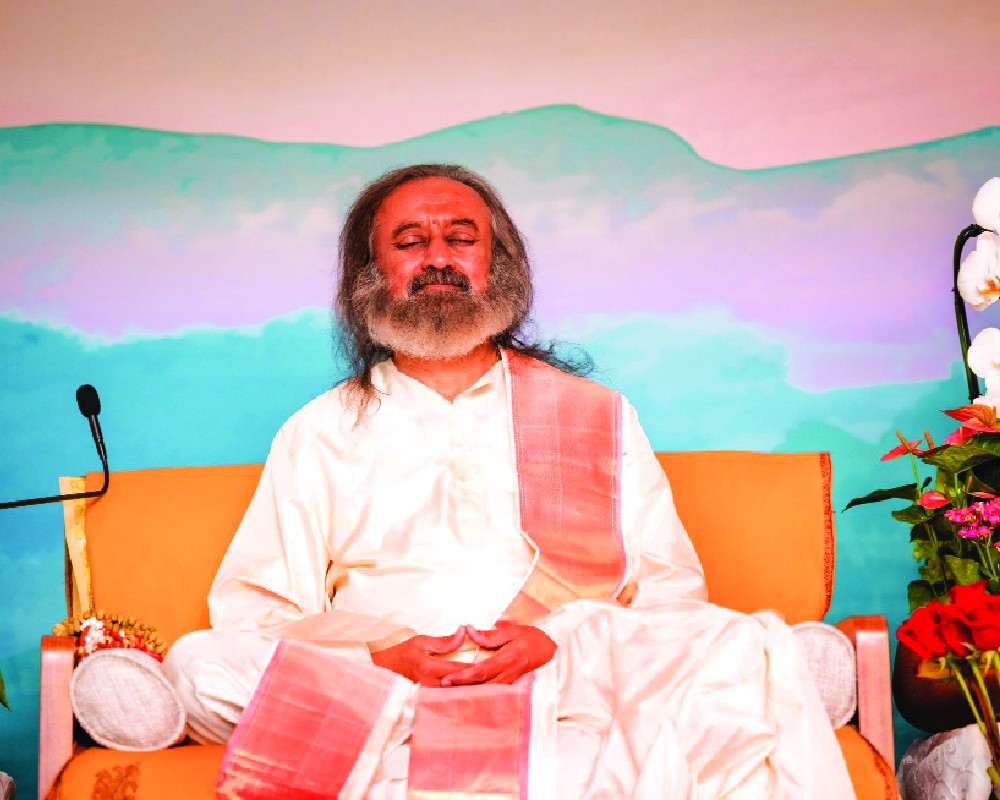
See, in schools, teachers often tell children not to get angry or not to feel sad. But nobody teaches you how not to get angry or how to handle this restless mind or negative emotions. We teach dental hygiene to our children, but forget to teach them about mental hygiene. What is mental hygiene? Taking care of your mind is mental hygiene. Everybody likes to wear clean clothes; everybody takes a shower daily. In the same way, we need to learn how to keep our minds free from the impressions we gather in the course of daily life.
Mental hygiene is necessary, and you can maintain it through practices like meditation. Taking some time out every day to consciously relax the mind and repose in your Self is like pressing the delete button on all the unnecessary files on your computer. It lets you start afresh with a clear slate. We teach children to brush their teeth when they are very young, so their teeth remain healthy and their smiles intact. But a smile comes not only from healthy teeth, but from a pleasant state of the mind, which you get from meditation to begin with. And then where does it lead us? Is it limited only to hygiene or wellness of the mind? No, it leads us to another dimension deep within us, which is a field of all possibilities.
The Antidote to Stress
A primary mental health concern today is stress, which does not go away just by talking or advising alone. We need to learn some techniques and tools to get rid of stress and calm the mind. Meditation is for those who have a lot to do in the world. It helps those with responsibilities, deadlines, challenges, and pressure. It gives you inner stability. It makes you peaceful within and dynamic outside. The quality of your life depends on the quality of your mind. If the mind is not centred, external influences can easily disturb it. Meditation helps you achieve that centredness.
The formula for stress is too much to do, too little time, and no energy to do it. Now, you cannot reduce your workload, nor can you have more time; you are left with only one thing to do, which is to increase your energy level. And this is where meditation can be of immense help.
Meditation gives you deep rest, deeper than the deepest sleep. When the mind becomes calm and centred, it gains access to the enormous intelligence and energy that reside within us. Meditation is a way to take that deep rest, and yet remain alert and conscious.
People have a common misconception that meditation is about focusing the mind. No, meditation is effortless and fun. It is what your soul has been looking for. When the mind becomes calmer with practice, you make better decisions and create a positive, harmonious atmosphere around you. When the mind is disturbed, your perception is disturbed, and any decision you take from that place is one you end up regretting.
What Does Science Say About Meditation and Stress?
Today, there are more than enough scientific studies on how meditation benefits both body and mind. Studies show that stress, anxiety, and negative feelings create lesions in the hippocampus of the brain. When these lesions are removed through deep conscious relaxation, you begin to feel better, fresher, and more alert. Meditation empowers you to be in the present moment — not worried about the future or brooding over the past.
Another study shows that the amygdala, the central part of the brain, starts shrinking when you begin meditating. When the amygdala is larger, you are more prone to nervousness and other emotional imbalances. Scientists also say that grey matter increases in the brain with meditation. Grey matter processes information and controls muscles, memory, and emotions.
Researchers at Harvard Medical School have found that under stress, the brain may shift from cognitive to survival mode, which can cause memory loss over time, as more energy goes into surviving than cognition.
Chronic stress can lead to atrophy of brain mass and a decrease in its weight. These structural changes impact how you respond to stress, cognition, and memory. Stress can lead to irritability, moodiness, anxiety, and depression. Meditation works at the root of this by calming the system and restoring balance. Through meditation and breathing techniques, we can cleanse the mind of negative emotions and address mental stress effectively.
Modern medicine also supports these spiritual practices in reducing stress hormones. Psychiatrists at the National Institute of Mental Health and Neurosciences have found that cortisol levels — the stress hormone — are significantly lower among practitioners of SudarshanKriya, a powerful breathing technique and meditation practice. Research from Sweden shows that SudarshanKriya reduces stress and anxiety and increases optimism and well-being. It is as effective as standard drug therapy, free of side effects, and does not strain the wallet. You can also increase your energy levels by chanting, which is a path to meditation. These chants have existed in human consciousness for thousands of years. When you chant, the deepest level of consciousness begins vibrating, energising you while calming your mind at the same time. It is because of these practices — singing bhajans and chanting — that people in ancient times did not experience many instances of depression, despite living modest lives in India. People chanted often, so the subtle energy remained high.
Meditation and Sleep
The biggest casualty of a stressful lifestyle is the quality of sleep. Every night when you sleep, you wake up energised and rejuvenated because the mind, body, and breath come together into one rhythm, eliminating the stress of the day. But there is another way of resting that is far superior to natural sleep — meditation. In meditation, you relax consciously.
With conscious meditation, or conscious rest, and this state of restful alertness, you can remove stress from the body-mind system in a very short period of time. It brings clarity to the mind, makes your skin glow, and your heart glow as well.
Power of Intention
There are more than 400 benefits of meditation; over 100 have been proven and documented. Meditation enhances intuition, creativity, decision-making, work-life balance, and interpersonal relationships. It also boosts immunity. Beyond these benefits, it strengthens the power of
intention.
When there is disturbance in the world, if you can remain calm and maintain equanimity, ideas arise in your mind about what to do. Peace becomes possible when the mind is serene. When we are disturbed, we are of little help to ourselves or to others. People seek altered states of consciousness through harmful means because they want relief, but the state they seek is already present in their breath. Sit and meditate for a few minutes, and you experience joy within. Millions have emerged from harmful habits, violence, and extreme stress through meditation.
Is Meditation for Everybody?
It is a natural human tendency to seek joy that does not diminish and love that does not distort or turn into negative emotions such as anger, hate, or jealousy. Wanting comfort is natural because you once experienced that unmatched state of comfort in your mother’s womb. There, you had to do nothing. Food was supplied effortlessly, and you floated peacefully. That is meditation, and meditation is absolute comfort. Meditation is an art. Just as everyone has ten fingers and only needs to learn how to use them to create something melodious with an instrument, similarly, as long as you have a mind with which you can think, you can
meditate. Often, people complain that it is difficult to focus the mind or relax, but meditation does not require renunciation or drastic lifestyle changes. You do not need to go to the Himalayas or practise extreme penance. To meditate, you simply need to know how to relax — like making an effort to catch a train, but once you are on it, you can rest. You can begin meditation with the help of a qualified instructor who uses a mantra — a specific sound. In Sanskrit, it is said, “Mananatrayateiti mantra.” A mantra protects the mind from repetitive thoughts and worries. Mantra-based meditation techniques such as Sahaj Samadhi help free the mind from this cycle.
To meditate effortlessly, I offer three principles. First, Achah — “I want nothing.” Put all desires aside temporarily. Second, Aprayatna — “I do nothing.” Meditation is not about effort, focus, or control. Just let go. Third, Akinchan — “I am nothing.” Drop all labels you associate with yourself. For those moments, simply be nobody.
In the very first sitting, you experience something beautiful. With regular practice, once or twice a day, a transformation begins within you — one that others around you will also begin to notice, recognising the calm and positive energy you carry. No, enjoy the ride for a while. Be on it! Never mind! But see that your goal, or what you set as a goal, is already there where you are. And knowing this brings you serenity, beyond any words or explanation.