




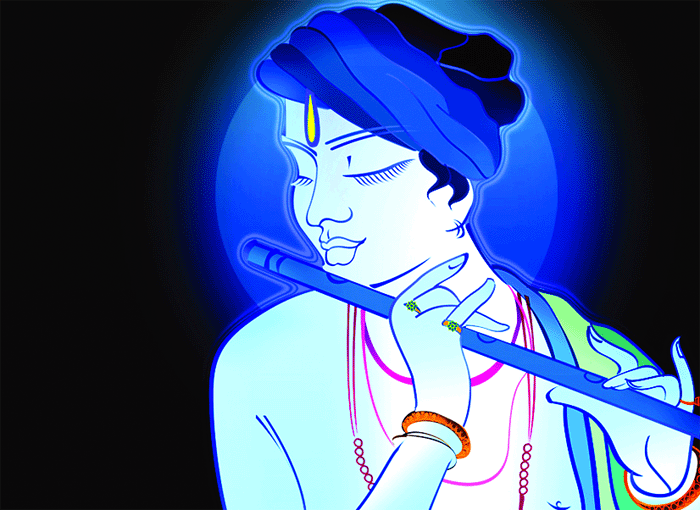
Combining in himself self-contradictory personality traits, he has caught the people’s attention all over the world, writes Dr ASHA GOSWAMI
For centuries, people all over have found solace and spiritual satisfaction by reading Krishna Katha and reciting his Gita. No figure historical or mythical has caught man’s attention as Krishna has. The personality of Krishna constitutes one of the grandest themes of Indian cultural history. He is described as a great teacher and preacher of Dharma. There is much controversy over his love affairs with the Gopis and Radha. It is fascinating to note that combining in himself self-contradictory personality traits he has caught the people’s attention all over the world on these grounds such as ‘that in theBhagavad Gita he teaches detachment but himself acts the other way as he is credited with having 16,108 wives apart from his relationships with the Vrindavan gopis and the raasa dance enacted by him in their midst, which present him as a sensuous personae’.
To reconcile both these opposite traits and to find the true reason as to why he is depicted in the Puranas as discharging both the opposite functions, let us firstly quote the Gita maxim declaring that Krishna represents the deity of amusements and joy which is lawful and it indicates ‘that Krishna represents the personified kamadeva in a man for procreation which is in accordance with dharma and is for the continuation of his race and which is pure, satvika and un-perverted by the feeling of carnal pleasures and hence the lord is present in it’.
Secondly, let us resort to the well-known maxim of Bhagavatapurana which directly answers this question as to why Krishna is endowed with inter-contra personality traits ‘that being super sensuous, he represents the quintessence of beauty and charm as well as the lord who is self-contained and in possession with his true self which he experiences within his own individualistic form that of Poorna- ahamataa, which also signifies his self-contained state in which he remains completely independent and experiences pure bliss on the highest plane of existence’. Enjoying this very state, he is full in himself at that moment, as his pure consciousness is enclosed from all sides with no external movements disturbing him. Hence, he is titled as aatmarati and aaptakama. Besides, he also turns into aaptakama personae due to his power known as ahlaadinishakti which signifies his very nature of blissful mode and the power that makes him indulge in frolic, sportive activities called lilas. In this state he also represents a revelation of sweet attributes, essence of all joy in one form, a mode of the almighty whereby he indulges in sportive activities for his own pleasures since he is hailed as atmarati.
Thirdly, the same personality trait of Krishna be understood with the help of Upanishadic notion which treats the divine as endowed with all transcendental glory with which he assumes a form and indulges in frolic sports or the lilas for his own pleasures as well as for the pleasure of all the beings. Besides, his Imagery as Radhavallabha may also cast some light on Krishna’s frivolous traits with Radha and the Gopis. Since, being endowed with this role as well as the trait of blissfulness, Krishna undoubtedly emerges as a manifestation of an amorous deity who is so beautiful that he not only excites love for himself among his devotees but at the same time also relishes adoring himself.
Consequent upon that he is best known as a ‘self-possessed God who even sports with his own devotees’. This makes the oft-quoted maxim absolutely clear that “there is no other wonder in this world than Shri Krishna who within himself personifies the great sentiments of wonder”. Moreover, Shukracharya long back in his Nitishastra while laying stress on the high moral standards of Krishna, had remarked that “Krishna can be cited as best example of a person endowed with self-contained mind who having married over 16000 charming damsels had ever remained calm and undisturbed by their sensuous advances”. Besides, as Radhavallabha, Krishna also fully manifests himself “as a god frolicking in company with his principal supreme energy personified as Radha, accompanied with which he turns into a god who is all perfect, illimitable for nothing being impossible for him who is all perfect and self-contained whose acts are the lilas which are not for any outwardly purpose, since all his desires are fulfilled”.
Besides, to quote Shridhara, the non-sectarian commentator of the Bhagavadpurana , who also with the same objective of providing true implication of the amorous lilas of Krishna like Raasa with the Gopis, had remarked “that Krishna’s raaslila narrative’s purpose was to make the readers, devotees overcome their sensuous impulses and express more deep love for the lord. As, those with much perverted minds may also be attracted towards Krishna by means of such love topics. Hence are introduced such amorous episodes in the narratives related to him”. Moreover, it is also held that Krishna is portrayed in amorous colours in later Puranas as a result of his identification with Vishnu, the most romantic god of the Vedas, and due to the erotic elements of Vishnu’s accounts of the Vedas which were superimposed on him. With the result he became the most romantic god of his times. Besides, the Puranic conceptualisation of the gopala Krishna phase of his personality which was made during 10-12 centuries also defends him thus on two premises. One, it raises romantic love to high state and illustrates that it was the best among all the ways leading to salvation, which was the impassioned adoration of God Krishna inculcated by Radha who also served his passion-adored mistress. Secondly, it proves that the romantic love which is likened to the devotee’s most exalted experience as mahabhava during the devotional practices was the best way of worship.
In conclusion, it is however ascertained “that while dealing with Krishna’s amorous lilas, one must realise that these happened only on non-physical plane where both Krishna and his partners were playing their roles of love and friendship in non-physical bodies”.
The writer is a noted Indologist and authority on Krishnaite Studies