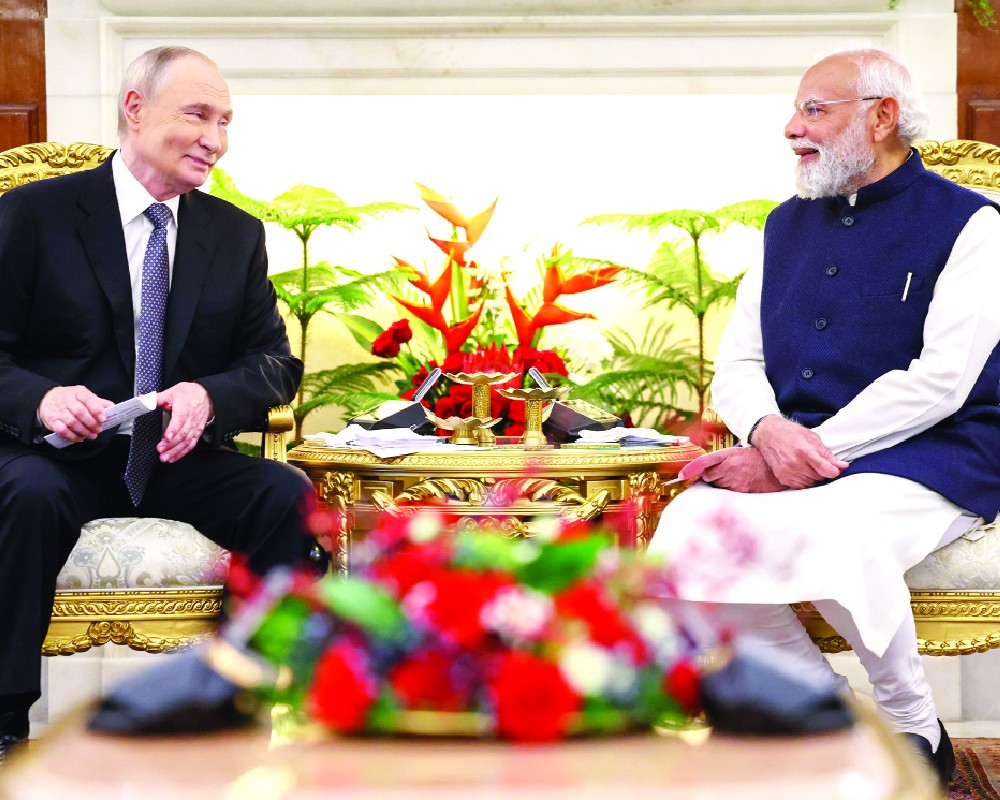
“Russian President Vladimir Putin and Indian Prime Minister Narendra Modi have laid the groundwork for boosting the economic partnership between the traditional allies, with the countries signing a series of pacts to raise bilateral trade to $100 billion by 2030.” This is an excerpt of the media reportage from Russia’s state-sponsored RT, earlier known as Russia Today, on the day Putin wrapped up his two-day visit to India. RT commemorated a special edition to the 23rd India-Russia Annual Summit, a tradition that dates to 2000, as President Putin launched RT India on December 5.
The point is not about the RT’s report as much as the optimism and euphoria that emanated from the short visit, and which was reflected in voices, opinions, and media coverage in Russia and India. The summit led to a detailed joint statement, and clutch of business deals that foregrounded economic resilience and agricultural security. It included a joint urea plant in Russia, which is expected to produce 1.8-2 million tonnes annually, and ease India’s fertiliser supply constraints. The joint declaration “welcomed steps to ensure long-term supply of fertilisers to India, and discussed the potential establishment of joint ventures in this area.”
One of the major steps, which was committed earlier, but inked during Putin’s visit, was the joint venture between Russia’s Uralchem, and three Indian fertiliser firms, Rashtriya Chemicals and Fertilizers, National Fertilizers, and Indian Potash. Incidentally, Indian farmers have faced recurring fertiliser shortages driven by global supply disruptions, rising demand, and logistical bottlenecks. In Madhya Pradesh, long queues were witnessed at the distribution centres, with reports of unrest in some places. The Government consistently denied the reports about shortages.
Demand has grown due to higher cropping intensity, and good monsoons, while domestic production and imports have not kept pace. This has led to periodic shortfalls in key nutrients such as urea and potash. India is the second-largest consumer, and third-largest producer of fertilisers globally. According to the official data, in 2023-24, the country's annual consumption was 601 lakh metric tonnes, with 503 lakh metric tonnes produced domestically, and the remaining being imported. Fertilisers play a crucial role to enhance farm productivity, and are essential for self-reliance in production.
The Government has tried to increase domestic production, but depends upon external supplies for feedstock like natural gas and ammonia. Global disruptions, including trade curbs, shifting trade flows, and higher feedstock prices affect the availability of competitively-priced imports. It pushes procurement into the expensive spot markets, and increases the costs for suppliers and farmers. Reports from several states indicate that the central allocations fell short of requirements for the Kharif season, leaving farmers waiting in long queues in some states.
Even when imports arrive in time, delays in port handling, inland transport, and state-level distribution networks create uneven availability across districts. While urea is heavily subsidised, shortages force the governments and private buyers to opt for emergency purchases at the higher prices, which strain the Budgets of the states and Centre. This translates into delayed or uneven subsidy flows that complicate timely access for smallholders. In the recent past, New Delhi inked deals with Saudi Arabia, Nepal, Bhutan, and Sri Lanka to secure long-term supplies.
According to a report in Tass, Russian news agency, Moscow “increased its fertiliser supplies to BRICS countries by 16 per cent this year, with India leading the increase.” It quoted the head of the Russian Association of Fertilizer Producers, Andrey Guryev, who said that India accounts for more than half of the Russian mineral fertiliser exports. The share of Russian fertilisers in India's imports grew to 26 per cent in the first nine months of 2025, he added. The planned joint-plant’s scale is expected to increase the steady flow of urea to India, which will reduce dependence on spot purchases, and ease seasonal shortages that led to the recent price spikes.
Russia is interested in expanding the farm input trade, but feels restricted by India’s import duty. Hence, the Russians wish that the “negotiations on a free-trade agreement between the Eurasian Economic Union and India must be intensified.” They want the duty to be abolished to reduce costs to the farmers, or official subsidies. According to the Russian side, “India has become the locomotive for the growth of our supplies to BRICS countries.” Hence, New Delhi can take advantage of the changed position, which is imposed on Moscow due to the growing and continuing global sanctions.
The new urea unit will assure cost stability by anchoring production to Russian ammonia, and long-term offtake arrangements. India can insulate the farmers from volatile global freight and commodity cycles, lowering procurement costs for public and private distributors. Locating a plant in Russia leverages abundant feedstock in that nation, diversifying supply away from source-related risks that previously exposed agriculture to curbs or logistical shocks. The deal will possibly follow a co-production and joint-venture model, where the Russian producers supply ammonia, and Indian firms provide capital and guaranteed purchases. It will align incentives to ensure continuous exports to India once commercial operations begin.
According to media reports, the three Indian firms will together hold 50 per cent in the venture, and the Russian entity the remaining 50 cent. If this is the case, the Russian firm will be the largest shareholder, but the decision-making process will be equally shared between the two nations. The model is the same as India’s fertiliser venture in Oman, which operates successfully. The objective: Bag long-term supply stability, rather than seasonal purchases.
This arrangement will reduce upfront capital risks for Russian operators, and provide Indian fertiliser agencies a secured share of output, and pricing leverage during the procurement cycles. Russia’s regional and industry outlets have framed the project as a natural fit to tap the abundance source of Russia’s potash and ammonia reserves to serve a large, nearby market, and emphasised export potential and industrial cooperation beyond fertilisers, including pharmaceuticals and energy projects mentioned in the joint statement. Moscow’s messaging highlights mutual economic benefit, and the logic of linking Russian feedstock with Indian demand.
What remains to be seen in the urea project are the further details such as project timelines, feedstock pricing clauses, logistics, and regulatory clearances. Monitoring the investment decision, offtake contracts, and phased delivery schedule will indicate how quickly the Indian farmers may see the tangible on-ground benefits. The summit’s joint statement therefore marks a pragmatic approach with strategic diplomacy converted into industrial partnerships aimed at securing agricultural inputs. If implemented on schedule, the urea plant may become a durable hedge against fertiliser volatility, and a meaningful supply-side relief for India’s farm sector.
(The author has more than three decades of experience across print, TV, and digital media); views are personal