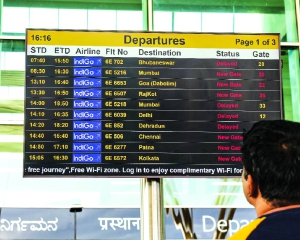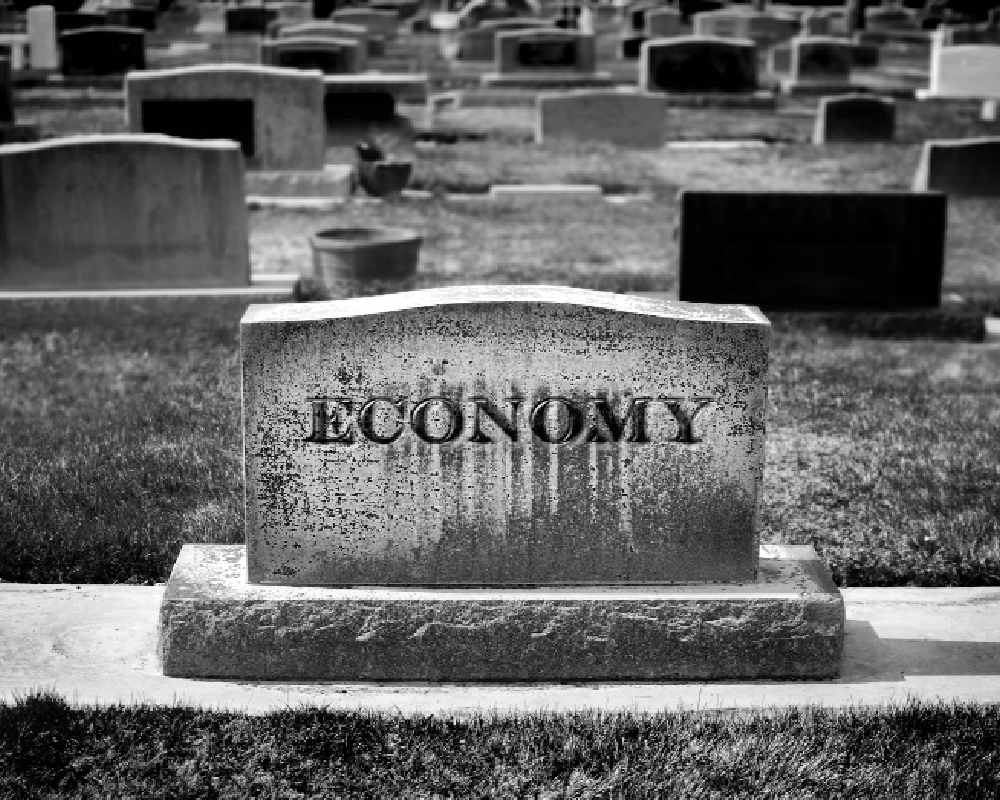
In these times of polarised social media warfare, and a mindset of either you are with us or against us, any writer needs to be prepared for brickbats from both ends of the ideological spectrum for an attempt to objectively analyse any issue. Hence, a balanced report card on the performance of the Indian economy in the first half of 2025-26 is bound to suffer the same fate. Even the visual with this piece will attract criticism. Please remember, it is only a representative visual to indicate what some sections feel: American tariffs will kill the economy unless alternatives are quickly found.
Nevertheless, while there can be a debate on whether the visual is necessary, it is important to evaluate what exactly happened with the economy in the past tumultuous six months, which generally witnessed wreckful external factors, and uplifting internal ones. Caught in the middle of these opposing, but equally powerful, forces, the economy’s future seemed turbulent. There were sections that forcefully endorsed a growing opinion that India was a dead economy. Others vociferously insisted that the country had emerged as a Vishwaguru, with an economy that was stronger than China. After all, it was the fastest-growing among major economies.
Both views seem to be from a faraway cuckoo land. Look at the numbers dispassionately, and one can reach a singular conclusion. Despite heavy and gusty headwinds, the economy remains a bright spot in the overall global order, standing tall as far as GDP growth rate is concerned. At the same time, for reasons discussed and analysed threadbare later in the piece, it is nowhere near the Chinese economic miracle over the past few decades.
Let us start with the numbers, which fascinate and frighten people and experts. The GDP of China grew at 5.2 per cent in the April-June quarter. India clocked a much faster 7.8 per cent. This is obviously praiseworthy, no doubts about it. But the GDP of China is nearing $20 trillion. India lags way behind at $4.2 trillion, or a fifth of it. Economists have repeatedly estimated that India needs to grow at least eight per cent every year for the next decade, or more, to match China’s economic size and strength. This is achievable, sometime in the far future, but does not seem feasible immediately.
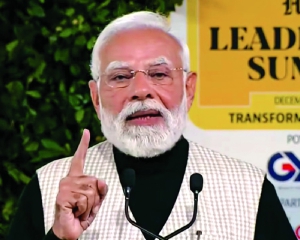
Prime Minister Narendra Modi has sharply elevated his ongoing rhetorical pitch, and urged Indians to become “AtmaNirbhar,” and doggedly pursue ‘Make in India.’ Yet, the biggest ‘Make in India’ miracle in the recent past relates to the local iPhone ecosystem, which is being strategically built and orchestrated by America’s Apple, and its Indian and other partners. This year, iPhone exports may account for 10 per cent of the country’s total merchandise exports. This too is iffy in the tempestuous times of Donald Trump.
What matters is that beyond the iPhone, the genuine ‘Make in India’ cupboard, which needs to be full of manufactured goods, seems bare. Yes, there are a few isolated examples across sectors. Maruti Suzuki and other automakers hope to export millions of vehicles to 100-odd nations. Drugmakers sell more than half their produce to the US. But something lacks in making India the global hub for certain products, just like China did in this century, or Japan before that, or the Asian Tigers that emerged as counters to both.
Yet, there are two spheres where the Indian economy displays remarkable resilience, and which came to the fore in the past six months. The first is fiscal prudence and stability. Since the days of the late Arun Jaitley, the finance ministry was extremely prudent about fiscal management. His successor, Nirmala Sitharaman, has continued the process, despite a tragic pandemic, a near-global war (Russia-Ukraine), trade and tariff troubles between the two superpowers (America and China), energy crisis, and so on.
The fiscal deficit in 2024-25 was 4.8 per cent of the GDP. The target for this year is a lower 4.4 per cent. This is achievable since there was no profligate spending spree between April and September, and tax revenue collections remained quite buoyant. The global investing community took note of this responsible behaviour. In August this year, the ratings agency, S&P, elevated India’s sovereign rating to BBB from BBB-, and declared the economy “stable”.
Recently, another ratings agency, Moody’s retained its sovereign rating for India, and declared a stable long-term outlook. Both forecasted that the GDP growth rate in 2025-26 will be 6.5 per cent or above, despite the ongoing trade wars inflicted by Trump. The only danger signal is the increasing propensity among the political parties, including the BJP, both at the Centre and states level, to announce reckless freebies during the assembly elections, and implement them if they came to power. This is a dangerous syndrome for future fiscal health, and can paralyse the economy.
The second bright spot is the success of both the finance ministry and the Reserve Bank of India (RBI) in taming retail inflation. Since 2021, the figure was consistently above five per cent, apart from a few months of extremely moderate inflation. Retail inflation fell to a multi-year low of 1.55 per cent in July 2025, and continued to be extremely moderate at 2.62 per cent in August. The September estimates point to low inflation. This enabled the central bank to cut interest rates by as much as 50 basis points in the recent past. Today, the RBI will take a call on another cut, or status quo.
However, inflation in nations like India is like a dragon or a hydra-headed monster. It may be down but is never out. The dragon can rise again, as it did in the recent past, with food inflation breathing fire on poor and rich households. Like a hydra-headed animal, it can raise one of its heads during times of shortages in onions, potatoes, tomatoes, or some other commodity. Climate Change too plays its role, as the temperature excesses and lows impact food supplies.
In summary, between April and September this year, the Indian economy showed no signs of dying, or being dead. It was not walloped into submission or comatose. But there were no hints that it was galloping like an Arabian thoroughbred. It was somewhere in between, standing tall and walking erect, yet unable to run or sprint during to some ailment related to Achilles Heel. Depending on taste, personal prejudice, and ideology, take your pick.
A recent report by Deloitte, a global think tank, “Growth next year will be even stronger, and the momentum over the next two years is set to lift GDP beyond its pre-Covid trend. The pandemic-induced gap will not just be closed, (but) it will be decisively surpassed.” In the same breath, it noted, “That said, India’s growth projections… will likely be tied to broader global trends, including rising geopolitical uncertainties and a delayed synchronous recovery in the West than previously anticipated. Disruptions to global trade and supply chains… will also affect demand for exports.” Now, go figure.
The author has worked for leading media houses, authored two books, and is now Executive Director, C Voter Foundation