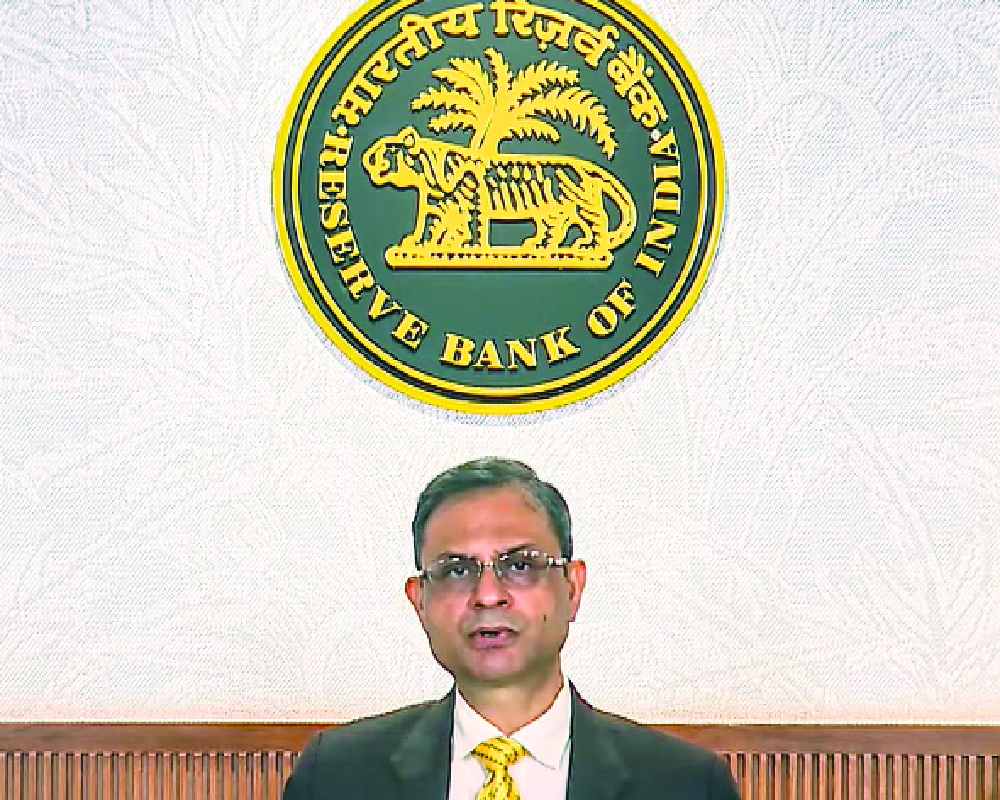
The die-hard optimists hoped for a miracle. The realists argued for a status quo. So, when the Reserve Bank of India (RBI) met on the eve of Dussehra, it did what the realists had said for weeks. The repo rate remains unchanged at 5.5 per cent. The announcement was dubbed as “pause,” “dovish approach,” “acknowledgement of risks,” and “space for further easing.” The optimism remains, even as there is a realisation that the economy is still rocking on unstable ground.
Retail inflation is below the orange-flag level of four per cent, and way below the red-flag level of six per cent. More importantly, the projected rate is graded downwards, from 3.1 per cent to 2.6 per cent for 2025-26. The post-Covid era of high inflation seems to be well and truly over, at least in the immediate future. In September 2022, the consumer price index-based inflation was 7.61 per cent, above the red-flag level. Currently, it hovers around three per cent.
Yet, while the RBI upgraded GDP growth for this fiscal year from 6.5 per cent to 6.8 per cent, it expects lower growths of just above six per cent in the last two quarters. The higher annual figure is based on higher-than-expected 7.8 per cent in the first quarter, and expectations of a not-too-low seven per cent in the second quarter. In such a scenario, it was not unrealistic to expect a rate cut.
Experts contend that a lower growth forecast in the second half of this year, and a lower 6.6 per cent in 2026-27, leaves “space for monetary easing, but the RBI awaits the impact of past actions to play out.” According to one of them, “We expect this rhetoric to be perceived as relatively dovish.” The central bank (see RBI Reactions on this page) is being cautious because it is unsure of which way the economic winds will blow over the next few months.
If there is a trade deal between India and the US by October-November, growth will perk up, and inflation will remain subdued. If there are delays, it will require recalculations. So, it is better to wait for a couple of months till the next policy is announced in December 2025. In any case, the links that practical and theoretical monetarists and central bankers draw between interest rates and inflation are tenuous, if recent global experiences are analysed.
First, as elementary economics informs us, inflation is impacted by both demand and supply. For the past few decades, Indian inflation was not demand-driven. Supply bottlenecks proved to be a problem. Food accounts for more than 40 per cent weightage in the calculations. It is food inflation that was a persistent worry, often touching double digits in the previous three years. Now, this has moderated, and retail inflation is down to tolerable levels.
Recent history shows that an obsession with interest rates does not help in an economy like India. Many experts, especially the monetary purists, make the mistake of assuming that repo rates alone are the instruments to combat inflation. They presume that raising repo automatically leads to lower inflation. This strategic mistake was inspired by the Chicago School of Economics and, perhaps, holds true for the highly-developed economies. Not so for India.
In the aftermath of the Global Financial Meltdown of 2008, almost every economy spent heavily to pump up sentiments. In layman’s terms, this was just printing more money. Inflation was inevitable because of more money in circulation, and this happened in India. Retail inflation skyrocketed to 11.4 per cent in 2009-10. Logically, there was a demand for substantive hikes in interest rates. The RBI obliged by hiking the repo rates to 6.75 per cent by March 2011.
What happened to inflation? It dipped, yes, but to 9.8 per cent. During 2010-12, the Indian central bank kept raising repo rates, which reached a peak of eight per cent. Retail inflation for most parts of 2011-12 remained in double digits. The repo-related measures proved to be in vain, as far as taming inflation was concerned. The opposite is also true. During periods of low-growth and low-inflation, lower interest rates may not always kickstart the economy. Especially if there are concerns, doubts, and apprehensions.
Given the current scenario, the RBI did the next best thing. As one of the experts (see RBI Reactions) said, the central bank “acknowledges downside risks to growth,” and initiated “regulatory measures to enhance the flow of bank credit to various segments.” It indirectly, and in specific cases, opened the lending and credit pipelines. For example, it hiked the limits for loans against shares, and IPO (Initial Public Offering) financing. It allowed banks, which were hitherto debarred, to fund Mergers and Acquisitions (M&As). It eased the nearly-decade-long restrictions on lending to specified corporate borrowers with banking exposures of over `10,000 crore.
The industry is happy that its demand to finance M&As is met. Recently, the banking industry made a huge pitch for it. To assuage the RBI, it maintained that domestic M&As related to listed entities may be included for transparency reasons. One is not sure if the RBI moves includes unlisted firms. In addition, the banks can lend to high-exposure borrowers, who have big plans but were not allowed to approach the former. In the recent past, credit flows to industry have slowed down, as firms decided to resort to non-banking options.
According to some experts, the move indicates the feeling among the regulators and policy-makers that M&As may increase next year. This is a given, especially due to the American tariffs. If they remain high, there will be disruptions in several export-oriented sectors, and businesses will either shut down, sell off, or merge. If they come down due to a deal, American imports will go up because India will need to reduce its import duties, which may impact another set of sectors, and lead to a similar wave of M&As.
Similarly, several high-profile, large, and expensive IPOs such as LG Electronics, Tata Capital, and Reliance Jio (first half of next year) are on the anvil.
Retail investors may find it hard to apply for the minimum shares, if the price bands are high, as they may be. Hiking limits for loans against shares (five times), and IPOs (one-and-a-half times) will allow small investors to participate in the large public issues. But they will need to be careful, and gauge the interest costs. If the IPOs tank, or list below offer price, both the investors and lenders may be in trouble. In cases of loans against shares, mark-to-market may create chaos, as it did in the past.
It is difficult to envisage any benefits to LG or Tata, as their IPOs will hit the market in a few days. Easing of credit limits for big corporate lenders may lead to bad loans in the future, as happened during the 2010s, and resulted in huge insolvencies.
The author has worked for leading media houses, authored two books, and is now Executive Director, C Voter Foundation