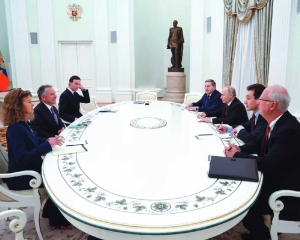
Last week, New Delhi was enveloped, as usual, in a terrible smog. Last week, the city was shrouded by a surreal sense of romantic eco-diplomacy nostalgia, which paraded as modern-day realpolitik. Informed pundits on TV channels squawked in hoarse voices about a new world order, even as their throats and lungs were impacted by the severe air pollution. Still, the mood seemed ecstatic and jubilant. The reason: During the grand visit of Vladimir Putin, India and Russia reaffirmed their long and historical ties, which seemed to grow higher than Mt Everest, and deeper than the Indian Ocean.
One was left with no doubts that the two nations, beginning from the times when Russia was a much-larger Soviet Union, enjoy enduring relations related to defense, geopolitics, economic cooperation, energy, among others. It is a form of partnership rarely seen in history, and perhaps unmatched in the modern times. While eloquence that reached fever pitch on the bilateral links were unique, even esoteric, and strong, my mind asked a delinked question: Is New Delhi looking at the glorious past towards Moscow, and ignoring its lucrative future that seems centred in Washington?
Look at a simple assumption. The primary goal of India, as stated by everyone from policy-makers to experts, economists to opposition political parties, is to grow economically, possibly at double-digits. In other words, the aim is for the country’s GDP to grow as fast as possible. How can India achieve this objective? One way to ascertain which way to lean, and which direction to look at is to compare the West with Russia. The G-7, which constitutes the US, and its key allies in western Europe, has a combined GDP of nearly $50 trillion, or 20 times larger than Russia, which is a $2.5-trillion economy.
If India’s priority is to grow rapidly, is it not better to be closer to the West? I am not talking about friendships and partnerships. Russia was, and will always be, a friend, and partner. I am talking about relationships that include transactional ones that will propel India to become a $10-trillion economy by the mid-1930s. Being allied more to Russia rather than the US may not provide the solution. Only Europe and North America have the economic and technological heft, and the fire power and might to help India along this journey.
To be sure, many Indians, including the policy-makers and others, are extremely angry with the antics and tactics of the US president, Donald Trump. And legitimately too. In a few months, Trump’s administration has destroyed two-and-a-half decades of carefully-nurtured trust between the two hitherto hostile nations. For some strange reasons, even though the US and India are the two largest democracies in the world, the bilateral relationship has always been testy, to say the least. Only after the 1998 nuclear tests by India was there more active engagement between the two nations.
Over the past 25-odd years, the two became close, and links developed into a crucial and significant strategic relationship. Quite clearly, Trump, with his own tantrums and peculiar behavior, has more-or-less diluted the level of trust that was assiduously built over the decades. While Indians may rave and rant at Trump, and his loyalists, can India do without the US? My short answer: Absolutely not. This is the harsh reality of today. Like it or not, New Delhi needs Washington, and Brussels. Trump is likely to remain in power for another three years, unless things go against him.
Russia can offer things that allow India to strengthen its present, through the connections of the past. Of course, a large part of our defence equipment and systems are driven by Russian technology. We need to diversify energy sources from the West, and Middle East to add new ones like Russia and Central Asia. Our agriculture, as the anchor piece on this page shows, can benefit from Russian inputs and products. Hence, the dependence on Russia will only grow, and is unlikely to come down, over the next decade or two.
But pause for a moment, and think about the future. Think about 2047, and beyond. The future belongs to adoption and adaptation of Artificial Intelligence, robotics, and other modern tech that are changing the world, and will drive the global economy over the next several decades. While Russia will remain a steadfast partner, it is no match to the West when it comes to these new-age tech areas. The tech we need, innovations-led processes that our economy demands, and the massive amounts of capital required can come from western Europe and North America. It is time for Indians to get out of their ivory towers, and face the bites of this harsh reality.
Consider another factor, which is not just a geopolitical and national security threat, but can derail India’s dreams and ambitions in business, economy, and tech. The US has openly acknowledged China as a competing and equal superpower. Over the next decade, China is likely to aggressively compete with the US in areas such as AI, robotics, biosciences, and consumer electronics. Since India will be unable to partner actively with China, although we will need to keep alive the economic links, it needs to look elsewhere. The future of India lies not towards Russia, but the West to take on China.
Hence, while there is no harm in praising India-Russia ties, claiming that the bilateral partnership will be eternal, the focus needs to be on the future. Let me leave you with another insightful, and critical, thought. India’s trade imbalance with Russia is enormous; of the $70 billion trade, India exports $5 billion worth of goods and services, or seven per cent of the total. The opposite is true in the case of the US, which runs a more than $40 billion deficit with India. India sells more goods to the US, with some semblance of a balance in services.
Hence, New Delhi has the trade levers to push Washington to part with its tech and capital. It can increase exports, and buy more. In the case of Russia, although there is talk of higher Indian exports, and Russian businesspersons claim that they were asked to buy more Indian goods, the opportunities are limited. We can go from $5 billion to $10 billion. By then, the total trade will be more than $100 billion, and our percentage share a shade higher at 10%. Maybe it is time to accept the new normal. There is little need for an unending celebration of Putin and Russia as India’s strongest friend.
The author has worked for leading media houses, authored two books, and is now Executive Director, C Voter Foundation; views are personal