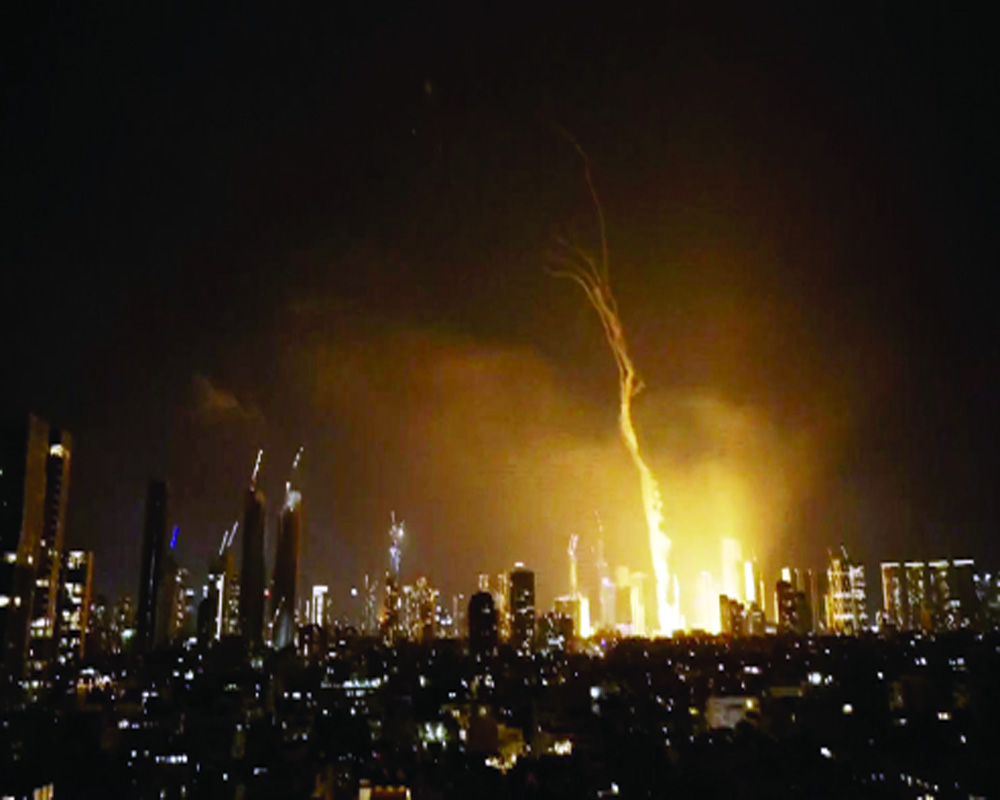
As the evolving and fast-deteriorating situation continues to send shockwaves across the world, it is quite clear that global uncertainty will persist in the coming few weeks or months. Political commentators and analysts are closely observing these developments and many have predicted very alarming scenarios. As the hawkish rhetoric between Iran and Israel continues unabated and the fierce missile exchanges by both light up the night skies, it is highly that the recent bombings conducted by the United States (US) on the three nuclear sites — Natanz, Fordow, and Esfahan, by its formidable B12 bomber is not the end game. The repercussions are going to be felt the world over. As the recent reports suggest, the Iranian missile response in Qatar was measured and precise — as the target was only the largest military base in the Middle East — but the attack was contained. Nonetheless, it was a symbolic action. Is the ceasefire agreement ironclad? Israel certainly does not have a stellar track record in honouring and adhering to them in the past; Gaza and Lebanon being a prime example.
The flurry of military actions over the past few days raises several pertinent questions. First, what exactly were Israel’s motives in initiating the strike? Does it have an end game? Why could Benjamin Netanyahu not persuade the US to conduct its deadly B12 operation in the first place? Sure, Iran would have retaliated by launching its missiles towards Israel but then the Israeli response would have been viewed as justified. Second, proxy wars are now evolving into confrontations, where enemies are facing each other. Third, with a slew of intersecting vested and strategic interests in the world today, how will the nomenclature of the political economy be influenced?
Iran is no Iraq and historically, it has been known to be a very resilient state which is very well capable of bouncing back from the damage inflicted on its facilities and energy infrastructure. It possesses the largest arsenal of missiles in the Middle East and the Islamic Republic of Iran Armed Forces are the largest in the region which makes a ground invasion virtually impossible. The recent attacks have not undermined the confidence of the establishment and will only embolden the state. The splintered group will likely unite and confront their enemy with indomitable force shortly. Iran, as it has in the past, will rise from the troughs of damage and will most definitely surprise the world.
The question regarding its nuclear programme for civilian purposes is open to debate. It’s a moot question and all the evidence points to the fact that the Iranians were not actively pursuing an atomic bomb. However, the vulnerabilities and causalities exposed by the airstrikes on the Islamic Republic will strengthen their resolve to relentlessly pursue it. This is indisputable. Heavy damage may have been inflicted on its nuclear facilities but the technical know — how is in place. Assassinating top nuclear scientists will only have a limited impact because the knowledge has percolated and all intelligence points to the fact that Iran had relocated the nuclear material to a safe place. That the ceasefire is far from the truth. Proxy wars will continue and Israel and USA’s military manoeuvres will backfire. Essentially, the mission to dismantle the nuclear programme seems to have failed. How the world will deal with yet another ‘Islamic Bomb’ is a question for a later date.
How will proxy wars be fought shortly? What are the ramifications of adversaries striking each other to contain terror threats directly? Iran and Israel have fought these wars by engaging in covert missions and arming groups, for decades. But this was the first confrontation. Every country has a threshold and the recent pre-emptive strikes exemplified its resolve to directly assault the enemy.
India showcased its ability in ‘Operation Sindoor’ by directly targeting and smoothly penetrating Pakistan’s Chinese air defence network. India has now demonstrated and articulated its military strategy. A swift war, under the shadow and threshold of nuclear weapons, is a possibility and will be India’s response in the future. The ecosystem of terror will not be tolerated. Ukraine also finds itself caught in the battle for power between Russia and America. The former may use its resources to strengthen Iran’s capabilities and it would be naïve to even assume that the Islamic Republic will not activate its assets in Gaza, Lebanon and Syria. China will also exert its power to reinforce a strong message which may bolster Iran’s confidence. War mongering with Taiwan may intensify. Proxy wars may very soon transform into real wars.
The political economy of the dynamic region we call ‘West Asia’ is mired in conflict. Wars and destruction have plagued countries for decades. Nonetheless, it is the energy powerhouse of
the world and manipulation and military influence by Western powers is a prominent feature. The 4C’s in the framework of political economy are change, context, collective behaviour and conflicting interests.
The coup led to the overthrow of Prime Minister Mohammad Mossadegh in 1953 when he moved to nationalise oil production. A corrupt regime and an establishment mired with a tarnished public image led to the 1979 revolution which culminated in the overthrow of the puppet installed by the West (Pahlavi Dynasty) and ushered in a new rule. Unarguably, history has taught us that bombing a nation to effect a regime change is a worthless endeavour. Former President Bush failed in his mission to change the political economy in Iraq swiftly.
Viewed from this context, Iran will not countenance any regime change because history has had a lingering impact on the intellectual discourse regarding this sensitive issue. The collective behaviour of seemingly disparate groups within Iran points illuminatingly to the anti-West
posture. In essence, despite conflicting interests within Iran, the common enemy will be the West. The political economy is certainly not immutable but the recent fiery exchanges and America’s involvement have only cemented the cracks in the Iranian regime.
If one thought that the October 7th attacks on Israel were a deadly miscalculation and blunder by Hamas, the recent pre-emptive strikes by Israel have only propelled Iran’s determination to strengthen its national security in an evolving and fast-changing geopolitical landscape.
This was a grave mistake for which Israel and the US may pay a very heavy price. These memories will have an everlasting influence on the trajectory of the events that will ensue. The cascading effects will be felt the world over in our intricately connected economies and will have an indelible impact on the global political economy.
(The writer is columnist and foreign policy analyst. Views are personal)