From colonial resistance to post-independence reform, the CPI’s journey reflects a relentless pursuit of justice, equality, and dignity for the working class. Though its electoral reach has diminished, its influence remains deeply embedded in the democratic and moral foundations of the Republic
Few political movements have imprinted themselves so deeply on India’s history as the Communist Party of India. Founded in 1925, at a time when the nation was still under colonial rule, the CPI was born not in the drawing rooms of elites but in the ferment of working-class struggle. From the outset, it carried a simple yet radical mission — to fight for equality, justice, and dignity for the toiling masses.
Over the next hundred years, the CPI would witness India’s transformation — from a colonised land to a free nation, from the hopeful dawn of independence to the complexities of globalisation. It fought its battles everywhere — on factory floors, in Parliament, in trade unions, in remote villages and restless cities. Through all these phases, it never abandoned its central conviction that democracy without social justice is hollow, and freedom without equality incomplete.
Critics have long dismissed the CPI as a party of “foreign ideas”, arguing that Marxism was an alien transplant from Europe. But this argument overlooks the living nature of ideas. Just as Buddhism travelled from India to shape the moral compass of Asia, Marxism too journeyed across borders to find new meaning in Indian soil. From its earliest days, the CPI was not about reciting European theory but about addressing Indian injustice. Its ideological pulse beat not in European libraries but in the fields of Telangana, the jute mills of Bengal, and the streets of Bombay. The party’s constitution consciously adapted Marxist principles to Indian realities — confronting caste oppression, feudal landlordism, and imperial domination.
In that sense, Indian communism was as indigenous as any other nationalist movement. It sought not to mimic Moscow but to marry socialism with the country’s moral and social struggles. Long before secularism became a constitutional principle, the CPI recognised that communalism was the greatest internal threat to India’s unity. Its members were barred from joining any communal organisation — a bold stance at a time when even mainstream parties compromised for political convenience.
While the Indian National Congress often wavered between nationalism and religious accommodation, the communists were uncompromising: they saw equality as incompatible with sectarianism. This clarity would later prove vital in shaping India’s secular democratic ethos.
The year 2025 also marks the centenary of the Rashtriya Swayamsevak Sangh (RSS). The parallel anniversaries of the CPI and RSS illuminate the sharpest ideological divide in Indian politics — two organisations born of colonial turmoil, representing opposite visions of India.
For the communists, nationalism meant liberation and inclusiveness; for the RSS, it meant exclusion and religious homogeneity. Where the Left imagined an India of workers and peasants united beyond caste or creed, the Sangh envisioned an India defined by Hindu identity and hierarchy.
The CPI’s role in the freedom movement remains one of its proudest chapters. From Bhagat Singh’s revolutionary socialism to Surjya Sen’s Chittagong uprising, communists stood on the frontlines of anti-imperialist resistance. They believed political freedom was inseparable from social and economic liberation — a radical idea in an era when many nationalists focused only on ending British rule.
Communists built vast movements of peasants, workers, students, and women, turning the freedom struggle into a mass awakening. They demanded purna swaraj — complete independence — and were among the first to call for an elected Constituent Assembly to frame the new nation’s destiny.
By contrast, the RSS stayed distant from the freedom struggle. While communists braved imprisonment and persecution, the Sangh focused inward, expanding its shakhas and avoiding confrontation with colonial authorities. Its leaders claimed the “real battle” lay not against British imperialism but against India’s minorities — a perspective that starkly revealed its priorities.
When Mahatma Gandhi was assassinated in 1948 by a communal extremist, the RSS faced a ban. Instead of introspection, it sought political rehabilitation by courting Congress leaders. The communists, meanwhile, paid a heavy price for their activism — facing repeated bans, censorship, and arrests. But they did not bend. Their loyalty was not to any ruler but to the cause of the people.
This moral distinction — between opportunism and conviction — continues to define the ideological clash between the Left and the Right.
After Independence, the CPI re-evaluated its strategy. Recognising the possibilities of democracy, it embraced parliamentary politics as a legitimate path to socialism. This faith bore fruit in 1957, when E.M.S. Namboodiripad led the world’s first democratically elected communist government in Kerala.
That government redefined Indian governance. It launched ambitious land reforms, expanded public education, and strengthened local democracy — policies that made Kerala a model of human development. Though dismissed after two years, the 1957 experiment proved that Marxism could coexist with democracy and enrich it. Later, under C. Achutha Menon’s leadership (1969-1977), the CPI once again demonstrated how left-wing governance could deliver both stability and progress. Menon’s government, marked by pragmatism and welfare-driven policies, remains one of Kerala’s most successful — a rare balance of ideology and efficiency that still inspires political thinkers today.
The Cold War era brought internal strains, culminating in the 1964 split between the CPI and the CPI(M). The division, driven by disagreements over Soviet and Chinese alignments, weakened the communist movement electorally. Yet, paradoxically, it reflected the party’s democratic culture — one where dissent and debate were integral, not suppressed.
Despite the setback, the CPI continued to influence national policy, shaping labour laws, land reforms, and welfare programmes that became pillars of independent India’s economic architecture.
Many of India’s early economic policies — from state-led industrialisation to public sector undertakings — bore the imprint of communist thinking. In Parliament, the CPI consistently spoke for the voiceless: the factory worker, the tenant farmer, the marginalised citizen.
When economic liberalisation arrived in the 1990s, the CPI warned of deepening inequality and erosion of labour rights. At the time, such warnings were dismissed as outdated dogma. But today, amid widening wealth gaps and corporate dominance, those concerns sound prescient. As the CPI enters its second century, it faces the challenge of reinvention in an India fragmented by identity politics and majoritarian narratives. Yet its moral compass remains intact. The party that once fought colonialism and feudalism now stands against the new forces of inequality and authoritarianism. Its task is to reclaim its historic role — not as a mere political entity, but as the conscience of the Republic. To speak again for the workers, farmers, students, and minorities who bear the brunt of economic and social injustice. The CPI’s centenary is not just a moment to celebrate the past, but to reimagine the future. Its relevance lies in its ability to unite people around common struggles — unemployment, poverty, ecological crisis, and democratic erosion — beyond the barriers of religion or caste.
As India marks the centenaries of both the CPI and RSS, it faces a profound moral choice. Will the future be guided by the inclusive, secular, and egalitarian ideals for which generations of communists fought and died? Or will it be shaped by exclusion, hierarchy, and intolerance?
The CPI’s journey over the last hundred years stands as a testament to the idea that democracy without equality is fragile, and freedom without justice hollow. It has not always succeeded, but it has never stopped trying — and therein lies its enduring strength.
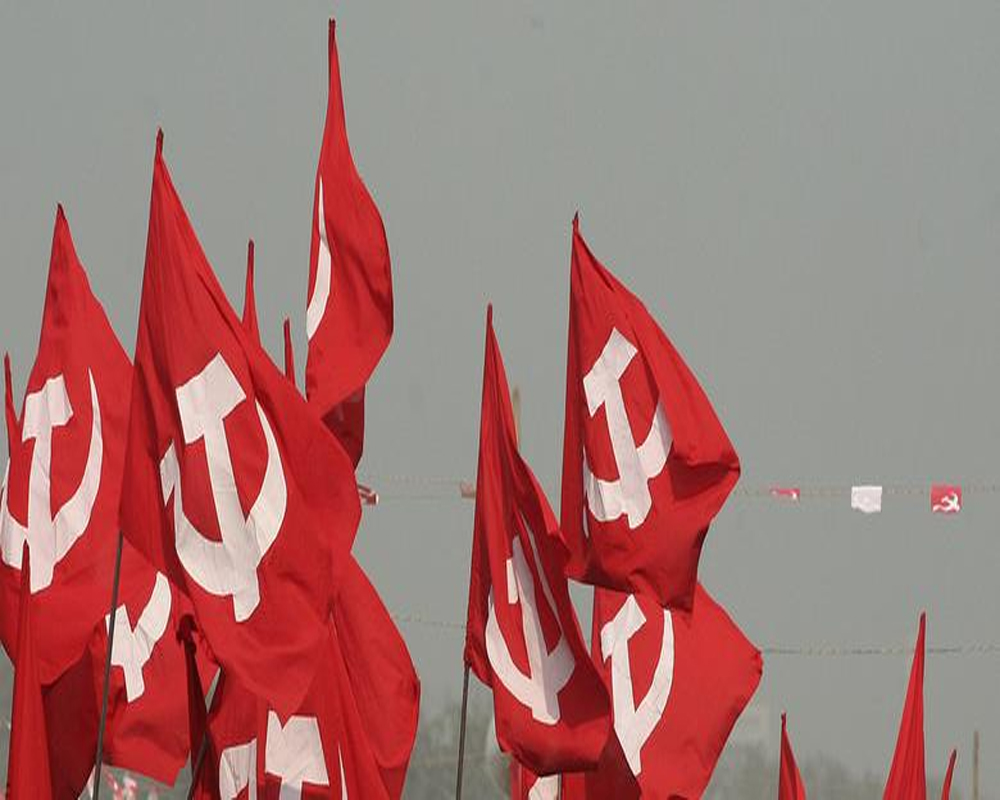
For a century, the Communist Party of India has been more than a political organisation. It has been a moral force — a reminder that democracy must serve the weak, not just the powerful. It has fought for values, not vanity; for people, not power. As it steps into its second century, the red flag may no longer dominate the skies of Indian politics, but it still flies high — steady, proud, and deeply rooted in the soil of India’s democratic journey. The struggle for equality and dignity continues — and with it, the timeless relevance of the CPI’s enduring red resolve.
The writer is National Secretary of CPI, Parliamentary party leader CPI