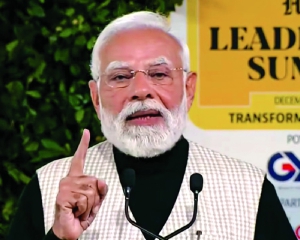
When Prime Minister Modi asserted on Sunday that India is shining in a world of uncertainties, he was largely on the mark. The phrase neatly captures India’s current growth trajectory. At a time when global volatility has become the new normal — marked by economic disruptions, geopolitical tensions, technological upheavals and rising environmental concerns — his remarks sought to position India as an island of stability and a country with clear purpose. Yet the address went beyond optimism; it attempted to outline both the architecture of India’s present momentum and the roadblocks that remain. The first quarter of the 21st century has tested nations in unprecedented ways. A global financial crisis, a pandemic, supply-chain breakdowns, wars and deepening political polarisation have shaken the international order to its core. Modi rightly noted that India has weathered these storms through a deliberate shift in its governance culture. There was a time, he said, when reforms were reactionary — driven by crises rather than conviction. Today, reforms are calibrated to national goals rather than global panic. This, he argued, is the essence of being “constant, consistent and nation-first”. There is truth in the narrative of India as a strong and resilient economy, somewhat insulated from the vagaries of international push and pull. Much of the Prime Minister’s confidence stems from India’s macroeconomic trajectory. Despite global slowdowns, India remains among the fastest-growing major economies. Investment activity has strengthened, and inflation is relatively under control compared with many advanced economies. India is also benefiting from shifts in the global trade environment, including the new tariff regime of the United States.
As South–South cooperation becomes increasingly important, India is well placed to emerge as a leading force. As a manufacturing base, a digital partner and a diplomatic stabiliser, India is positioning itself as a contributor to global stability. However, not all is rosy. Where exactly does India stand today, and where is it headed? Modi’s speech implicitly portrayed a country in transition — from a service-heavy model to a more balanced economy, from welfare delivery to welfare empowerment, and from being merely a large market to becoming a global player shaping norms and supply chains. This moment of confidence, however, demands clarity about unresolved challenges. Job creation must accelerate, particularly in high-productivity sectors. Skilling needs to keep pace with rapid technological change. The manufacturing push still requires smoother regulation, deeper logistics reform and faster dispute resolution. Social challenges — urban stress, recurring rural distress and climate vulnerability — require sustained, long-term planning rather than episodic responses. Externally, India must navigate carefully. Conflicts in the Middle East and shifting trade alignments could unsettle even the most resilient economies. What the Prime Minister’s address captured well is a vital balance: confidence is warranted, but complacency would be costly. India may be shining — but sustained effort will be essential to keep it that way.