The Indian Army, Navy, and Air Force concurrently conducted three massive and high-tech exercises in October-November 2025, across the full span of the country. Codenamed Astra Shakti (weapon power), Trishul (trident), and Poorvi Prachanda Prahar (eastern fierce attack), these exercises covered the northern Himalayan, western, and northeastern theatres respectively.
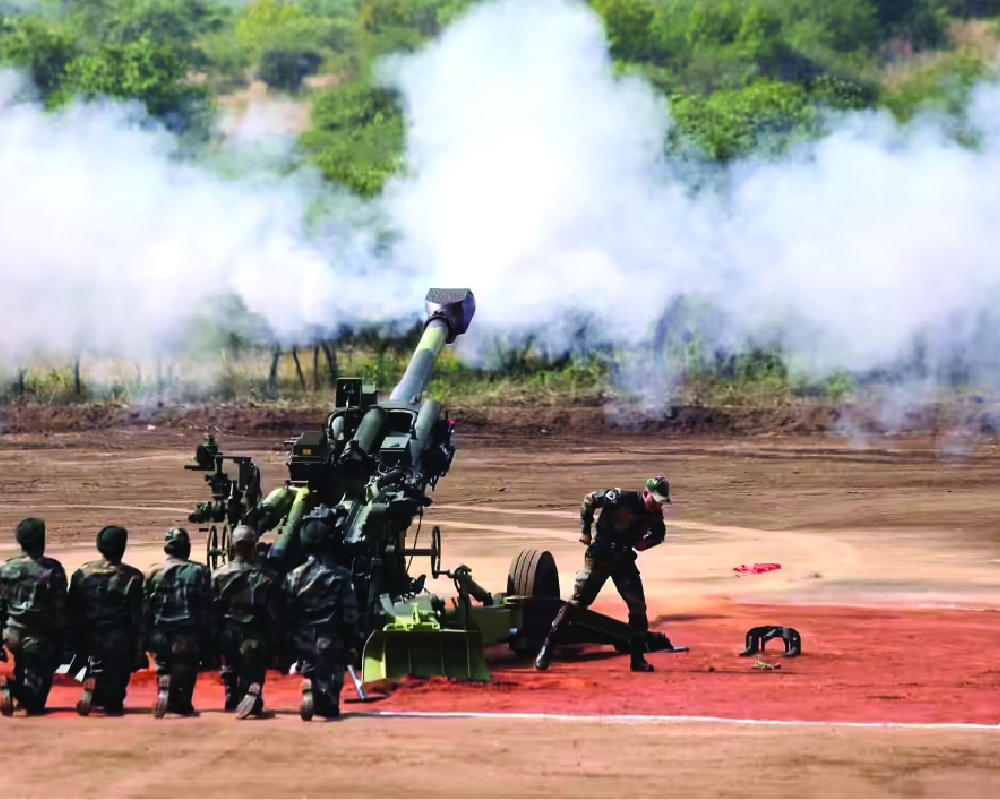
Ex Astra Shakti was conducted in the high-altitude areas of Ladakh, showcasing long-range precision artillery firepower, the use of swarm drones and counter-unmanned aerial systems (UAS), and commando operations in the icy expanse of the region. The exercise was witnessed by the GOC-in-C, Northern Command, Lieutenant General Pratik Sharma, and emphasised multi-domain dominance and synergy with the Indo-Tibetan Border Police (ITBP). It was described as a “thunderous validation” of India’s readiness and technological prowess in one of the world’s most challenging battle environments.
The Indian Army redefined high-altitude warfare and added a new chapter to world military history in the first India-Pakistan War in 1947-48, by fighting at an altitude of 11,575 feet above sea level and even transporting battle tanks there. For the entire Western/European world, high altitude meant the Alps at 8,000 feet. ‘Alpine’ was their ultimate qualification, and ‘Himalayan’ was not known to them.
Ex Trishul (Western India) was conducted along the western frontier, specifically in the Sir Creek, the British corruption of the Baan Ganga (Baan means arrow and Ganga is the sacred river) area, the Rann of Kutch, the Saurashtra coast, and the desert regions of Rajasthan and Gujarat, as well as the northern part of the Arabian Sea. Land operations were primarily concentrated in the desert zones of Rajasthan and the Kutch region of Gujarat; amphibious operations were conducted along the Saurashtra coast, and maritime operations extended into the northern Arabian Sea, coordinated by the Western Naval Command.
The primary goal was to validate joint operational capabilities and synergy across the Army, Navy, and Air Force in a large and complex operational environment, testing multi-domain operations (land, air, sea, cyber, and space). It involved a large-scale deployment of assets, including over 20 warships, 40 fighter aircraft (including Rafales and Sukhoi-30MKIs), tanks, and amphibious platforms, with over 50,000 personnel participating.
Sir Creek, one of Asia’s largest fishing grounds, is believed to contain untapped oil and gas reserves and is an ecologically sensitive zone. Its location also has major implications for defining each country’s Exclusive Economic Zone (EEZ) in the Arabian Sea, impacting maritime security and resource rights. Intelligence reports indicated that Pakistan was increasing its military presence near the Sir Creek region, including constructing new bunkers, observation posts, and logistics facilities.
On October 2, 2025, Indian Defence Minister Rajnath Singh, while celebrating Vijayadashami with troops in Bhuj, Gujarat, issued a strong warning to Pakistan, stating that any “misadventure” in the Sir Creek area would invite a “decisive response that will change both history and geography”. He also remarked that “a route to Karachi passes through the Creek”, signalling India’s readiness to act decisively. Mr Singh virtually inaugurated a Tidal Independent Berthing Facility and a Joint Control Centre in the strategic Sir Creek sector, enhancing India’s coastal security coordination and rapid response capabilities.
The operations were conducted along the entire western border with Pakistan and the adjoining maritime areas, displaying India’s joint operational capabilities and strategic readiness to Pakistan’s forces, with the aim of sending a message to Pakistan’s delusional military leadership that it should avoid any misadventures.
Ex Poorvi Prachand Prahar was a major tri-service drill held in the eastern theatre, including areas in and around the Siliguri Corridor and Mechuka in Arunachal Pradesh, near the Line of Actual Control (LAC) with China. The aim was to enhance joint operational capabilities and strengthen military preparedness along the northeastern frontier, focusing on integrated and technology-driven warfare in the strategic region. This involved integrated battle drills and multi-domain operations to counter emerging threats and reinforce the Eastern Command’s readiness.
Recent intelligence reports and analyses, particularly in November 2025, suggest an increased presence and convergence of Pakistan’s Inter-Services Intelligence (ISI) and Pakistan-backed terrorist groups in Bangladesh, with Chinese backing, to establish terror camps for training operatives for anti-India activities. While the Muhammad Yunus government, reportedly strongly backed by Jamaat-e-Islami, is facilitating radical Islamic groups and Pakistan’s narco-terror networks to operate for anti-India activities, it has created an “unchecked corridor” that facilitates the entry of Pakistani smugglers, terrorists, and intelligence operatives. Reports also suggest collaboration or shared interest between China and Pakistan, and their proxies like Jamaat-e-Islami, in fostering a regime in Bangladesh that is friendly to Pakistan and China and hospitable to anti-India terror groups. India’s intelligence apparatus has reportedly pointed to the ISI and China for allegedly fuelling the unrest that led to the ousting of the previous Awami League government.
For the past few months, Bangladesh is reportedly developing military infrastructure near the 22 km-wide Siliguri Corridor, also known as Chicken’s Neck, including the revival of an airbase in Lalmonirhat with reported Chinese assistance. The Indian Army has responded by deploying multi-layered weapon systems in the Siliguri Corridor, including many of those used in Operation Sindoor. Lt Gen Shokin Chauhan (Retd), former DG Assam Rifles, stated that if Bangladesh tampered with the Siliguri Corridor, the Indian Army could extend its control from 22 km to up to 70 km within 72 hours.
The Indian Air Force celebrated its 93rd anniversary with a spectacular flying display over the Brahmaputra river at Guwahati, involving a wide array of aircraft, including helicopters, transport, and fighter jets, which greatly impressed spectators, particularly the youth of the Northeast. Operation Sindoor, these three exercises, and certain other moves have projected a new avatar of India and her Armed Forces as a no-nonsense, assertive military power and geopolitically astute, transforming to a new normal.
The author, Col Anil Bhat, VSM (Retd), a strategic affairs analyst and former Defence Ministry and Indian Army spokesperson; views are personal