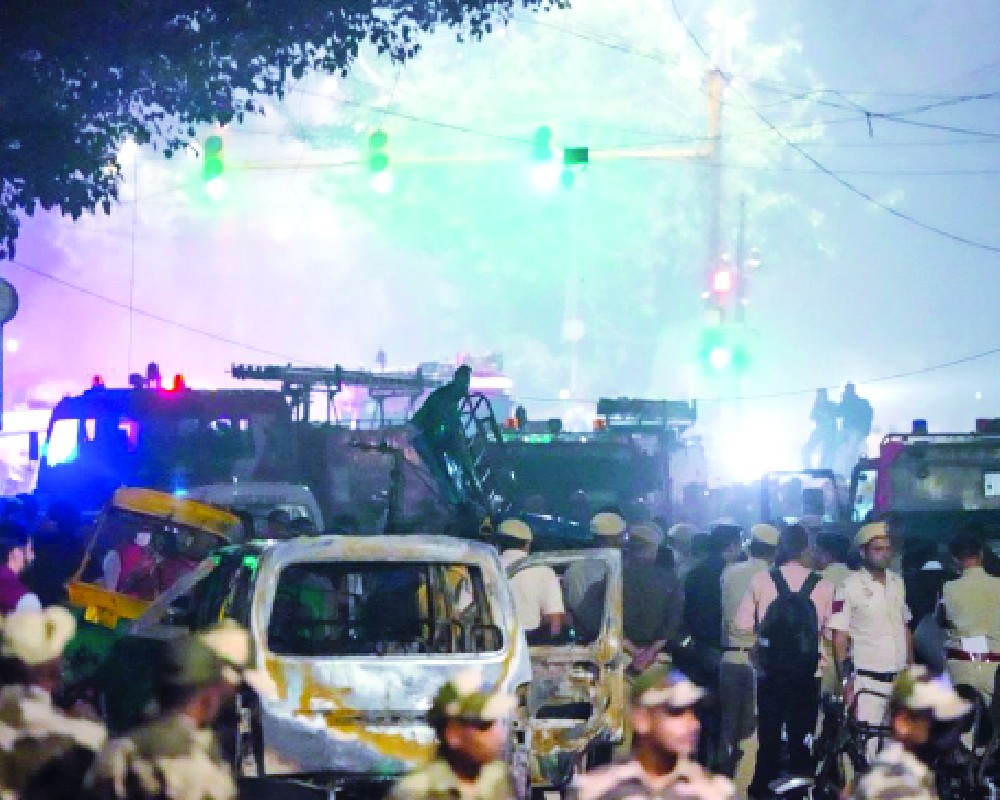
Radicalisation today stands as one of the most serious challenges to India’s national security. Modern terrorism does not begin with the gun or the bomb — it begins with the mind. No terror attack is possible unless someone is first convinced, manipulated and mentally prepared to commit violence. The recent arrests in Faridabad, the recovery of explosives and detonators, and even the involvement of highly educated individuals such as doctors in the Delhi blast demonstrate how deep and sophisticated the radicalisation machinery has become. These cases show that the threat is no longer confined to the poor, the uneducated or those living on the fringes of society.
The new targets are educated, urban youth — young men seeking identity, purpose and belonging in a complicated world. Radicalisation generally begins in two key environments. The first is the religious space — madrasas and mosques — where a small number of preachers with Salafi or extremist leanings deliver emotionally charged, misleading interpretations of religion. They twist noble concepts such as Ummah, Zakat and Jihad to create a sense of grievance, victimhood and moral justification for violence.
The radicalisers deliberately misuse verses and stories to convince young minds that their “religious duty” lies in fighting or opposing the State. Over time, these false interpretations become the ideological entrance gate for deeper radicalisation. The second environment (peer group radicalisation) is far less visible but equally dangerous: quiet street corners, small tea shops, college hostels, student groups, parks and closed conversations among friends.
In these informal spaces, long discussions take place on religion, alleged injustices, communal grievances and global events. Slowly, these conversations become an echo chamber. Anger is reinforced, isolation develops, and extremist ideas begin to appear reasonable. Peer-group radicalisation is especially powerful. Once a few individuals in a college or locality adopt extremist thinking, they can easily influence others through trust, friendship and emotional bonding. Young people do not want to lose their place in the group and, therefore, begin accepting ideas they would otherwise reject.
This pattern has been seen in Indian Mujahideen modules, PFI circles and sleeper cells of Lashkar-e-Taiba and Jaish-e-Mohammed. After these initial stages, many youths are sent for several months of training to Pakistan or Pakistan-occupied Kashmir.
There, they are taught how to handle weapons, assemble IEDs, communicate secretly, avoid surveillance and maintain operational discipline. When they return, their behaviour changes in noticeable ways. They withdraw from family, become serious or secretive, avoid normal conversations, express rigid religious views or cut themselves off from their old lifestyle. These behavioural changes are visible to parents and neighbours. A disturbing example of structured radicalisation comes from the confession of an Indian Mujahideen leader. He described how he radicalised educated youth through a step-by-step psychological process. He would begin by discussing the meaning of life and the concept of life after death. Gradually, he introduced manipulated beliefs — such as that real life begins after death, that paradise is full of pleasure, and that martyrdom in jihad guarantees entry into heaven. He claimed that a jihadi receives “72 hoorein” and that his parents will also enter jannat because of his sacrifice. According to him, one act of jihad was more valuable than lifelong namaz, roza or charity.
This kind of spiritual poisoning creates a false sense of moral superiority. Then he would show videos of global conflicts and alleged atrocities against Muslims — in Palestine, Iraq, Afghanistan and Kashmir. He repeatedly displayed photographs of the Gujarat riots, the Babri Masjid aftermath, Israeli-Palestinian clashes and alleged US operations. The aim was to fill young minds with anger, helplessness and the feeling that “someone must take revenge”. To intensify this emotional impact, he distributed radical literature — books like Maidan Pukarate Hain, Salah ad-Din Ayuubi, Sayyid Qutb’s Milestones and biographies of Osama bin Laden. Graphic magazines showing dead bodies and destroyed villages were used to bypass logic and directly trigger emotions. He also used PowerPoint presentations and motivational jihadi songs to create a charged atmosphere. Radicalisation by Abdul Karim Tunda – Madrasa Setting Another major example is Abdul Karim Tunda, the dreaded Lashkar-e-Taiba bomb-maker. Tunda used a madrasa-linked method of recruitment. He targeted poor, uneducated and semi-educated youth, especially those who were frustrated or carrying emotional wounds from communal events. He portrayed himself as a fatherly guide.
Through fiery speeches, he misquoted religious texts, glorified violent jihad and convinced youth that terrorism was their religious duty. He also displayed injuries he had suffered in earlier attacks, building an image of a “battle-hardened warrior”. Unlike some radicalisers who only preach, Tunda offered immediate operational roles — teaching bomb-making, logistics and safe-house procedures. This made young boys feel “important” and “chosen”. By isolating them from their families and creating a cult-like brotherhood, he ensured total loyalty. Today, radicalisation has a new and even more dangerous dimension — online grooming. Terrorist organisations use encrypted apps, anonymous social-media profiles, short propaganda videos, online games and closed chat groups. Algorithms push vulnerable youth deeper into extremist content without them even realising it. Online radicalisation is fast, private and boundaryless, making it extremely difficult to detect. Because radicalisation is psychological and emotional, countering it is not just the job of the police or intelligence agencies. Family members, neighbours, teachers, religious leaders and community elders often notice the warning signs much earlier. A youth suddenly becoming secretive, cutting off friends, disappearing for long periods, or adopting a rigid interpretation of religion — all these are important signals. Beat constables, because of their daily interaction with the community, also play a major role in early detection.
The Government of India is taking major steps in Jammu and Kashmir by promoting community policing, counselling, religious guidance and rehabilitation. Effective counter-radicalisation requires a cooperative model. Parents, elders, imams, teachers, police and civil society must stay alert and communicate openly. Timely counselling and emotional support can prevent many youths from going down the dangerous path of extremism. In conclusion, radicalisation is a psychological weapon deliberately designed to manipulate emotions, distort religion, exploit grievances and provide a false sense of identity and heroism. It transforms ordinary young people into instruments of violence. Countering terrorism is therefore not only about catching militants or seizing weapons — it is about dismantling the ideological machinery that creates terrorists. Early identification, family involvement, community vigilance and timely intervention are the most powerful tools to protect vulnerable youth and safeguard India’s long-term peace and national security.
Writer is former Chief of Enforcement Directorate and retired IPS Officer; views are personal