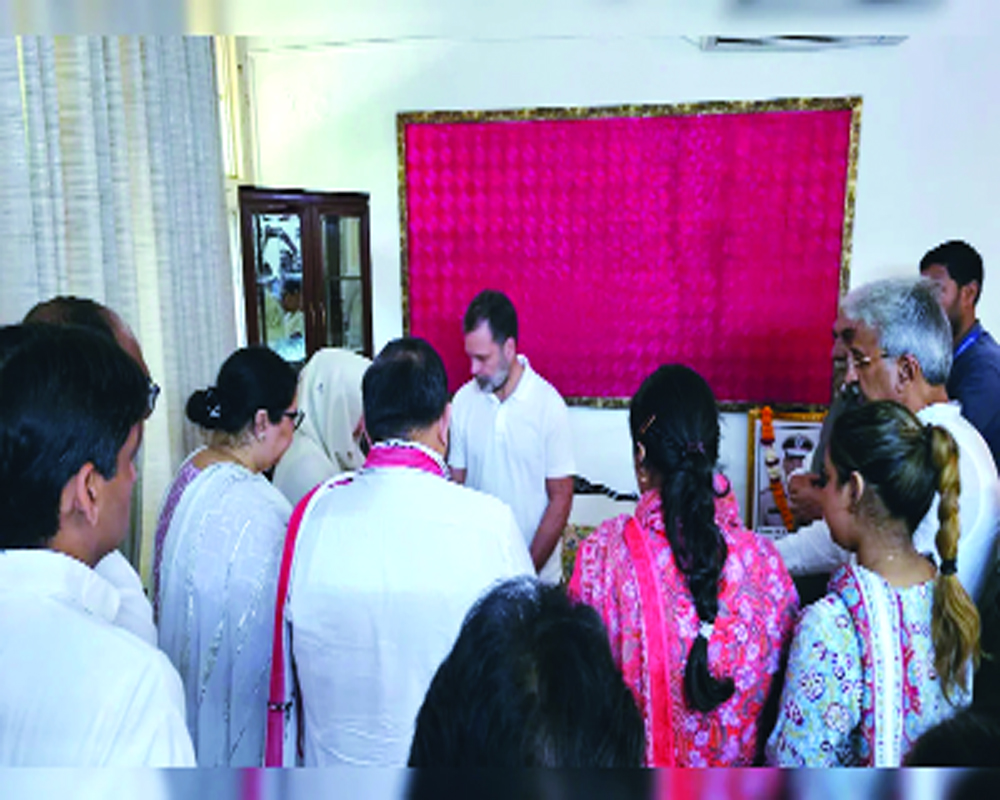
Congress leader Rahul Gandhi’s visit to the residence of late IPS officer Y Puran Kumar in Chandigarh has ignited a political storm across Haryana and Punjab. By framing the tragedy as a question of Dalit dignity, he has brought the spotlight back on the region’s entrenched caste fault lines
Rahul Gandhi’s visit to the residence of the late Haryana IPS officer Y Puran Kumar in Chandigarh is more than a condolence call — it is a calculated political move into the fault lines of caste, power, and justice in Haryana and its border regions. In doing so, Rahul Gandhi seeks to transform what the BJP has presented as a “personal tragedy “ into a political flashpoint of institutional bias and Dalit assertion. His message is unmistakable — this is not merely the suicide of one senior officer but a warning to millions of Dalits that success does not shield them from humiliation and discrimination.
As he met the grieving wife, IAS officer Amneet P Kumar, and the deceased officer’s two daughters, Rahul Gandhi demanded that the Centre and the Haryana Government move beyond perfunctory statements and deliver concrete accountability. “Crores of our Dalit brothers and sisters are watching, “ he said, urging an end to the “drama “ surrounding the case and pressing for prompt action against those named in the suicide note.
In the preceding days, protests and outrage had already escalated across Haryana and Punjab. Dalit organisations, student bodies, and opposition parties, including the pro-Dalit BSP, have threatened statewide agitation if justice is not delivered. The eight-page suicide note names senior police officers, including Haryana Director General of Police (DGP) Shatrujeet Kapur and Rohtak Superintendent of Police (SP) Narendra Bijarniya, accusing them of caste-based humiliation, mental harassment, and systematic targeting over the years.
By framing this as a matter of Dalit dignity, Rahul Gandhi is not only applying pressure on the state machinery, he is compelling every party to stake a clearer claim on the narrative of caste justice.
A Turning Point in Haryana’s Dalit Politics
Haryana, where Dalits account for nearly 20 per cent of the population, about 42 lakh people, is witnessing a significant churn. With 17 of its 90 Assembly seats reserved for Scheduled Castes, the community’s electoral influence extends far beyond reserved constituencies. Dalits form decisive blocs in at least two dozen other segments, often determining outcomes in close contests between the BJP, Congress, and regional players such as the INLD, JJP, and BSP.
The alleged caste-based humiliation of a senior IPS officer has struck a deep emotional chord among Dalit communities across the state. In villages across Rohtak, Hisar, Ambala, and Jind, areas with dense Dalit populations, protests and solidarity marches have become platforms for articulating long-suppressed anger. For Rahul Gandhi, who in recent months has amplified the Congress’s pro-Dalit pitch, this tragedy offers both emotional and political resonance — a chance to consolidate the party’s base in a state where Dalit voters are electorally fluid.
His visit effectively reclaims the moral high ground on social justice, a space the Congress has been trying to occupy nationally. Rahul Gandhi’s choice of words, “Crores of our Dalit brothers and sisters are watching “ — was not incidental; it was calibrated to transform grief into collective political consciousness.
For the BJP, which has long claimed that its welfare schemes transcend caste barriers, this case exposes vulnerabilities. The ruling party’s handling of the investigation and its perceived indifference to caste injustice could alienate Dalit voters who had begun drifting towards the BJP in recent years.
Punjab’s Dalit Axis
Across the border, Punjab’s Dalit population, at 32 per cent, the highest in the country, forms the single most influential social bloc in the state. Dalits hold sway in 34 of the 117 Assembly constituencies and are decisive in dozens more. Their votes, often fragmented among the Congress, AAP, Akali Dal, and BSP, can tip the scales in any election.
In recent years, both the Congress and AAP have aggressively wooed Dalit voters, the former projecting Charanjit Singh Channi as Punjab’s first Dalit Chief Minister in 2021, and the latter promising an inclusive social justice agenda. Yet, beyond token representation, many Dalits feel systemic discrimination persists in employment, education, and administration.
The Y Puran Kumar case, though rooted in Haryana’s bureaucracy, has resonated powerfully in Punjab’s Dalit-dominated Doaba and Malwa belts, where memories of caste injustice run deep.
Rahul Gandhi’s visit to Chandigarh — the joint capital of Punjab and Haryana — is being read as a deliberate attempt to bridge Dalit sentiments across state borders. It positions the Congress as the party willing to confront caste discrimination institutionally, not just rhetorically. The Aam Aadmi Party, which was quick to organise candlelight marches and issue solidarity statements, suddenly finds itself outflanked — as the Congress seizes the narrative of Dalit dignity through Rahul Gandhi’s direct intervention.
Reinforcing a National Narrative
Rahul Gandhi’s engagement with Dalit issues is not new, but it has acquired a sharper political definition since his Bharat Jodo Yatra and subsequent Lok Sabha campaign. From visiting the families of the Hathras and Una victims to his speeches on caste census, manual scavenging, and institutional bias, Rahul Gandhi has methodically sought to weave a national narrative of social injustice under BJP rule. His framing of the Y Puran Kumar case fits seamlessly into this continuum, portraying it as another instance of a system that, in his words, “fails its Dalit citizens, however accomplished they may be. “ By taking the battle to Haryana, a state the BJP considers its stronghold, Rahul Gandhi is signalling that Dalit politics is no longer confined to states like Uttar Pradesh or Tamil Nadu. Instead, he is reframing the debate in northern India’s administrative heartland, where the alleged suicide of a Dalit IPS officer becomes symbolic of institutional rot and unequal power.
Shifting the Political Arithmetic
Political observers believe the Congress’s immediate gain from Gandhi’s visit lies in reclaiming the confidence of Dalit voters disillusioned by both the BJP’s bureaucratic aloofness and AAP’s inconsistent caste politics. Dalit groups such as the Bhim Army and Ambedkar Sena have already praised Rahul Gandhi’s “courage to speak out, “ giving the Congress symbolic legitimacy in Dalit circles where it had lost ground.
For the BJP, the challenge is steep. The Haryana Government’s decision to send the DGP on leave and suspend another officer came only after public fury intensified, feeding perceptions of reluctance rather than resolve. Any further delay in justice could harden Dalit resentment, especially among educated urban and semi-urban Dalits who see Y Puran Kumar’s plight as a reflection of their own struggles within the bureaucracy.
In Punjab, where the Dalit electorate often swings, the optics of Rahul Gandhi standing with a Dalit family wronged by systemic bias may revive Congress’s credibility among a community that had been shifting towards AAP. It also puts pressure on Chief Minister Bhagwant Mann to prove that AAP’s moral posturing on caste discrimination is more than symbolic solidarity.
Rahul Gandhi’s visit has transformed a personal tragedy into a regional reckoning. It has linked the death of a Dalit officer to the broader question of caste justice in governance, forcing all political parties in Haryana and Punjab to revisit their Dalit outreach strategies. The Congress leader has effectively turned grief into a political statement, anchoring his long-term campaign to redefine the national discourse on social equality.
The writer is Chief Reporter, The Pioneer, Chandigarh