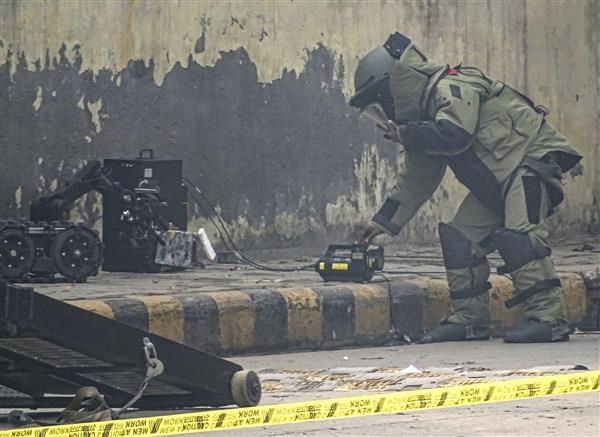
Transparency is certainly not the hallmark of the Narendra Modi government. This is true in its normal functioning, when there is ample elbow room to take the countrypersons into confidence. And when it comes to crunch situations such as the Delhi blasts at the threshold of Lal Qila-the symbol associated with India’s freedom and the podium for Independence Day celebrations-the word transparency goes for a toss. The heinous act of blasts that claimed 13 innocent lives has shaken Delhi. Why so? Because it has ruptured the decade-long peace which the national capital had been enjoying.
It has also raised serious questions about the claims made by the authorities concerned, including the Prime Minister and the Home Minister, that terror acts — particularly with focus on Kashmir — had been stubbed out and that terrorism in all its formats was gasping for its last breath. A terror strike in the heart of Delhi, that too near a strong national symbol such as Lal Qila, accompanied by disturbing reports of about 2,000 kilograms of high-grade explosives having been recovered in the National Capital Region (NCR), barely 20 kilometres from the seat of power, certainly worries these authorities and forces them into a real-time-based appraisal of the entire situation, rather than indulging in high-octane claims. The terror attack, which, as per the claims of the competent authorities, has a Kashmir link and has taken place after the restoration — after six years — of the ‘Durbar Move’ (shifting of the capital on a six-month basis from Jammu, the winter capital, to Kashmir, the summer capital, and vice versa) on intense public pressure, particularly from Jammu, the stronghold of the BJP — a development related to the dilution of Article 370 on August 5, 2019 — has put the ruling dispensation’s credibility at stake.
Touted as a panacea for all the ills plaguing Jammu and Kashmir, including the onslaught of terrorism, the government’s claims justifying the constitutional developments in Jammu and Kashmir, including its division and demotion to two Union Territories, have been exposed by the terror attack. It should compel the Modi government to think afresh on the entire gamut of policy governing not only Jammu and Kashmir and Ladakh but also national security as a whole.
Notwithstanding the near fool-proof security network, Delhi, being the national capital and power centre, has always been a target for Punjab, Kashmir, or North-East-centric terrorist groups seeking to challenge the powers that be. The latest act of terrorism — as the Union Cabinet has declared it — is meant to throw a gauntlet and challenge the might of India at its very power centre. There is no doubt that this must have set the political leadership and the security apparatus thinking about its fallout, emerging challenges, and countervailing strategies.
The biggest lesson and in fact the eye-opener-for the ruling BJP should be not to mingle its political agenda with issues related to national security. The political agenda or ideological issues are, most of the time, not in consonance with either the ground realities or the situational challenges.
One lesson the government should draw from the Lal Qila blast is that the ruling dispensation must operate in real time to tackle serious issues. Transparency is the keyword in adopting such an approach, accompanied by taking the nation into confidence to prevent speculation and kite-flying. The problem becomes even more complicated, as is the case presently, when the higher quarters in the government seek refuge in leaking “source-based” stories.
Why not come upfront? That is in the interest of the nation. Otherwise, speculations can lead to complications and provide ample space for anti-India forces to fish in troubled waters. Not only the government but the media should also refrain from running or writing such stories, despite professional compulsions and tight timelines. Lesson two is that, as far as possible, the political and ideological agenda should be separated from the national agenda. Issues such as national security and its offshoots-such as Kashmir and the North-East-should not be viewed entirely from a political perspective. A case in point is the fledgling situation prevailing in Manipur and the ruling BJP at the Centre again indulging in political permutations and combinations to reinstall its government in the state despite public opinion to the contrary.
The same spirit prevailed when the Narendra Modi government hurriedly brought the State Reorganisation Bill to Parliament in 2019 to change the constitutional status of Jammu and Kashmir. In a first-of-its-kind development in independent India, a state was demoted to a Union Territory, and all democratic rights, including the people’s right to elect their own local government, were curtailed. Be it Manipur, Jammu and Kashmir, or Ladakh, public sentiment should remain at the centre of any policy formulation. Ignoring or suppressing this sentiment is always fraught with dangerous consequences. This has been witnessed in the past, and the Delhi blast of 2025 is a warning in that direction.
Lesson three — and nothing new about it-is that in situations like Jammu and Kashmir, the external and internal dimensions of the issue, though intertwined, have to be viewed through different prisms on a real-time basis. Otherwise, there is a danger of falling into the trap of external forces inimical to India’s interests.
Lastly, lesson four is that no act of terrorism should be viewed through the prism of religion. Doing so will not only undermine the country’s multi-cultural and multi-religious harmony, which is already under severe strain, but will also provide a platform for anti-India forces. A democratically elected government has no option but to avoid sitting on self-professed laurels if these are not in consonance with the ground realities. A real-time-based assessment-accepting both success and failure-and avoiding a “might is right” approach, should be the positive way forward. The answer does not always lie in the jugglery of statistics, which the current ruling dispensation excels at, but in accepting the ground reality and reshaping strategies accordingly. The disturbance of urban calm in multi-cultural Delhi should act as an immediate eye-opener. Transparency-to substantiate the claims of busting terror networks and recovering a huge quantity of explosives-should be the buzzword to avoid speculation and the resultant confusion.
The writer is a political and national affairs analyst; views are personal