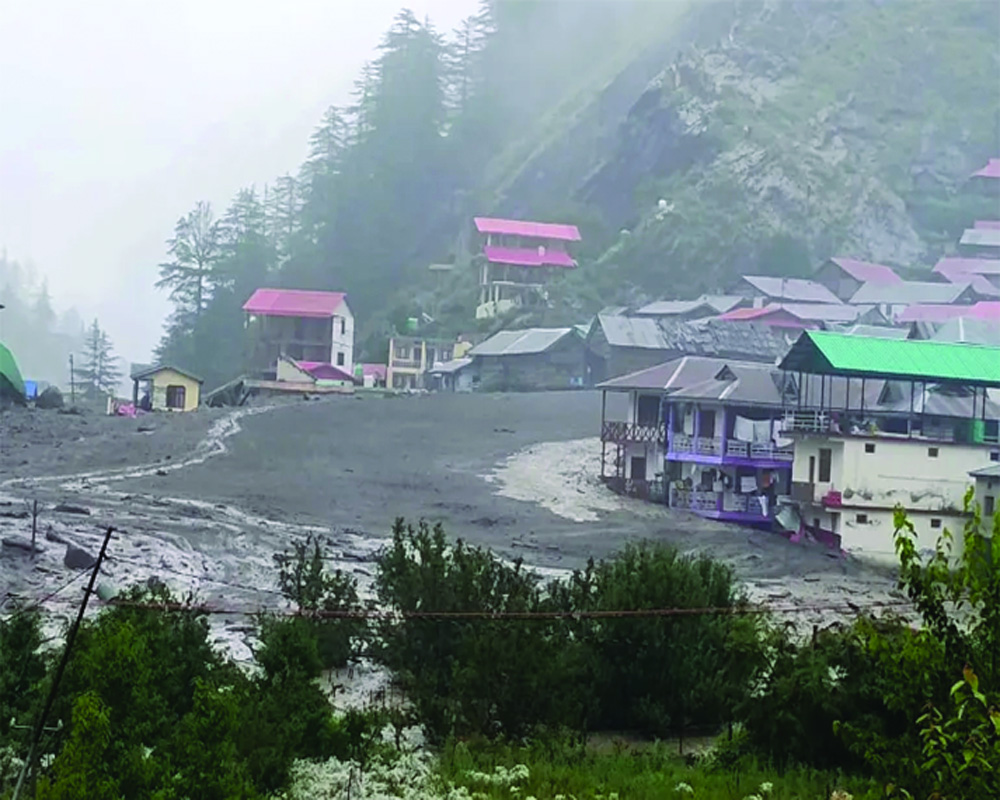
The recent devastation across India’s northern Himalayan States has reignited grave concerns among scientists, seismic experts, and environmentalists. They are urging the Central Government to build a national consensus and implement a comprehensive, science-backed policy to halt reckless development that is inflicting irreversible damage on the fragile Himalayan ecosystem.
Without swift and decisive intervention, they warn, the region will continue to face a worsening cycle of floods, landslides, and cloudbursts. Experts insist that the focus must shift from post-disaster relief to preventive action through strict regulation of all construction —Government or private — within the region. They stress the need to control unplanned tourism, rampant road expansion, and infrastructure projects that are putting immense pressure on the delicate mountain terrain.
Dr VK Bahuguna, former Director-General of the Indian Council of Forestry Research and Education (ICFRE), attributes the growing intensity of monsoons directly to climate change. “Warmer air retains up to seven per cent more moisture with every one-degree Celsius rise in temperature,” he explained. “The warming of the Indian Ocean and Arabian Sea has increased atmospheric moisture, resulting in sudden and intense rainfall.”
This changing weather pattern has made States such As Uttarakhand, Himachal Pradesh, and Jammu & Kashmir become increasingly vulnerable, these regions have witnessed repeated disasters — landslides, cloudbursts, glacial lake bursts, and tunnel collapses during construction.
The use of dynamite for road and tunnel expansion has hollowed out mountain interiors, while deforestation has stripped slopes of their natural stability. Projects like the Rishikesh–Karnaprayag railway and the all-weather Char Dham road have led to large-scale tree felling and soil destabilisation, making the Garhwal hills dangerously fragile.
Much of this area falls under Seismic Zone V, India’s highest earthquake risk category. Torrential rains and flash floods during recent monsoons have claimed hundreds of lives and destroyed homes and infrastructure. Environmentalists emphasise that these are not natural calamities but human-made disasters — driven by greed, poor planning, and short-term economic thinking. Despite repeated warnings, policy implementation remains weak. Experts have long sought accountability to prevent deforestation and unscientific construction, but enforcement has lagged.
Financial aid, too, has been inadequate. The Union Government’s sanction of Rs 315 crore and Rs 1,066 crore for six Himalayan States barely covers the rebuilding needs of even one disaster-hit region. Scientific data paint a grim picture: the Gangotri-Gaumukh glacier has retreated nearly 40 kilometres, and ICFRE reports over 1,500 landslides along the Char Dham highway.
A 2015 Government survey identified 1,266 glacial lakes in Uttarakhand, 13 of them highly vulnerable to Glacial Lake Outburst Floods (GLOFs). The message from scientists is unequivocal: the Himalayas are under siege. Unless India adopts sustainable, science-led development that prioritises ecology over expediency, the cost will be measured not just in crores — but in human lives, livelihoods, and the survival of an entire mountain ecosystem.
The writer is a senior journalist specialising in Himalayan ecology