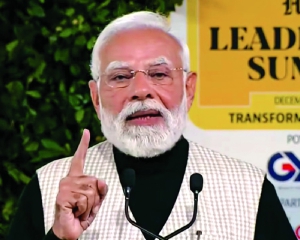
The Air India One carrying Prime Minister Narendra Modi will land at Navi Mumbai International Airport (NMIA) at 2.40 pm on October 8, marking the inauguration of the NMIA and placing Mumbai in the league of cities havingtwin airports.
Being constructed at a cost of `19,647 crore, the new state-of-the-art airport is spread over 1,160 hectares. The first phase of the NMIA will handle two crore passengers annually and five lakh tons of cargo. Once it is fully operational, the airport will have four terminals with a total capacity of nine crore passengers per year and 3.25 million tons of cargo annually. The NMIA will become operational from December 2025. The Prime Minister is expected to arrive at the NMIA at 2.40 pm October 8. He will remain at the new airport for nearly two hours. His itinerary includes a tour of the terminal building, followed by an address to dignitaries and guests.
Ahead of the formal inauguration of the NMIA, the Air India One — operated by Indian Air Force - made a trial landing at the new airport located at Ulwe in Raigad district on October 1.
On that day, the VVIP aircraft made a successful landing at the NMIA at around 10.30 am from Delhi and returned to the national capital at around 2 pm.
The NMIA has been developed by the Navi Mumbai International Airport Pvt Ltd (NMIAL), which is a special-purpose vehicle formed by the Adani Airports Holdings Ltd (AAHL) and City and Industrial Development Corporation of Maharashtra Ltd (CIDCO).
The CIDCO was the nodal agency for the project. Located in Ulwe in the adjoining Raigad district, the NMIA -- a Greenfield airport --will serve as the second international airport for the Mumbai Metropolitan Region (MMR), operating alongside the Chhatrapati Shivaji Maharaj International Airport (CSMIA) of Mumbai.
The distance between the CSMIA and NMIA is around 40 km. The Adani group, which has 74 per cent stake each stake in both CSMIA and NMIA, is addressing connectivity. With the Commissioning of NMIA, Mumbai will become a twin-airport model along the lines of Dubai’s DXB-DWC, London’s Heathrow-Gatwick, and New York’s JFK-Newark pairs. As per the fact-sheet released by the at Navi Mumbai International Airport Private Limited (NMIAL) on Monday, the new airport — built to global standards - will have 66 check-in counters, 29 aerobridges, premium CIP lounges, and an 80-room transit hotel.
At the new airport terminal, 12 sculptural columns rise like unfurling petals, while 17 massive hidden pillars support the sprawling roof canopy — blending art and engineering into a stunning but unique Indian design statement.
Located around 37 km from South Mumbai, the new airport has two Code F-compliant parallel runways, each 3.70 km long and 60 metre-wide, and will host 5 passenger terminals.In comparison, the Chhatrapati Shivaji Maharaj International Airport (CSMIA)’s 09/27 main runway is 3.45 kms long - and has 2 passenger terminals. Beginning with Phases I and II, the NMIA Terminal 1 (234,000 sq mts) will cater to 20 million passengers annually, followed by Phase III with Terminal 2 (400,000 sq mts) and handling a total of 50 million travellers.
The Phases IV and V, still to be commissioned, to provide adequate leg-room, shall catapult its capacity to 90 passengers per year in less than a decade.
The NMIA has been named as Loknete D B Patil Navi Mumbai International Airport. The airport has been named after farmers’ leader and social activist late Dinkar Balu Patil, who had led several protests by farmers and landowners surrounding Panvel tehsil in Raigad district when the City and Industrial Development Corporation (CIDCO) acquired land some decades ago. The International Air Transport Association (IATA) had designated the code ‘NMI’ to the new airport.
The NMIA received the Aerodrome License from the Directorate General of Civil Aviation (DGCA) on September 30.