




In October 1949, two years after our long-cherished freedom at the “stroke of midnight hour” on 15th August, 1947, our first Prime Minister Jawaharlal Nehru undertook his maiden visit to the United States which the 33rd American President Harry S Truman described as “the voyage of discovery of America”.
In June 2025, Justice Surya Kant, who is all set to don the mantle of the 53rd Chief Justice of India on 24th November, 2025, embarked on a historic trip to the United States, which fortuitously turned out to be his voyage of discovery of America! Justice Kant is an assiduous student of American law and jurisprudence and the truly inspiring lives of the prodigious American judges and lawyers have influenced him immeasurably. He is never tired of quoting the timeless words of the monumental American judge and jurist Justice William Joseph Brennan Jr, “Nothing rankles more in the human heart than a brooding sense of injustice.”
Significantly, on 3rd June, 2025, Justice Kant visited the Washington State Supreme Court Temple of Justice in Olympia, the very first building constructed in the Capitol Campus, where he elaborately dealt with the Supreme Court’s role in defending free speech rights, saying it had laid down that “pre-censorship and vague notions of public order cannot trump the right to free speech”. Both Indian and American judiciaries, he said, had “consistently pushed back against the temptation to suppress dissent under misguided and deceptive notions that the Executive may hold, both our systems were designed not to trust power blindly, but to restrain it”.
The high point of the people's judge Justice Kant’s visit was on 4th June, 2025, when he visited Seattle University to participate in events hosted by the university’s Round Glass India Center. During his visit, he spoke eloquently on the subject of “The Quiet Sentinel: Courts, Democracy and the Dialogue Across Borders”. In an impassioned affirmation of judicial independence, he robustly defended India’s Collegium system of appointing judges, stating that despite its imperfections, it served as a crucial institutional safeguard to preserve the judiciary’s autonomy and insulate judges from executive and legislative interference.
He described the Collegium as “a vital institutional bastion” which despite its flaws, remained instrumental in shielding the judiciary from unwarranted external influence. With unrelenting conviction, Justice Kant declared that the Collegium mechanism “substantially curtails the potential overreach of the Executive and Legislature”.
Taking note of the persistent criticisms levelled against the system, particularly its perceived opacity and the absence of clearly enunciated selection benchmarks, Justice Kant observed that the Supreme Court was actively engaged in reformative strides. He pointed to recent initiatives aimed at ushering in greater transparency, thereby nurturing public trust and renewing faith in this time-honoured system of judicial appointments. He emphasised the importance of judicial independence as central to the functioning of India’s democracy. He shared insights into the Indian judicial system and touched upon his work toward increasing the number of women in the Indian judiciary. He also participated in an animated fireside chat with King County Superior Court Chief Judge Ketu Shah, discussing India’s legal systems, judicial reforms and the global intersections of law and economy.
On 6th June, 2025, Justice Kant delivered an incisively insightful speech at the global headquarters of Microsoft Corporation (Microsoft)in Redmond, a bustling city in King County, Washington. His speech primarily focused on the interchange of artificial intelligence (AI) and the legal system. He emphasised that while technology like AI could assist in legal research, drafting and identifying inconsistencies, it could not replace the human element of the legal profession. He stated that the human touch, perceiving emotion, moral weight and anguish, was crucial and advised that “Let technology be the guide and the human govern”.He noted the legal field could not afford to ignore technology and urged legal professionals to shape and guide AI development by embedding legal and ethical values within its design to strengthen, not supplant, justice.
He, however, sounded a word of caution, “Transparency, equity, responsibility and respect for human dignity must not be afterthoughts, but the pillars upon which all technological advancement rests… Technology, if left unchecked, can reflect and reinforce societal inequities. AI is not a perfect technology and it can perhaps never replace the human element that the entire Rawlsian theory of justice hinges on.”
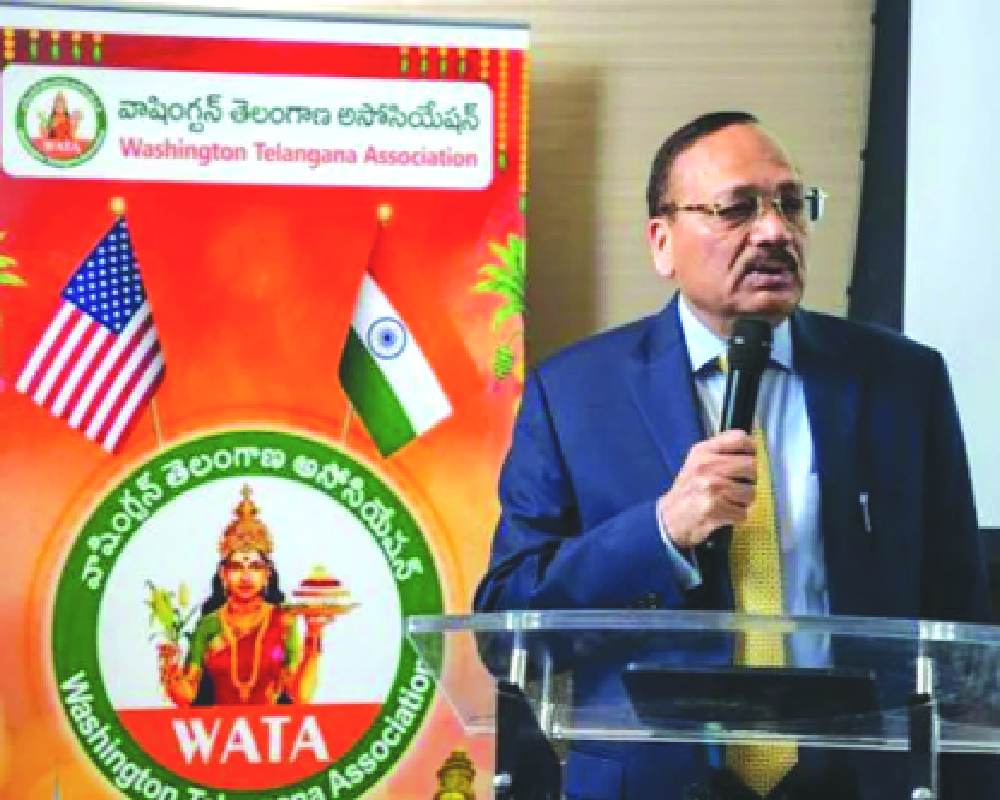
On 8th June, 2025, Justice Kant delivered a most illuminating keynote address to the Indian diaspora at an event organised by the Washington Telangana Association (WATG) in Redmond. The WATG event was part of the association’s “Incredible Indians” series. Addressing the august, well-packed gathering, Justice Kant proudly stated,” The Indian judiciary plays a unifying role in sustaining the diverse and democratic character of the nation. Through its reasoned decisions and moral authority, the judiciary not only resolves legal conflicts but also affirms a vision of justice that binds the nation together.”
He said the constant endeavours of the Indian judiciary to reassure, affirm and protect values dear to the Indian diaspora made it a “source of pride”, reaffirming the values within the constitutional order in India. Stating that “Tradition keeps us rooted in who we are, but it is the strength of India’s constitutional framework that safeguards the principles underpinning our identity-justice, fairness and inclusivity”, Justice Kant highlighted the pragmatic approach of institutions in giving meaning to values, which were no longer just symbolic or confined to ceremonies. Among these institutions, he said, “the judiciary stands out as a pillar that continues to reflect and reinforce the spirit of India, both within its borders and across the global Indian diaspora”.
He hailed the judiciary’s role in resolving a variety of contentious issues faced by Non-Resident Indians (NRIs), including property, inheritance, custody and matrimonial disputes. He emphasised that the judiciary had acted as a crucial pillar in safeguarding the principles of fraternity, equality and human dignity for all Indians, both within and outside the country. He also lauded the diaspora for maintaining strong ties to their roots while contributing to their host nation and asserted, “The sense of continuity remained especially meaningful in the lives of NRIs, whose ties to India often involve not just emotional and cultural bonds, but also legal and familial”. Appreciating the diaspora not only for its international success but also for its promotion of cultural heritage, Justice Kant underscored, “this shared heritage is not only preserved through culture and community but also through the enduring institutions that uphold our democratic values”. He further said, “It is a community, a family and a powerful reminder that while we may be thousands of miles from India, the heart of India, our values, our warmth, our celebration of diversity, continues to thrive… As we reflect on what binds us together-across States, professions, and continents-it becomes clear that our strength lies in the values we carry and the institutions that uphold them… Whether through community associations abroad or constitutional guardians at home, the Indian identity remains resilient because it is both lived and protected. It thrives not only in our languages and festivals but also in our collective commitment to justice, dignity and mutual respect.
These are the ideals that shape not just who we are but who we continue to become — no matter where we live… It is a community, a family and a powerful reminder that while we may be thousands of miles from India, the heart of India, our values, our warmth, our celebration of diversity, continues to thrive… For the diaspora, this becomes a source of pride and reassurance, affirming that the values they hold dear are not only protected, but continually reaffirmed within India’s constitutional order.”
Justice Kant also spoke effusively about the judiciary’s vital role in upholding national unity. He ended his address on a resounding patriotic note by calling on members of the diaspora to act as proud ambassadors of India’s cultural richness and constitutional values, encouraging them to carry forward India’s inclusive and democratic spirit across the world: “Let us continue to be rooted yet forward-looking, proud yet inclusive, committed to building bridges across communities and generations.”
In conclusion, the enthusiasm, coverage and above all the hype that Justice Kant’s voyage of discovery of America generated was simply stupendous and had a wide and far-reaching impact.
The author is an internationally reputed senior lawyer practising in the Supreme Court of India and various High Courts and Tribunals in India.