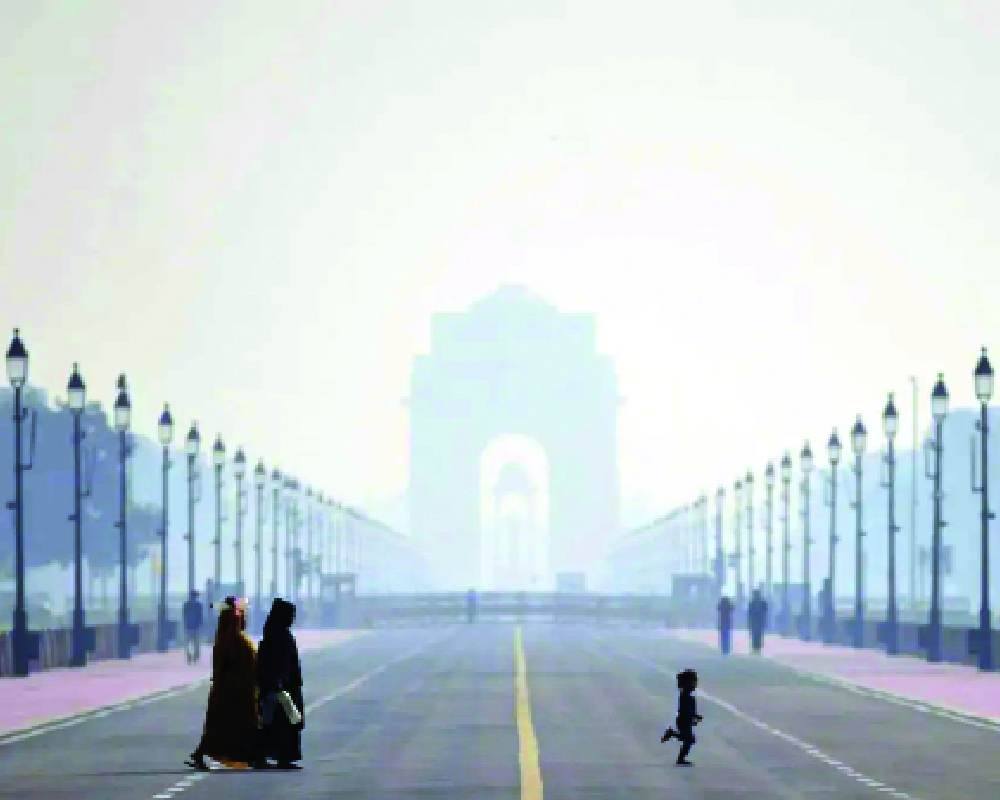
A thick layer of haze enveloped the national capital on Monday, with the air quality remaining in the “very poor” category and very likely to deteriorate to “severe” on Tuesday. According to the Central Pollution Control Board (CPCB), Delhi recorded an overall Air Quality Index (AQI) of 309 at 4 pm, indicating persistent pollution levels.
People in Delhi NCR have been waking up to a thick layer of smog and haze-filled skyline for the last couple of weeks, and the days during and after Deepavali saw the problem worsening, thanks to firecracker residue.
Burari was in the “severe” category with a reading of 400, followed by Wazirpur, which recorded 390. Additionally, 23 monitoring stations recorded “very poor” air quality, with readings above 300, as shown on the CPCB’s Sameer app.
According to the Air Quality Early Warning System (AQEWS) for Delhi, the wind speed dropped below 8 km/h from the northwest direction during the evening and night hours, reducing the dispersion of pollutants.
It added that a ventilation index lower than 6,000 m²/s and wind speeds less than 10 km/h are unfavourable for pollutant dispersal. The air quality is likely to remain in the “severe” category on Tuesday, AQEWS said.
The PM2.5 concentration stood at 155 micrograms per cubic metre and PM10 at 278. PM2.5 refers to fine inhalable particles with diameters that are 2.5 micrometres or smaller, while PM10 includes slightly larger particles up to 10 micrometres in diameter, according to the CPCB. At such levels, these pollutants can cause breathing discomfort, especially among people with lung or heart diseases, children, and the elderly.
According to experts, pollutants are being trapped close to the ground owing to a combination of reasons such as vehicular emissions, stubble burning in neighbouring States and low wind speed. Air pollution continues to be Delhi’s biggest health threat.
According to an analysis by the Institute for Health Metrics and Evaluation (IHME), ambient particulate matter pollution was linked to 17,188 deaths, accounting for 15 per cent of all fatalities.
Delhi’s maximum temperature was recorded at 31.5 degrees Celsius, 0.2 notches above the seasonal average, while the minimum temperature settled at 17.9 degrees Celsius, 1.9 notches above the season’s average, according to the India Meteorological Department (IMD).
Humidity was recorded at 58 per cent at 5.30 pm. The weather office has forecast mist for Tuesday morning, with the maximum and minimum temperatures likely to hover around 29 degrees Celsius and 18 degrees Celsius, respectively.