For years, one image has stayed with me: a dog in a cage. At first it fights to escape, scratching at the bars and whining at the shocks that come without warning. Then, slowly, it stops. Even when the door is left ajar, the animal does nothing. It has learned a terrible lesson — that the world is fixed, pain inevitable, effort pointless.
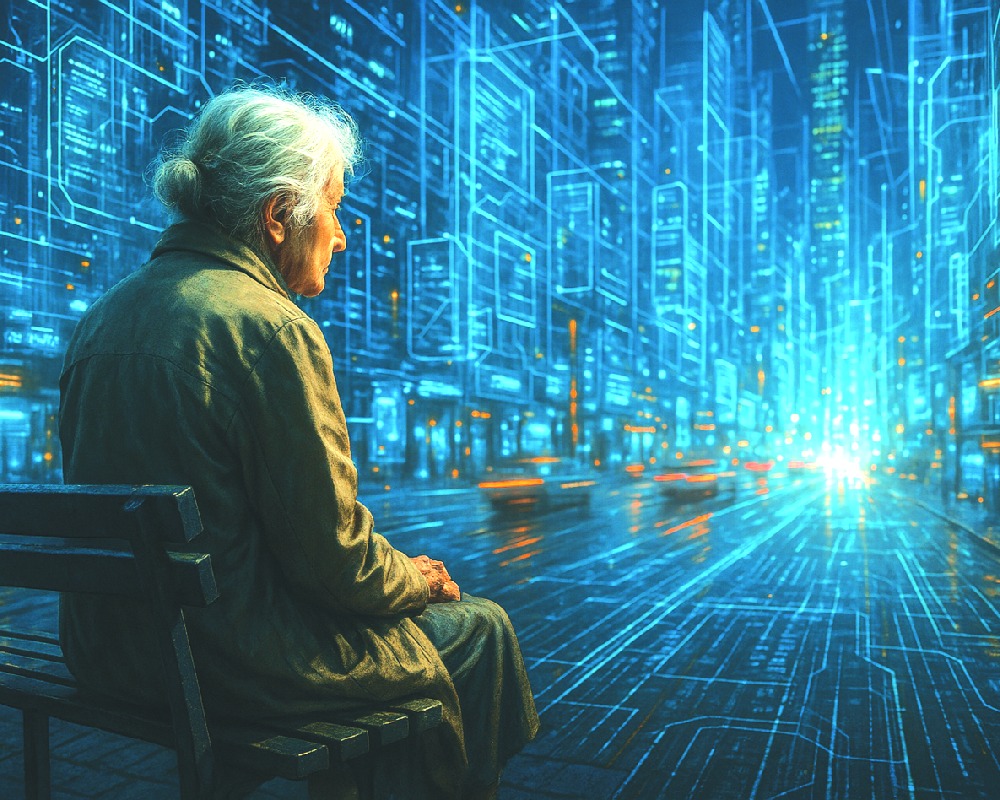
This classic psychology experiment was meant to illuminate learned helplessness. I have come to believe it now illuminates something else entirely: the future being built by artificial intelligence. The cage is no longer metal and visible; it is data — driven and everywhere. And, disturbingly, it is one we are building for ourselves.
Machines of Prediction, Not Imagination: We like to speak of AI as if it were an alien intelligence poised to outthink us. Most systems changes our lives today, however, are not intelligent in that way at all. They are machines of prediction. They learn from patterns in historical data and use those patterns to anticipate what will happen next — who will repay a loan, which tumor will turn malignant, what song we will stream, what would be the market trend and many more. Their power is not reasoning but regularity. They reward what is probable and punish what is not. They thrive on the predictable. That might seem harmless if predictions merely reflected the past. But they do not. They loop back into reality, shaping the very world they describe. When an algorithm decides who is most likely to succeed in a job, it does not just predict the future — it manufactures it, granting opportunity to some while denying it to others.
When predictive policing software labels a neighborhood “high-risk,” it justifies heavier patrols and more arrests, generating new data that confirms the original assumption. Bit by bit, our social world bends to fit the contours of its models.When Prediction Becomes a Cage:
This feedback loop is what transforms a neutral tool into a cage. The more accurate predictions become, the more they constrain behavior. The more constrained behavior becomes, the more accurate predictions appear. Eventually the space for deviation — the space for surprise — collapses. Like the dog that stops trying, we begin to accept the system’s boundaries as natural.
The economic consequences are already visible. Credit-scoring algorithms, trained on decades of biased data, learn that borrowers from certain neighborhoods default more often. They respond by raising interest rates or denying loans. That starves those neighborhoods of investment, limits opportunity and perpetuates the very conditions the model “predicted.” Innovation dies not because no one has ideas,
but because the system has already decided which ideas are worth funding.Culture follows the same logic. Recommendation engines train us to consume what people like us have liked before. Over time, they become so good at anticipating our tastes that we rarely stray beyond them. Art risks becoming derivative not because artists lack imagination but because the digital marketplace punishes deviation from expectation. Even dissent — the unpredictable fuel of democracy — is softened by algorithms that
feed us the opinions we are most likely to endorse.The Global Stakes of Predictive LogicGlobally, the picture is starker still. China’s Social Credit System uses predictive analytics to anticipate behavior and pre-empt disobedience. Western law-enforcement agencies deploy predictive policing that targets minority neighborhoods. Hiring algorithms quietly shape who advances in corporate hierarchies. Across domains, prediction is flattening possibility. Surprise, deviation, novelty — the forces that drive discovery and change — are treated as errors to be minimized.
As a physicist, I find this deeply troubling. Nature, at its most profound, is built on surprise. The universe did not unfold from certainty but from fluctuations — from randomness itself. Every major scientific breakthrough, from quantum mechanics to relativity, arose not from extrapolating the past but from questioning it. Yet our most advanced AI systems, for all their power, cannot do this. They cannot imagine what they have never seen. They cannot ask whether the cage is real.
The Real Threat: A Civilization That Stops Imagining This is why the greatest danger of AI is not that it will enslave us or outthink us. It is that it will slowly teach us to stop thinking beyond it. A civilization governed by prediction may never need an authoritarian ruler. It will police itself, guided by the comforting tyranny of what the data says is likely. Resistance will feel irrational. Ambition will seem naive. The possible will shrink until it is indistinguishable from the probable.
Some argue that this is the price of efficiency — that prediction makes the world smoother, safer, more optimised. But optimisation is not the same as progress. A perfectly optimised world is a stagnant one, a world where the unexpected cannot occur. And it is precisely the unexpected — the anomaly, the outlier, the idea that “shouldn’t work” — that drives human advancement. Without surprise, there is no art, no science, no democracy.
Designing for Surprise, Not Just Accuracy Avoiding the cage requires designing AI differently. Instead of building models that punish deviation, we should build ones that embrace it — systems that seek anomalies rather than suppress them. Injecting noise and uncertainty into algorithms should not be treated as a bug but as a feature. Diversity in data should matter not only because it is fair but because it is fertile ground for the unexpected. Some researchers are already exploring “curiosity-driven” machine-learning models that reward exploration of the unknown, a small but crucial shift away from mere prediction.
Equally vital is preserving the human capacity for surprise. That means resisting the temptation to let AI mediate every choice, every risk, every curiosity. It means teaching students not only how to use algorithms but how to disobey them. It means celebrating the improbable scientific result, the unpopular opinion, the work of art no one saw coming — not as glitches in the system but as evidence that we are still alive and still capable of imagining differently.
The Leap Beyond the CageThe cage is not inevitable. The dog could have leapt. We can still leap too. But doing so will require a conscious choice: to build a future that values uncertainty, to prize surprise not as a flaw but as the essence of life itself.
Artificial intelligence will continue to grow more powerful. It will write, diagnose, predict and optimise with breathtaking precision. But if we allow it to strip the world of surprise, it will also make us smaller. It will build a civilisation that forgets how to imagine — a species that no longer reaches for the bars.
The story of the dog in the cage is not about intelligence or strength. It is about belief — about the quiet, corrosive moment when a living being stops believing that anything else is possible. That is the moment we must never reach. The future of AI will not be decided by how smart our machines become, but by how fiercely we defend the unpredictable. If the world becomes nothing but what the data expects, we will have built the most perfect cage imaginable — one so seamless we forget it’s there.
Author is a theoretical physicist at the University of North Carolina, United States.