




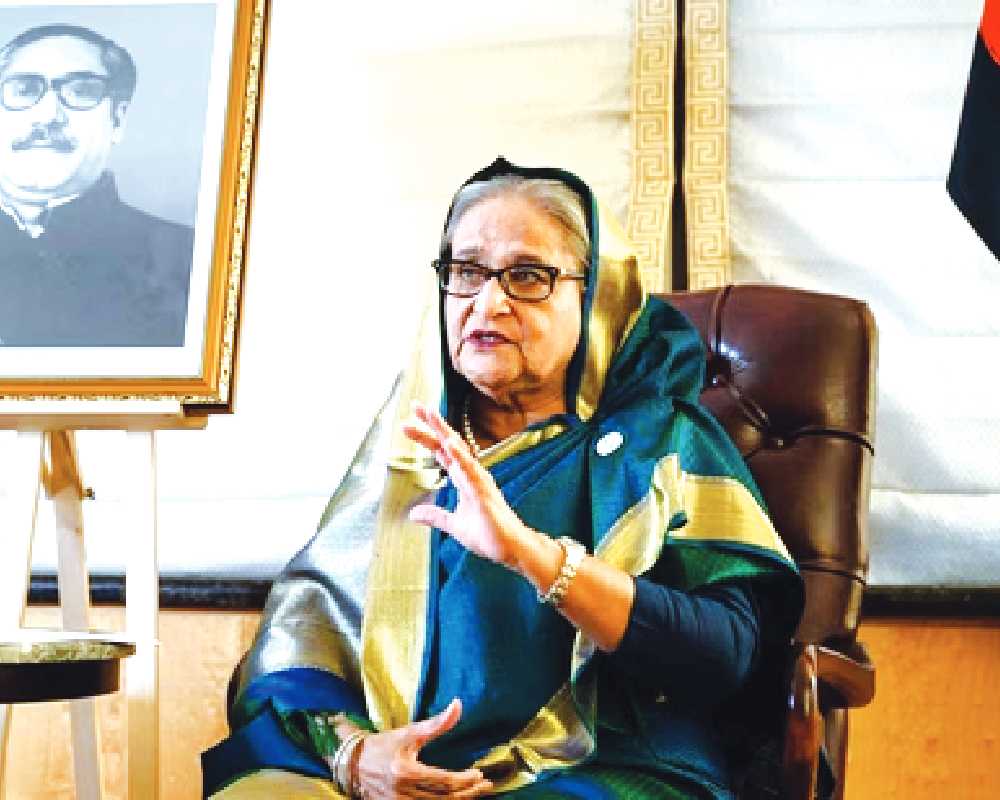
A special tribunal in Bangladesh on Thursday said it will deliver judgement on November 17 in a case against deposed prime minister Sheikh Hasina over alleged crimes against humanity committed during the July Uprising. Hasina, 78, faces multiple cases in Bangladesh after being ousted in August last year following the mass student-led agitation. According to a UN rights office report, up to 1,400 people were killed between July 15 and August 15 last year (dubbed as July Uprising) as Hasina's government ordered a security crackdown on protesters.
"Justice Golam Mortuza Mozumder, chairman of a three-member panel of the International Crimes Tribunal (ICT-BD), set November 17 for delivering the verdict," a lawyer, attending the tightly secured special court in the capital, told. Hasina, her home minister Asaduzzaman Khan Kamal and then inspector general of police (IGP) Chowdhury Abdullah Al-Mamun were tried in the tribunal. The ex-premier and Kamal were tried in absentia, with the court declaring them fugitives. Chief prosecutor Mohammad Tajul Islam has demanded the death penalty for Hasina, alleging that she was the "mastermind and principal architect" behind the crimes against humanity committed during the mass protests last year.
Hasina's supporters say the charges against her are politically motivated. Mamun faced the trial in person but emerged as an approver or state witness. The former police chief appeared on the dock as the ICT-BD chair Justice Majumder fixed the date. The tribunal on October 23 concluded the hearing on the case after over 28 working days, when 54 witnesses testified before the court describing how efforts were made to tame last year's student-led movement called July Uprising that toppled Hasina's now disbanded Awami League government on August 5, 2024.
Hasina fled Bangladesh on August 5 last year amid escalating unrest and is currently residing in India. Kamal reportedly also took refuge in the neighbouring country. The interim government led by Muhammad Yunus has sought Hasina's extradition, but India has yet to respond to the request. Security in the capital was heightened over the “Dhaka lockdown” call by the Awami League, coinciding with the tribunal's announcement of the verdict date. Authorities called up army troops, paramilitary Border Guard Bangladesh (BGB) and police in riot gear to spread a security blanket in and around the International Crimes Tribunal (ICT-BD) complex at central Dhaka.
Witnesses and reports said Dhaka streets looked unusually empty, though many commuters stepped out of their homes and cautiously headed for workplaces and schools. However, many private institutions, including private universities, preferred to operate online, fearing the outbreak of violence. Transport operators said passenger numbers on long-haul buses leaving Dhaka dropped sharply, while the capital's major Gabtoli bus terminal remained largely empty with fewer trips and delayed departures. Hasina and the two others were accused of committing crimes under five counts, with the first one alleging the defendants of murder, attempted murder, torture, and other inhumane acts.
The second count accused Hasina of ordering the “extermination” of protesters. Under the third count, she was accused of making inflammatory remarks and ordering the use of deadly weapons against protesting students. Under the rest of the counts, the defendants were charged with the shooting and murder of six unarmed protesters, including students in Dhaka and its suburbs. In several recent interviews with major international news outlets and the Indian media, Hasina called the ICT-BD a kangaroo court run entirely by men linked to her political opponents.