China on Tuesday successfully launched the last satellite of its BeiDou Navigation Satellite System (BDS), touted to be a competitor to the Global Positioning System (GPS) of the US, taking another step to becoming a major space power.
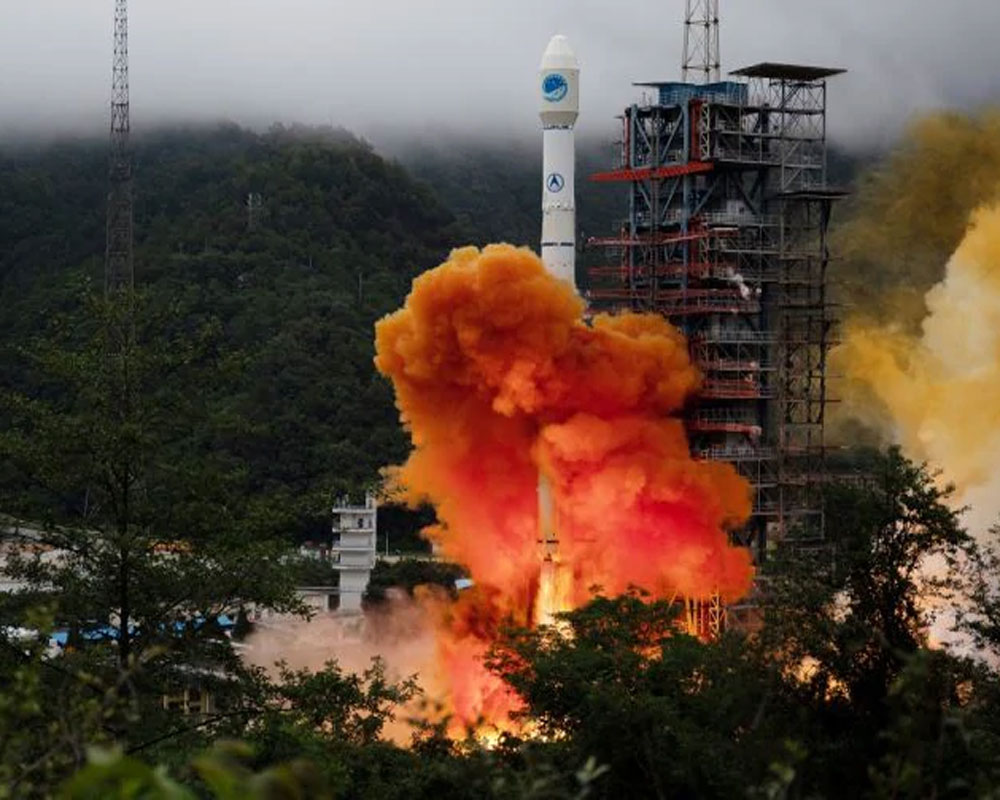
The satellite was launched on Tuesday morning from the Xichang Satellite Launch Centre in southwest China's Sichuan Province.
The satellite, the 55th in the family of BeiDou that means "Big Dipper" in Chinese, was successfully sent into space by a Long March-3B carrier rocket, according to the China Satellite Navigation Office, state-run CGTN reported.
The launch will mark the completion of the country's domestically developed BeiDou network, one of the four global navigation networks alongside with the US' GPS, Russia's GLONASS and the European Union's Galileo.
India too is building its navigational system called the Indian Regional Navigation Satellite System (IRNSS), with an operational name of NAVIC.
Some of the countries like Pakistan are using BDS. China is also promoting its use in the countries signed-up for its mega Belt and Road Initiative, (BRI).
The BDS-3 satellite was originally scheduled to be launched on June 16, but it was later postponed due to technical problems which were discovered in pre-launch tests.
The latest GEO satellite is the 55th BDS system, and will work with other members of the network, allowing global users to access high-accuracy navigation, positioning and timing as well as communication services, official daily Global Times reported earlier.
Compared to previous generation series, the constellation of BDS-3 with an array of 30 satellites flying on three different orbit planes - three at the GEO, three at the inclined geosynchronous orbits, and 24 at the medium Earth orbit - have higher bandwidth.
They enable enhanced communication capability and carrying more accurate and stable domestically developed atomic clocks to improve the precision of timing and navigation services, the report said.
The first BeiDou satellite entered orbit in 2,000, and started providing positioning, navigation, timing and messaging services to domestic users in China and users in the Asia-Pacific region in December 2012.
The BDS system started providing global services at the end of 2018, when construction of the BDS-3 primary system had been completed.
The Tuesday mission will complete the BDS-3 system, which, according to Wu Di, a scholar with the satellite positioning technology centre of Wuhan University, will further enhance the quality of services of the system for global users providing stronger signals.