Serious poetry involves an intensive and extensive use of all mental processes like insight, concept formation, cognition, sensations, impulses, judgments, memory, associations, etc. Poets' perception of ideas thus is a perception continuously regulated by these mental processes
In this article, an attempt is made to explore why serious poetry is called nebulous, indecipherable and abstract. Oftentimes, a poet looks at things that lie behind; he travels on a road stretching backwards. He goes back on the same road, to the same spot, to meet his self-image. What slither out of him are human anomalies unable to get over the seized fancies enveloping these. Beneath the burden of such fancies are laid feeble remnants of dreamy, forcibly conceived indeterminate hum that sucks so many absorbing voices occasioning him the summit of the awakened realities or unrealities.
Poets find themselves sitting buried in meditation within a strange world, stripped of its own nakedness. Problems of internal and external upheavals, as they descend into the arena of such a world, being aflame, their conditions can be best compared with what Carl Jung writes in his classical essay, After The Catastrophe, “how churned up one still is in one’s own psyche, and how difficult it is to reach anything approaching a moderate or calm point of view in the midst of one’s emotions.â€
Poets write as by doing so they reshape themselves as clouds do in a wind. Writing poems is a way to survive. Poets feel deeply and those who feel deeply need to survive too. Through life’s thorny thickets a poet looks here and there to search a royal road at the end of which he meets a resting place: a fuzzily defined amalgamation of perception, cognition and analysis. A different voice speaks through that great amalgamation. In one magnificent rush that missing link is arrived at. Writing poems is akin to adventuring on the waters that have not halted at a place, but been flowing continuously with no obstacles on the way.
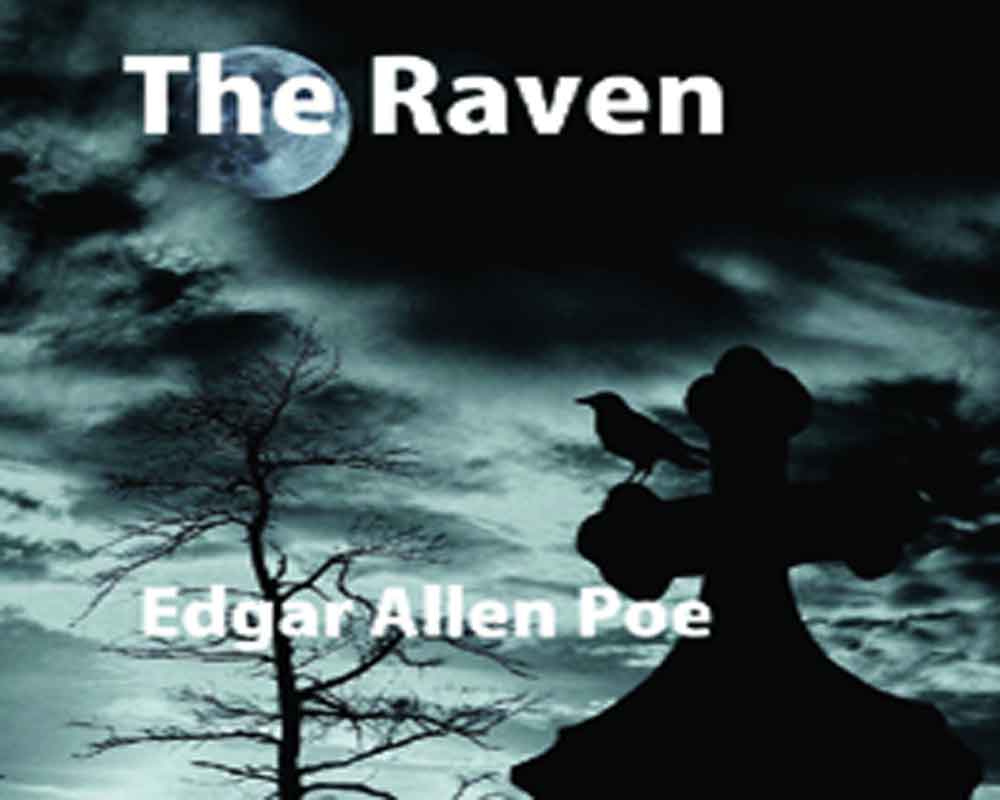
Edgar Allan Poe enchants one with his tales as much as with what he calls trifles such as the one titled “The Poetic Principle†in which he divides the world of mind into the Pure Intellect, Taste, and the Moral Sense: the first concerns with truth, the second with the beautiful and the third with duty. Try to link these with his tale — “The Murders In The Rue Morgue†where he prefixes a confounding preface containing narrations as to the relationships between the analytic and the imaginative that go together. So relevant for poets. Poets, if I am permitted to use the terms Poe employs, are fond of “enigmas, of conundrums, hieroglyphics…†use their “retentive memory†to arrive at “sum total of good playing†which has “the whole air of intuition.†Thereby, the instincts of poets get sublimated. A poem, like life, regulates itself as much as it constitutes itself. Writing a poem seems to be analogous to employing a gestalt experience i.e. putting feelings, will, thoughts and experiences together to yield place to something that is new, raw and inexperienced.
Poets have barely an idea as to where their poems would head them to. “Where, then shall I be brought?†These words of Kafka haunt poets confronting them with a sort of inexplicable dilemma which becomes, perhaps, poets’ greatest strength, for it confers on them a sense of intellectual detachment, at times transcendent and naïve, at times awful; and with this sense they write their art poetique, amid ambiguous, sardonic and dusky obscurity and self-effacement about the ideas going into making of serious poems. Ideas with a myriad of structural forms mingled with images create what Jorge Luis Borges calls a maze of forking paths from which several realities may flow.
Coming to serious poems a question raises itself. Do ideas and words form a thought process? Or differently put, “Can our thought apprehend the nature of thought?†Way back in 1907, a psychologist named Buhler, in one of introspective reports tried to answer this question. “I knew at the moment precisely what the whole thing was about; there were no words in it, though, and there were no ideas either.†Both this question and answer to this question are very relevant when thought over in the context of ideas that poets deal with while writing poems that later on become serious poems. Many times unclear, embryonic, incoherent and formless ideas convey to poets jumbled and fragmented images.
Serious poetry involves an intensive and extensive use of all mental processes like insight, concept formation, cognition, sensations, impulses, judgments, memory, associations, etc. Poets’ perception of ideas thus is a perception continuously regulated by these mental processes. Serious poets wade through their thought process knowing not the inner details of exploratory mechanism at work when they pen their lines. The exploratory mechanism typically has five components: observation, selection, scrutiny, analysis and reporting, all parts of the elemental process having links to consciousness. Poets struggle to reach out ideas in terms of clear images which need not be logically connected and coherent. This is the most difficult task before a poet. Unclear, imageless thoughts make it difficult for him to reproduce the output of his thought process. This is a dilemma of expanding a thought that has not come to a poet with words but for which he has to introduce words and he does not know if words he selects really explain that nebulous thought.
When TS Eliot disagreed with Edgar Allan Poe’s assertion that a long and, let me add, a serious poem is “at best a series of short poems strung togetherâ€, Eliot was basically concerned with “the conditions of the age’’. A poem becomes long and serious because it involves, “a variety of moods†requiring “a number of different themes or subjects†and involving, “the widest possible variations of intensity.†Thus poets enter the clustering log, thinking nothing of the log and bring out pieces unfathomably logical. The incessant fluctuations of their thoughts carry images impacting the innovative mind of poets. Particles glimmer. Images within images glimmer too but their thought processes deny these images within images a reach essential for meaningful writings. The hot cauldron of noisy stars, I mean, our brain and its deeper holes hide obsessive impulses. None to shoulder the weight of either unborn or up-rooted ideas. Amid that weight lies a wait — irreversibly long wait when poets experience thoughts’ sterile grounds looming onwards.
Emotions and emotional distortions, both having life: inner: a concealed one, as well as outer one: a revealed one, which allow poets indulgence in poetical possibilities leading to a state of imaginative equilibrium: a drift towards infinite nothingness because fragmented and disintegrated emotions and emotional distortions represent an indivisible continuum. Overall unity and scheme of serious and difficult poems: longer ones in particular, pose problems of both form and content as these absorb various influences poets have received in the past as also what they receive while penning poems over a long period of time. For example, Allen Ginsberg’s long poem KADDISH, where he is, “dreaming back thru life. Your time — and mine, accelerating toward Apocalypseâ€. Poets voyage in the direction of exploring unique and unpoetic things, as contrary to mundane issues.
Time: a continuum of past and present. Accidentally, it is through Proust’s fascinating but exhausting amplification of what happens in between the last moments of waking state and initial moments of sleeping moments: things, ages, memories, remembrances come and go in between as though nothing of any importance is left out, that serious poets seem to actualise the art of writing. Excitements, as a writer, trouble them but never distract them. They creep into a state of subconscious from conscious and an uncomfortable desire to ultimately melt their conscious into the unconscious one is never a strange phenomenon for serious poets. It just happens. They have the liberty that bestows on speculative minds, the liberty to move to and fro — a way into innumerable reciprocal causations that ultimately culminate into a world of ideas and images. “Shifting and confused gusts of memory†as Proust calls, function decisively in as much as these delve into linkages between the past and the present. Poets are faced with a compounded state of an organic whole wherein is transmitted to them a faint, kaleidoscopic interaction of past and the present and also an array of succession and penetration of moments that had long become parts of the past and that seem to be turning toward the present. Look at these lines from KADDISH, “The telephone rang at 2 am — Emergency —she’d gone mad — Naomi hiding under the bed screaming bugs of Mussolini — Help! Loins! Buba! Fascists! Death! — the landlady frightened — old fag attendant screaming back to her.†All such remembrances and associated images are part of that great flux.
Conflicting identities ail poets: a desire to seek separateness but unable to get rid of the other’s identity. The simultaneous order of irrevocable sufferings and sorrows imprison the frequent visits to lands of anonymity and speculations and poets as prisoners keep seeking their own identity through their outpourings. These are unknown, inhabited paths they move on exploring strangeness of worlds that lie just beyond their obvious reality. Every poet sublimates his experiences to some sort of formal images. There are riddles, scattered all around, but poets oftentimes are unable to realise the existence of such riddles. Unhinged as these riddles are, poets are lost as, Schopenhauer ably avers, amid the cognitive forms of appearance. Poets wantonly forsake ideas and ideals rapturously seeking a way out: hankering after an identity.
Poems enable poets to bring to fore reflections that have been passing through their mind: the literary ideas, unformed or half-formed experiences, never exhausting clash of words with incisive ideas, unsettled gloom that each day brings with it, albeit unintentionally, — morbid thoughts hidden beneath melancholic immobility, unique in splendor, all helping them explore path-ways to immense possibilities of reaching out to consciousness of existence, a voyage into the being and the becoming, the world of estrangement and alienation in the backdrop of Pascal’s image of man — man with weak body, immensely aware of his stupendous power as a thinking being. Poems place limitations on poets. Words don’t help explain fully these limitations. Blurred and inexplicable images and scenes, grafted somewhere in their mind, accrue to reality as if from the edge of an inner world of darkness, poets limp into inner worlds of another darkness. Illusions of past constitute illusions of present — poets visualise these illusions, agile and alive, as they relish impenetrable quietness.
Poets are veritable fountainheads of poems, an inexhaustible ocean of exquisite and enigmatic tales. Don’t poets, in the process of composing long, anfractuous poems, dance with unknown partners? They do and in doing so allow their serious poems to probe the abyss of “The shaping spirit of imagination…†to use Coleridge words. Poems represent concentration of expansion — there is no skewing. Poets seek unity in their poems but are fronted with fractured realities. Thus I round up — the importance of reconciliation of differences of perceptions and attributes, not so foreign to a reader, he climbs up and then suddenly realises, the ladders are pulled. Readers grope into the whole from which parts have suddenly disappeared and like Leibnitz they begin seeking reality of parts to determine the nature of the real parts of the whole. So it constituted the beauty of a serious poem. Readers, with patience, enjoy the freedom to go athwart.
(The writer is a former civil servant, a poet, writer and columnist. Currently, he is a nominated member from the category of ‘literate person from the public and community’ of Ethics Committee on Research of Mental Health Establishment, IHBAS (Institute of Human Behaviour and Allied Sciences) of the Government of NCT of Delhi. Views expressed are Personal.)