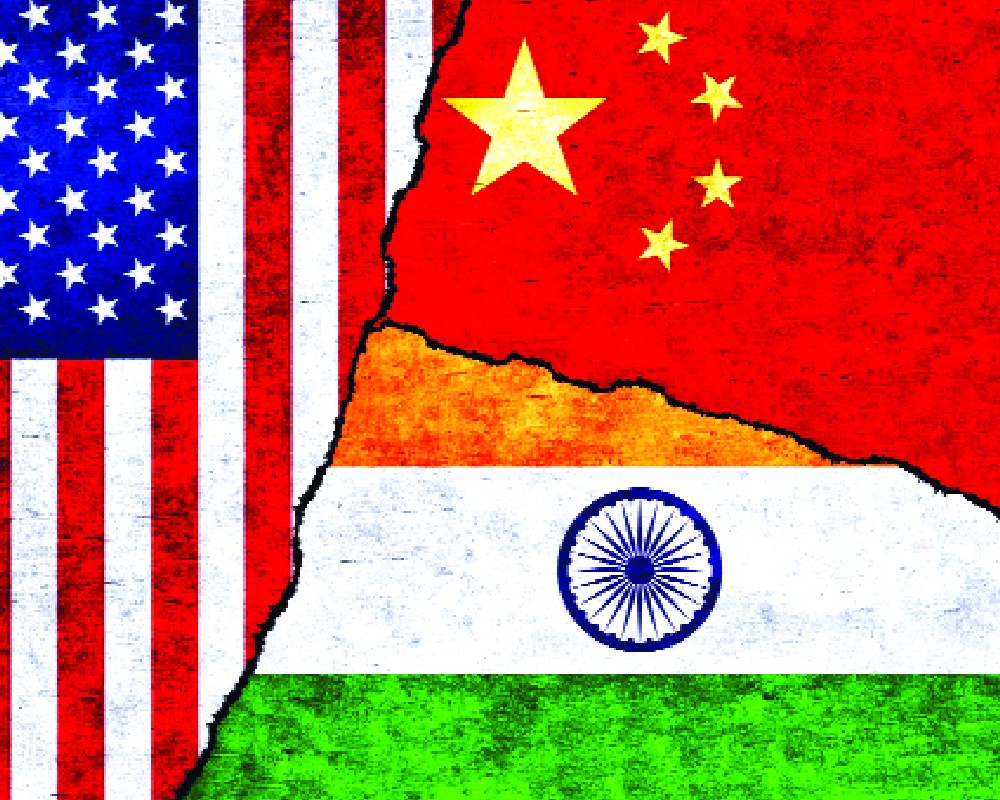
As with several issues, one can see wide and visible oscillations in the US’ look-East policy, especially on how to deal with India and China, separately and collectively. Washington plays the carrot-and-stick game with New Delhi, as the former tightens screws in some areas, and its leaders verbally praise the Indian Prime Minister Narendra Modi. America changed its stock-and-stick policy vis-à-vis China to a stick-and-carrot one, after President Donald Trump inked a temporary, but sweet deal with the Chinese counterpart, Xi Jinping.
Now, a White House document reflects a pivot to deepen ties with India, despite the tariff overdose, and delays in signing a bilateral trade deal, as a counterweight to China in the Indo-Pacific region. The ‘National Security Strategy of the United States of America November 2025’ states, “We must continue to improve commercial (and other) relations with India to encourage New Delhi to contribute to Indo-Pacific security, including through continued quadrilateral cooperation with Australia, Japan, and the United States.” Quad representatives recently met in New Delhi for a counter-terrorism conference, despite the US sanction on India over Russian oil.
“Moreover,” adds the security document, “we will also work to align the actions of our allies and partners with our joint interest in preventing domination by any single competitor nation.” Note the reference to “any single competitor nation,” whose inherent meaning obviously refers to China. The relationship with China may be framed as a strategic competition with episodic summitry, marked by deep economic interdependence alongside tensions over trade and technology. These include tariffs, export controls, and restrictions on advanced semiconductors, with a security posture focused on deterrence around Taiwan and maritime disputes.
Ties with India are increasingly cooperative and transactional, driven by expanding commercial links, and supply-chain partnerships, growing technology collaboration, and a security partnership that emphasises Quad cooperation, and defence interoperability. The US thus uses trade, investment, and joint exercises to deepen alignment, and enlist India as a partner in shaping the Indo-Pacific balance. “America should similarly enlist our European and Asian allies and partners, including India, to cement and improve our joint positions in the Western Hemisphere and, with regard to critical minerals, in Africa,” states the report.
However, such grand rhetoric, and vision is punctuated by what seems like a caveat. “America’s economic partners should no longer expect to earn income from the United States through overcapacity and structural imbalances but instead pursue growth through managed cooperation tied to strategic alignment and by receiving long-term U.S. investment,” adds the report. President Trump’s “G-2” moment with Jinping revived an old idea of US-China co-leadership, even as Indian analysts cautioned that the remark was possibly rhetorical, and did not erase deep structural rivalry.
Washington’s codified posture in the National Security Strategy appears to balance a desire to manage competition with a clear push to deepen commercial and strategic ties with India. The US hopes to explicitly link improved economic relations to India’s contribution to regional security, and continued Quad cooperation. However, the language signals a shift from bilateral hedging to coalition-building using trade, technology partnerships, and defence ties to align like-minded states against coercive behaviour by “rivals.”
‘Love you not-maybe love you” appears’ to be Washington’s alternating relationship with Beijing, depending on the need of the hour. It swings from an economic interdependence, and global coordination to rivalry over technology, allegations of human rights, among others. “A related security challenge is the potential for any competitor to control the South China Sea,” observes the White House. It adds, “This could allow a potentially hostile power to impose a toll system over one of the world’s most vital lanes of commerce or, worse, to close and reopen it at will.”
The mentions of “South China Sea,” “potentially hostile power”, among other phrases possibly point to a single nation, but can be a matter of interpretation, and conclusion. For Washington, either of the two outcomes, a toll system, or willfully closing or opening the channels, is harmful to the US economy, and broader US interests. The White House advocates “strong measures… along with the deterrence necessary to keep those lanes open, free of “tolls.” It admits that this will require not just further investment in our military, especially naval, capabilities, but strong cooperation with every nation that stands to suffer, from India to Japan and beyond.
One of the points that emerges is the ongoing spat between Beijing and Tokyo over the latter’s stand on Taiwan. With India, which possibly believes in quiet accommodation if it serves its interests, the dynamic shifts more towards strategic convergence on Indo Pacific security, supply chain resilience, and technology despite trade frictions. New Delhi can leverage ties with Washington with an emphasis on trade, investments, and technology to deepen interoperability and align incentives for regional security. While rhetorical gestures like “G-2” can ease tensions between America and China, it requires backing through crucial agreements.
However, pushing partners to choose sides risks fracturing multilateral institutions, and complicating cooperation on global issues. The Trump-Xi meeting, White security document, and ongoing India-US trade talks reflect an American approach through engagements, if possible, and competition, where necessary. The aim is to build partnerships, and shape a stable Indo-Pacific order. This will define Washington’s diplomacy in the future, and determine whether rivalry hardens into containment or is managed.