




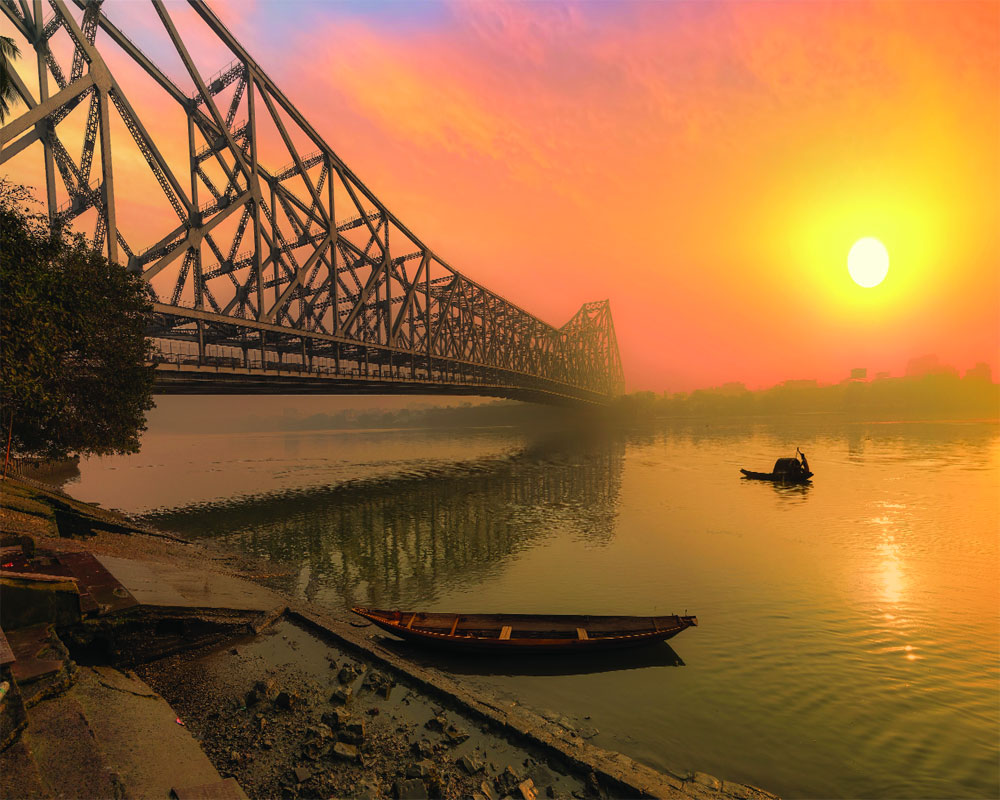
“O’ Ganga, why do you flow?” asked the celebrated singer-composer Bhupen Hazarika in his song released over half-a-century ago. The lyrics questioned the mighty river for flowing, even as the countrymen were exploited along its banks. The socio-political message was echoed over loudspeakers in events and public gatherings. Raj Kapoor’s Ram Teri Ganga Maili, released four decades ago, addressed the issue through its female-lead character, named Ganga. The real Ganga flowed as it did for centuries.
But neither Hazarika nor Kapoor questioned the exploitation of the holy river. Its deteriorating health went unnoticed. Of course, there were hues and cries about pollution and waste, but actions were minimal. The Ganga serves over 40 per cent of the population, and offers water for drinking, irrigation, industry and cultural order. But this vital lifeline faced pollution due to decades of urban growth, industrial expansion, population pressure and underinvestment in environmental management.
By 2016, the Governments had cumulatively spent `30 billion on interventions. But it was between 2014 and 2015 that a new mission, with multiple objectives, and an integrated conservation project, began to unfold. The objectives were effective abatement of pollution, conservation and rejuvenation. Named Namami Gange Programme (NGP), it is an approved ‘flagship’ project of the Government.
The first phase of NGP was approved in 2015 with a budget of `20,000 crore for a five-year period. The implementation did not commence until 2016-17 due to a two-year planning period. The next phase was approved in January 2022, with a budget of `22,500 crore until March 31, 2026. The aim was to enhance sewage treatment capacity, improve water quality, and regulate industrial waste discharge to rejuvenate the Ganga. The aim was to get to prescribed bathing standards by the end of this year.
Despite the huge challenges, some results are apparent. In 2022, the United Nations ranked NGP among its top 10 global river-cleaning projects, lauding its scale and replicable model. Experts like Vinod Tare of IIT Kanpur and Nupur Bahadur of TERI spoke highly of its achievements. According to a third-generation boatman in Varanasi, Sunil, the river has never been as clean as he finds it today. He has seen it since a child, and he sees a visible difference.
On the flip side, a Ministry of Science and Technology statement in December 2021 shared the highlights from a study by a team of experts. The latter found that the water quality in the lower stretches of the Ganga was “alarming.” There were reports of threats impacting water quality and flow.
In some places, like Patna, the river’s flow shifted far away from its earlier banks. In 2023, a report by the Comptroller and Auditor General (CAG) mentioned that the Bihar Urban Infrastructure Development Corporation failed to meet its deadline for use of funds under the NGP to improve the sewage infrastructure.
“Ganga’s tributaries are shrinking because the water table is falling. As a result, smaller rivers are no longer able to feed the Ganga. That is why, along with protecting the Ganga, we must also focus on reviving our smaller rivers,” emphasises Raman Kant, president of Bhartiya Nadi Parishad.
However, the issue is not confined to the Ganga, its tributaries, and the rivers that feed the holy river. The Central Pollution Control Board identified 311 polluted stretches on 279 rivers across 30 States and Union Territories. Though Namami Gange addresses the requirements of certain other rivers, more efforts are needed.
Take the case of the Yamuna, which is part of the NGP. Cleansing faced political and bureaucratic issues. However, efforts began in January 2023 under a mission-mode drive set up by a National Green Tribunal-mandated high-level committee. The body, chaired by the Delhi Lieutenant Governor, is tasked to rejuvenate the river’s critically polluted stretches. In June 2025, the Delhi Government approved a 45-point action plan. It aims to tackle sewerage management, drain-trapping, solid-waste removal, storm-water controls and environmental-flow augmentation, with major milestones slated by September 2026.
What is crucial is that pollution, which afflicted Ganga in the plains, is now part of upstream and downstream. This is due to huge infrastructure projects in the hills, and inability to tackle the issues in the delta regions. As the river still quietly flows in dismay, it may be wise to listen to India’s ‘Waterman,’ Rajendra Singh, who says, “Every state needs a river rejuvenation policy.”
The author is a senior journalist with over three decades experience across print, TV and digital media