India’s biogas sector stands at a pivotal juncture. Under the SATAT initiative, the vision of deploying 5,000 Compressed Biogas (CBG) plants has ignited strong momentum, yet the sector's full potential remains constrained by fragmented feedstock chains, inefficient logistics, limited infrastructure readiness, and financing challenges. With over 500 million tonnes of agricultural residue and organic waste generated annually, India possesses an immense
resource base. Converting this into reliable, commercially viable energy demands an integrated approach that aligns technology choices, local realities, and financial frameworks.
1.Feedstock: The Foundation of Sustainability
India’s diversity in agro-climatic zones demands a state and district-level understanding of feedstock ecosystems. Aggregation cycles differ widely. In northern states like Punjab, the effective collection window has shortened to as little as 15 days, often coinciding with misty weather that heightens fire risks. Central and eastern regions offer slightly longer aggregation periods but lack sufficient machinery to exploit them effectively. Smaller landholdings in states such as Uttar Pradesh further elevate aggregation costs due to higher machine density requirements. Meanwhile, in Punjab and Haryana, machinery is abundant but frequently controlled by unions that influence feedstock pricing.
Challenges: Feedstock aggregators operate without long-term contracts, resulting in speculative spot markets that undermine price stability and complicate project financing. The absence of risk-mitigation structures makes lenders wary, constraining debt availability.
Solutions: Project developers must account for state-specific dynamics rather than applying uniform pricing models. Building vendor ecosystems that can deliver long-term feedstock contracts will provide price visibility and reduce project-level volatility. These contracts should include robust force majeure and equitable pricing clauses to protect both parties. Developers can also leverage the centrally funded BAM scheme to procure their own machinery, thereby improving control and reliability of feedstock supply.
2. Logistics: Bridging the Rural-Industrial Divide
Biomass logistics form the operational backbone of any CBG facility. Transporting biomass in baled form beyond 30 kilometres sharply increases costs, often rendering the feedstock unviable. The small average field size across India compounds the challenge, as it limits the productivity of large harvesters and necessitates multiple smaller machines, raising both capital and operating costs.
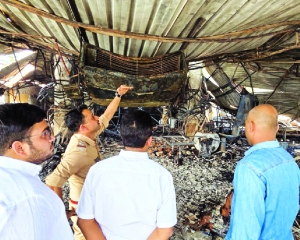
Storage introduces further complexity. Feedstock must be protected from India's harsh summers and unpredictable monsoons. Without well-designed storage yardsequipped with fire-safety systems, proper drainage, and all-weather access roads, developers risk losing significant volumes to fire, moisture, and handling damage. Despite this, there is still no widely accepted benchmark for annual feedstock losses across the sector.
Solutions: Comprehensive logistical planning must begin at the project-concept stage. Developers should map potential collection zones, assess proximity to plant sites, and identify safe storage areas distanced from residential clusters. Capital investment in storage infrastructure should be treated as integral to plant viability, not an afterthought. Experience shows that haulage and storage costs can be equal to or even exceedthe base feedstock price, underscoring the importance of precision planning and fire-safety discipline.
3. Infrastructure: Translating Policy into Execution
While policy frameworks such as SATAT and GOBARdhan have created a robust foundation, ground-level implementation often lags. Developers face delays in land acquisition, environmental clearances, grid connectivity, and pipeline tie-ins. Many state-level CBG policies are recent, and their on-ground application remains uneven.
One recurring challenge is power reliability. CBG plants, typically located in rural zones, rarely enjoy uninterrupted 24×7 electricity, and some lack access to grid injection points, an issue that can jeopardise project viability. Compounding this, the sector faces a shortage of technically trained manpower to operate and maintain plants efficiently.
Solutions: Developers should conduct comprehensive due diligence on local policy execution before finalising sites. Project locations must be evaluated for 24×7 power availability, gas grid connectivity, and infrastructure support.
Where grid reliability is weak, integrating dedicated backup systems is essential. Simultaneously, building a skilled workforce through targeted training programs can significantly enhance operational reliability.
4. Financing: De-Risking Green Investment
Access to capital remains a defining barrier to sectoral growth. CBG projects are capital-intensive, have long gestation periods, and depend on variablesfeedstock availability, offtake pricing, and plant uptime, which traditional lenders find difficult to quantify.
Unlike solar or wind, biogas generation cannot be simulated with standardised models, making revenue projections inherently complex.
As a result, banks often over-collateralise or decline funding altogether. Several early projects that underperformed have further eroded confidence, creating a cycle of risk aversion. Yet large-scale collateral is impractical for most developers, stalling investment flow.
Solutions: A multi-pronged approach is needed. Developing a formal training curriculum for banking officers can equip them to evaluate biogas proposals through technical and financial lenses.
Blended-finance mechanisms, viability-gap funding, and interest-subvention schemes can substantially enhance project bankability.
Long-term feedstock supply and gas offtake contracts will further assure lenders of predictable cash flows, paving the way for sustainable project financing.
Conclusion:
Building a Scalable and Resilient Ecosystem India’s biogas journey is no longer about pilot projects; it is about building an industry that underpins national energy independence and rural prosperity. Achieving this vision requires a collaborative ecosystem that integrates technological discipline, financial innovation, and policy pragmatism. By localising feedstock strategies, professionalising logistics, strengthening infrastructure readiness, and de-risking finance, India can transform its vast organic-waste reserves into a dependable energy asset. The coming decade offers an opportunity to make biogas not just a renewable alternative but a cornerstone of India's sustainable energy future.
Varun Karad is the Co-Founder and CEO of REnergy Dynamics, a renewable-energy company advancing biogas technology and sustainable energy solutions across India.;views are personal