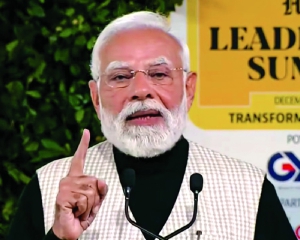
The Prime Minister exhorts the countrymen to move out of its demoralising influence fully and completely by 2035, when Macaulay’s strategic planning completes its 200 years in India. That the PM should be talking about it in all seriousness reaffirms once again the ingenuity and acumen in the futuristic educational planning contained in Macaulay’s Minutes of 1835, intended to cement English rule in India by demolishing Indian education and knowledge systems, hitting at the very roots of India’s history, culture, scriptures, and individual self-respect. One of the most well-established villains of Indian educational discourse in the post-independence era has been Thomas Babington Macaulay and the contents of his Minutes of 1835.
The great success of Macaulay in his mission is crystal clear: India acknowledges the need in 2025 to proceed in a national mission mode to move out of the influence of slavery and self-negation that has engulfed the Indian mind-set and persists even after independence, and the National Education Policies of 1968, 1986/92, and NEP 2020. The relevant challenge is to analyse why India could not wash off the influence of an alien strategy even after serious intentions to do so were expressed earlier in policies and by policymakers in their discourses.
The widespread impact of Macaulay’s ingenuity and foresight was so clinical, incisive, and widespread that it impeded the spread of the strength of the Indian knowledge quest to global knowledge and its civilisational contribution to the world outside. It was demoralisingly infectious to India and Indians, though vehemently beneficial to the empire. India needs to analyse it in the contemporary context and comprehend the strength of the ingredients contained in the Minutes of Macaulay that could transform the psyche of Indians and seriously injure a great tradition of knowledge quest. Not only this, it made Indians drift away from a sense of pride in their spiritually enriched culture that firmly believes that “Truth is one; the learned reveal it in various ways”.
Could we take a view on how to refurbish the sense of pride and inspiration in Indian culture to this day? The manner in which Sanatan is shamelessly despised, and even Vande Mataram is detested, says a lot about the inadequacies in the intent, civility, and culture of the admirers of Macaulay’s ingenuity and influence.
Macaulay, his ingenuity, and outcomes offer a great learning opportunity for policymakers and implementers working in the arena of education, culture, social cohesion, and religious amity in India. One insists on it while fully appreciating how seriously injurious but effective were his skills in demoralising an ancient people and making them shift their reverence to an alien and subjugating culture and language. The respect for the English language that traversed to every home and hearth in India-including the illiterate-owes it completely to this one-man ingenuity.
Even today, practically everyone in India is convinced that the passage to a better future lies in learning the English language. This is what made the PM mention why it is also necessary to refurbish linguistic pride, as that alone offers a sound basis for cultural renaissance. Why do we need to refer to Macaulay for it? Yes, we do, and we need to do so with real sincerity and commitment. Even after eight decades of independence and repeated emphasis in NEP 2020 on the mother-tongue medium, the rush for admissions to English-medium schools in the capital city of Delhi from day one of schooling is just rising-and rising further. It represents the national urge.
And why should it not be? In the first week of December 2025, the media reported that for 613 positions of assistant professors in Haryana government colleges, 17,195 candidates applied, but only 151 could clear the English qualifying test. In the SC category, only two out of 60 qualified. English separates them and prevents them from entering the system, which is their rightful constitutional due. This is just one of numerous instances that could be cited as the suffering inflicted by the craze for English that persists practically unsullied even after independence, in spite of assurances being made in favour of the mother-tongue medium.
The rush for English-medium private schools and the social upliftment it assures lucky families remains a queer phenomenon across the spectrum. The great rush for urbanisation has generated numerous socio-cultural contexts that indicate the urban mindset. Preferred housemaids are those with skills to place orders in English to home suppliers and read and understand items, expiry dates, etc., English being the preferred language of most malls and other home-delivery suppliers.
It was only a casual acquaintance with Macaulay in my university days, as I was studying and researching physics in the sixties of the last century. The compulsions of the English medium were naturally serious deterrents to most of us in acquiring the desired level of comprehension, forcing refuge in learning by rote. As one transitioned from physics to the arena of professional education, teacher education, and educational administration, one had to read Macaulay in detail and in depth. It became a professional requirement with increasing involvement and association with aspects such as curriculum development, teacher preparation, education policy formulation, and institution building. It was interesting to observe that everyone around-in institutions, meetings, and conferences-was keen to blame Macaulay for practically every misery that was thrust on India and its people by the British. Macaulay was “accepted” by practically most educationists and educators in India as the father of the doctrine: “To subjugate India, Indians must be delinked from India.” Macaulay’s Minutes of 1835 were implemented rather ruthlessly.
The English language, Western literature, Western civilisation, and culture were to be firmly established in India as the only path to becoming advanced and superior human beings. Not that everyone who mattered agreed, as some were interested in supporting Sanskrit and Arabic, but they were ignored and left to their fate under the argument that these needed financial support, while English schools had a rush of fee-paying students from the upper echelons of society. It is a long story that has established Macaulay even in schemes of futuristic educational planning.
He succeeded in creating “a class of people, Indians in blood and colour, but English in tastes, in opinions, in morals, and in intellect.” Over the last eight decades, India could not wriggle out of the clutches of the “Western cultural superiority syndrome”. Will the PM’s call make a difference? It could, only if serious efforts are initiated urgently to transform the institutional work culture in a mission mode. Further, individual inspiration and recognition could work wonders. NEP 2020 has the strength to achieve the target indicated by the PM within ten years. There are, however, certain basic systemic requirements to do so: cleaning up the regulatory mechanism, streamlining teacher recruitment systems, filling up all vacant teaching positions, appointing succeeding heads of institutions one month before the incumbent relinquishes charge, and imposing a strict ban on irregular, low-honorarium-based teachers at every stage.
The author is an educationist, a Padma Shri awardee, and works in religious amity and social cohesion; views are personal