Strengthening India’s own research, data, and policy capacity is key to shaping a development model rooted in national priorities
- Ravi Pokharna and Kuntala Karkun
India's Viksit Bharat aspiration by 2047 transcends traditional capital investment. While tangible infrastructure remains critical, the primary constraint to sustained, high-quality growth is the knowledge ecosystem deficit. To successfully transition from a middle-income economy to a fully developed nation, India must aggressively cultivate a robust, home-grown intellectual infrastructure, one encompassing R&D, credible think tanks, advanced data infrastructure, and scalable domestic innovation capacity.
India’s R&D Gap: The Core Structural Weakness
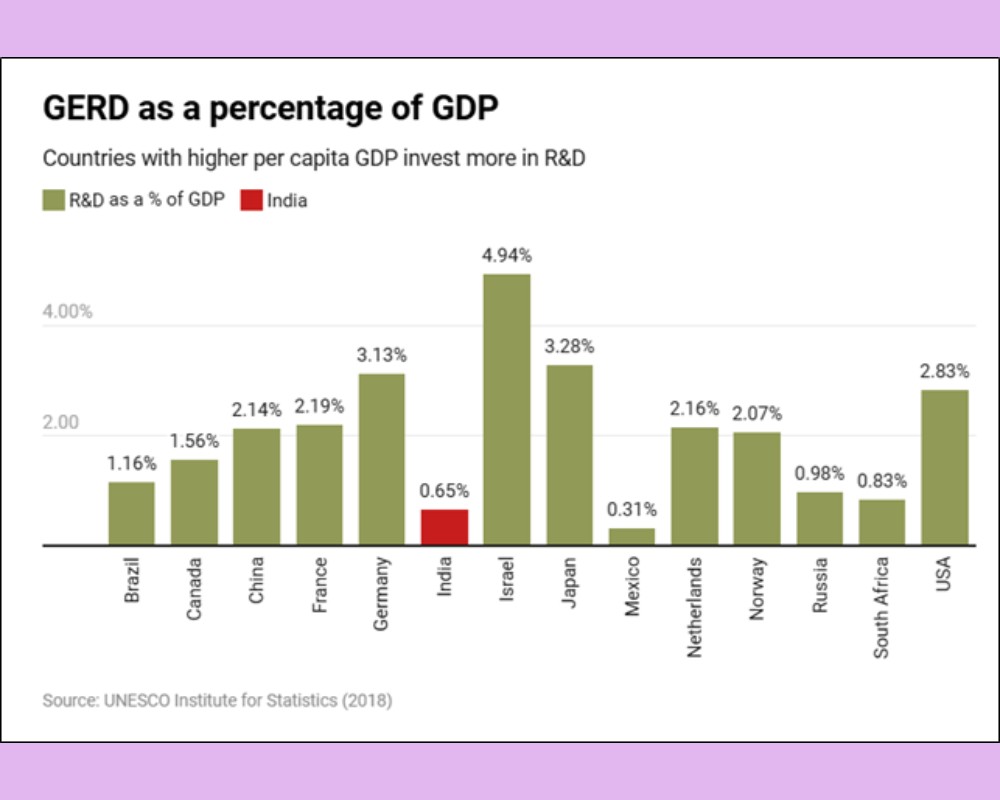
India’s gross expenditure on R&D (GERD) remains persistently low at just 0.65 per cent of GDP, far below advanced economies such as the US and Germany (3 per cent), as well as emerging markets like China (2 per cent). This places India well under the global average of approximately 1.8 per cent, reflecting a structural underinvestment in innovation.
This structural weakness is compounded by a profound imbalance: only about 5 per cent of India's R&D spending comes from the private sector, compared to approximately 70 per cent in the US. While the 2025–26 Union Budget increased national R&D allocations to ?61,028 crore, representing only 1.28 per cent of the Central Budget, the scale is still insufficient to trigger the kind of innovation acceleration India needs. The government’s announcement of a ?1 lakh crore Research Development and Innovation (RDI) Fund in 2025 could be transformative, but its impact will hinge on execution discipline and meaningful alignment with private-sector investment. For the fund to succeed, execution discipline must include transparent governance, mandated industry co-funding, and a focus on measurable outcomes tied to national priorities.
This chronic underinvestment depresses innovation output, technological absorption, and productivity growth. OECD studies show that a 1 per cent rise in business R&D increases productivity by approximately 0.13 per cent, and an equivalent increase in public R&D yields about 0.17 per cent productivity growth. If India does not correct its R&D deficit, it cannot realistically close its productivity gap with peer economies.
Innovation Momentum Exists, but the Base Is Narrow
India’s innovation output has improved. Patent grants have grown fourfold, from 7,509 (2010–11) to 28,391 (2020–21), and patent applications have risen from approximately 39,400 to 58,500 (Economic Survey 2022). In 2023, India was among the fastest-growing patent origins globally (WIPO).
The gap, though, remains large. India’s patent portfolio is still only a small fraction of China’s or the United States’, and over 70 per cent of high-quality publications come from fewer than 200 institutions, signalling an ecosystem that is still narrow, institutionally shallow, and highly concentrated.
Yet India has proven that strategic investments yield transformative outcomes. ISRO’s space programme, built on modest budgets and indigenous capabilities, has delivered world-class missions such as Chandrayaan and Mangalyaan, at a fraction of global costs. India’s digital public infrastructure (DPI) has revolutionised financial inclusion and service delivery, now serving as a model for developing nations worldwide. These successes demonstrate that when India invests in knowledge systems with clarity and commitment, the results can leapfrog conventional development paths.
Talent is not the constraint. Institutional depth is.
Why Domestic Think Tanks and Knowledge Institutions Matter
A successful knowledge ecosystem requires more than isolated R&D labs; it needs the systemic translation of research into actionable policy and practice. Strong, independent domestic think tanks, policy centres, and data institutions are critical for:
- Contextualisation: Bridging the gap between academic research and on-the-ground implementation, generating timely, granular, India-focused data for evidence-based governance, which global firms often lack.
- Diffusion: Ensuring technology and best practices are adapted and diffused to MSMEs and lagging regions, mitigating the concentration of innovation within a few large firms or urban centres.
- Intellectual sovereignty: Protecting India’s development agenda from being shaped by foreign-funded or non-contextual research, offering a cost-efficient alternative to large, protracted global consulting engagements for structural and social reforms.
India’s current policy research landscape remains fragmented. While NITI Aayog plays an important role in policy formulation, the broader ecosystem of independent think tanks and research institutions operates at a limited scale with constrained resources. Many rely heavily on project-based funding or external grants, limiting their ability to pursue long-term, strategic research agendas.
Global studies show that a 1 per cent increase in R&D intensity typically delivers a 0.13–0.17 per cent annual boost in productivity growth (OECD). Raising R&D spending could help India break into the upper-middle-income bracket, strengthen industrial competitiveness, and power high-skill job creation in advanced manufacturing, digital technologies, biotechnology, artificial intelligence, and clean technology.
A Policy Playbook for Viksit Bharat
To realise this vision of a home-grown knowledge economy, policymakers must act with long-term focus. Key steps should include:
- Raise R&D investment to globally competitive levels. Set a clear national target for R&D intensity, for example, gradually increasing from approximately 0.65 per cent to at least 2 per cent of GDP by 2047, with an increasing share from the private sector. This will require not only higher government outlays but incentives such as tax credits, grants, and public–private partnerships for industry R&D.
- Institutionalise long-term funding for domestic think tanks and policy research bodies. Create a dedicated Viksit Bharat Knowledge Fund or similar endowment, allowing multi-year grants, seed funding for new institutions, and stable operating resources.
- Build a National Knowledge Ecosystem. Link universities, research institutes, think tanks, industry, and government in a network that facilitates research, innovation, technology transfer, policy formulation, and diffusion of knowledge, especially to MSMEs and lagging regions.
- Promote technology diffusion beyond large firms. Provide support for smaller firms and regional enterprises to adopt or adapt technologies through subsidies, incubation, outreach, and technical assistance.
- Expand the notion of a “domestic Big Four” beyond consulting firms. Encourage the emergence of large, credible, Indian-owned knowledge institutions and think tanks that can compete globally in consultancy, policy research, data analytics, design, and technology transfer.
The Private Sector Must Step Up
India’s CSR spending has grown sharply, from ?26,278 crore in FY22 to ?34,909 crore in FY24 (Bharat CSR Performance Report, 2024), yet less than 3 per cent of this pool supports research, policy, or knowledge infrastructure. Redirecting even 5–10 per cent of CSR funding towards knowledge creation, such as think tanks, public data systems, applied research labs, and digital public goods, would significantly strengthen India’s intellectual capacity.
In parallel, industry must deepen its own R&D investment by leveraging fiscal incentives, building in-house research capabilities, and expanding industry–academia collaboration. Together, these shifts would reduce dependence on imported technologies and external consulting while building the long-term competitiveness required for India’s innovation-driven growth.
Knowledge as National Strategy
For India to become a developed nation, it must invest as much in brains, ideas, and institutions as in roads, ports, and industrial parks. Countries that mastered the knowledge game—South Korea, Germany, and Japan—used it to leapfrog into high-growth, high-productivity, high-innovation economies. India’s story must now follow that path.
Viksit Bharat requires Viksit Buddhi; a developed nation needs developed minds. The time to build is now.
Ravi Pokharna is Executive Director at Pahle India Foundation & Kuntala Karkun is a
Senior Fellow at Pahle India Foundation