India stands at a defining juncture in its clean-energy transformation. Guided by the Panchamrit commitments announced by Hon’ble Prime Minister Shri Narendra Modi ji at COP26, the country has set for itself some of the world’s most ambitious climate goals: 500 GW of non-fossil fuel capacity by 2030, meeting half of its energy requirements from renewables by the same year, reducing projected carbon emissions by one billion tonnes, cutting carbon intensity by 45 per cent, and ultimately achieving Net Zero by 2070. These targets are not distant aspirations; they form the backbone of a nationwide movement that is steadily gathering momentum.
India’s progress in renewable energy over the past few years has been nothing short of remarkable. The country has already crossed the milestone of achieving 50 per cent of its total installed power capacity from renewable sources, with the renewable energy portfolio now reaching an impressive 259 GW. Solar and wind continue to drive this growth with record annual capacity additions. The rise of ultra-mega solar parks, hybrid renewable corridors, offshore wind zones and floating solar plants reflects a sector in rapid evolution. Yet, complementing these large-scale investments is an equally important push for distributed solar, one that brings clean energy directly to households, farmers and communities.
Two flagship programmes of the Government of India underscore this vision. The PM Surya Ghar: Muft Bijli Yojana, launched by the Hon’ble Prime Minister, is propelling rooftop solar to an unprecedented scale. With a target of one crore household installations and subsidies streamlined through a single national portal, residential solar has moved from novelty to mainstream, easing electricity bills and empowering families to become producers of clean energy.
Similarly, the PM-KUSUM scheme has emerged as a transformative initiative for India’s farmers. By solarising agricultural pumps, both standalone and grid-connected, and enabling decentralised renewable plants in rural areas, the scheme reduces diesel dependence, stabilises farm incomes and supports climate-resilient agriculture. Thousands of farmers across the country have already benefited, turning agricultural fields into clean-energy hubs.
However, as India accelerates renewable capacity growth, the challenges associated with bulk RE-intermittency, long-distance transmission requirements, land availability and rising grid congestion-highlight the need for innovative, decentralised energy models. Distributed generation, especially rooftop and community-level solar, is proving to be a powerful solution. By producing electricity where it is consumed, it reduces network stress, improves voltage stability, cuts transmission losses and significantly lowers infrastructure costs for power utilities. The future of India’s renewable strategy will depend on striking the right balance between utility-scale projects and widespread community-level solarisation.
This becomes particularly relevant for missions such as the Jal Jeevan Mission (JJM), which aims to ensure clean tap water for every rural household. Water supply systems depend heavily on energy-intensive pumping infrastructure. Solarising these assets offers dual benefits: substantial cost savings for departments and uninterrupted service delivery for communities. It is against this backdrop that a noteworthy clean-energy initiative has emerged from Old Goa, showcasing how renewable power can strengthen essential public utilities.
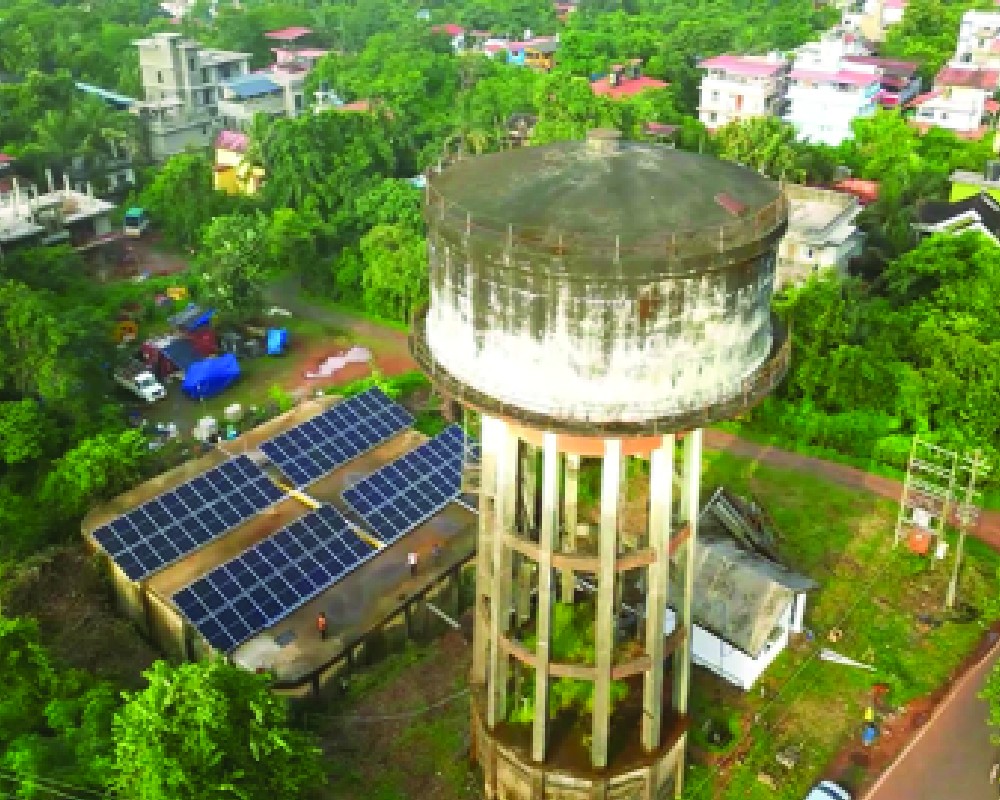
At the pumping station near Podar School in Old Goa, a pioneering solar project has been implemented under the CSR support of IREDA, a PSU under the Ministry of New and Renewable Energy. The facility, which operates 60 HP pumps to lift water from a ground-level sump to an overhead tank, generally functions between 9 am and 1 pm, coinciding perfectly with peak solar generation hours. By integrating a 45 kW solar plant with net-metering capability, the station not only meets its daytime energy needs but also exports surplus clean power to the grid.
The impact has been significant. The Drinking Water Department now saves nearly `4.0 lakh annually in electricity expenditure, while revenue from surplus energy generation further strengthens its operational budget. Environmentally, the system offsets close to 45 tonnes of CO? every year, equivalent to the carbon absorption of more than 2,050 mature trees. Nearly 650 residents now rely on a water supply system powered substantially by renewable energy. With a project cost of `28 lakh, a payback period of seven years and a system life of around 25 years, the initiative will continue delivering free, clean electricity for nearly two decades after cost recovery — an exemplary model of sustainable public infrastructure.
The success of this project reflects the foresight and commitment that guide my efforts to strengthen essential public services through clean and sustainable energy solutions. These efforts are deeply inspired by the broader national vision shaped by Hon’ble Prime Minister Shri Narendra Modi ji, under whose guidance India has emerged as a global front-runner in renewable energy adoption. At a time when cities across the world struggle with deteriorating air quality, such grassroots initiatives demonstrate how local innovation can drive both environmental protection and community development.
The solarisation of the Old Goa pumping station is more than a technical upgrade; it is a blueprint for India’s sustainable future. As the nation marches towards its Net Zero commitment, the next phase of growth must lie in harnessing renewable energy for unconventional, often overlooked applications such as water supply systems, government buildings, rural institutions, agricultural infrastructure and community assets. Each such project not only reduces the burden on the grid but also brings clean energy closer to the people it serves. India’s clean-energy journey is ultimately a collective one. With the right blend of visionary leadership, technological innovation and community participation, projects like the one in Old Goa will become the cornerstone of a greener, more resilient and more inclusive future.
The writer is the Union Minister of State for Power and New and Renewable Energy, Government of India; views are personal