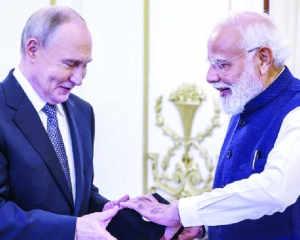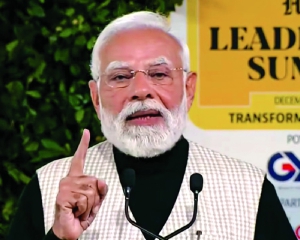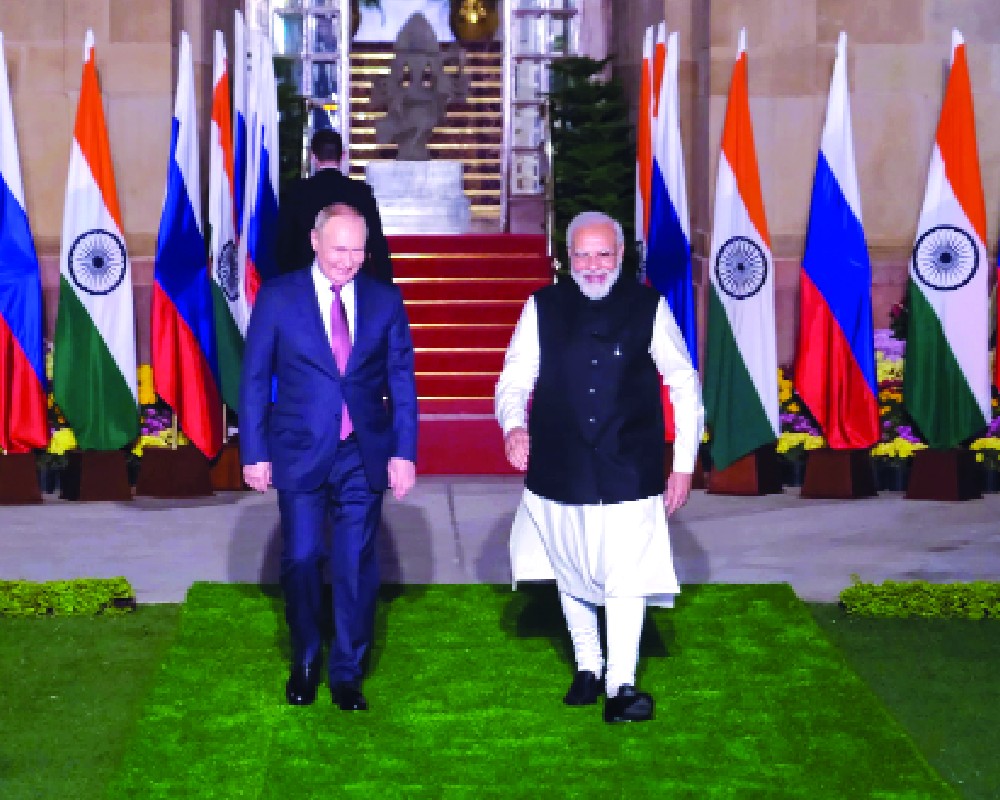
That was no ordinary greeting; on the frosty evening of last Thursday, Indian Prime Minister Modi embraced Russian President Vladimir Putin in a bear hug at Delhi airport and, within moments, presented him with a copy of the Bhagavad Gita in Russian. The choice of gift was laden with symbolism-echoes of Robert Oppenheimer, who drew profound philosophical reckoning from the same text, declaring, “Now I am become Death, the destroyer of worlds,” after witnessing the first atomic explosion. Was Modi signalling the weight of nuclear-age responsibility to Putin, or was this a deliberate affirmation of India’s comfort in maintaining ties with a pariah state under global sanctions?
The streets of Delhi, festooned with Russian and Indian flags and dominated by colossal billboards of Modi and Putin, suggested more than ceremonial protocol-it was pageantry of influence, an audacious statement of India’s strategic independence. In that gesture, New Delhi appeared to assert that moral judgement from the West would no longer dictate its choices, and that the Indo-Russian relationship, forged during the Cold War and hardened by decades of defence dependence, remains a pivot capable of unsettling the established order in South Asia and beyond.
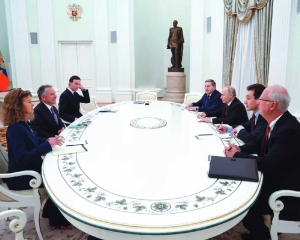
Putin’s first visit to India in four years, coinciding with talks in Washington over a possible Ukraine peace framework, came at a time when New Delhi is walking an increasingly delicate tightrope between Moscow and Washington. The optics of the visit-from ceremonial receptions at Rashtrapati Bhavan to summit talks at Hyderabad House-reflected not merely diplomacy but an overt projection of influence. Modi’s presentation of the Bhagavad Gita in Russian was emblematic: a centuries-old text of dharma and duty, layered with the moral weight of choice, now inserted into the theatre of high-stakes realpolitik.
Putin himself, in an interview with India Today, described India as a “major global player, not a British colony,” praising Modi as a “reliable person” who does not succumb to pressure. These words, spoken against the backdrop of US sanctions, EU manoeuvres to leverage frozen Russian assets for Ukraine, and growing Chinese assertiveness, highlight India’s determination to claim agency in a multipolar world where Washington and Brussels no longer set the rules unilaterally.
Historically, the Indo-Russian relationship has oscillated between strategic necessity and opportunism. Declassified CIA documents from the 1980s reveal the delicate dance India played with the USSR during the Cold War. Indira Gandhi’s approach, as the CIA observed, was staunchly nationalist and fiercely protective of India’s regional supremacy. The United States feared that India’s policies towards its neighbours, coupled with its Soviet alignment, could destabilise South Asia while simultaneously granting Moscow a strategic foothold. Today, the echoes of that era reverberate: New Delhi remains Moscow’s top arms buyer, leases nuclear-powered submarines, and maintains energy ties that have drawn ire from Washington, while ensuring that its engagement with Russia does not fully alienate the United States or Western partners.
What is important to note here are the economic metrics. India-Russia trade in FY 2024-25 amounted to approximately USD 68.7 billion, heavily skewed in Moscow’s favour due to energy imports, with a trade deficit of around USD 59 billion. Both Russia and India aim to expand bilateral trade to a target of USD 100 billion by 2030, a goal that falls just two years after the next general elections, when Prime Minister Modi is widely expected to contest again despite the symbolic 75-year age limit for party leadership-a restriction largely treated as political theatre and quickly forgotten. Meanwhile, India continues to negotiate with the United States to mitigate punitive tariffs, including a 25 per cent secondary tariff imposed on India’s purchases of Russian oil. It is also worth noting that India recorded a goods trade surplus of about USD 41.18 billion with the US in FY 2024-25, with exports of USD 86.51 billion and imports of USD 45.33 billion, reflecting strong bilateral trade despite earlier concerns over tariffs. Remittances provide a partial counterweight: total remittances to India reached roughly USD 135.46 billion, including USD 25-30 billion from the US, while Russian remittances are negligible in comparison. This indicates that while India faces challenges in trade metrics, its diaspora injects substantial financial resilience into the economy.
The summit also highlighted defence collaboration in stark terms. India’s USD 2 billion lease of a Russian nuclear-powered attack submarine, with delivery scheduled for 2028, signals an unprecedented deepening of underwater capabilities.
The vessel, unable to enter combat under lease terms, is intended to train crews and refine India’s nuclear submarine operations — a critical step for strategic deterrence in the Indian Ocean amid rising Chinese and US naval competition. Russia, despite sanctions and Western pressure, continues to sustain a military-industrial complex capable of producing tanks, missiles, and drones at accelerating rates. As reports from Ukraine’s Centre for Analytical Studies and Countering Hybrid Threats indicate, nearly half of Russian defence enterprises remain unsanctioned, exposing the limitations of Western punitive measures. In this context, India’s engagement with Russian defence capabilities is both a practical necessity and a symbolic assertion that strategic imperatives can outweigh Western orthodoxy.
Sanctions, however, remain a persistent backdrop. The European Union, under Ursula von der Leyen, has attempted to deploy emergency measures to convert frozen Russian assets into loans for Ukraine, challenging EU treaties and raising the prospect of legal confrontations with countries such as Hungary and Belgium. The United States, meanwhile, has explored using the same assets in US-led investment frameworks to facilitate reconstruction or political leverage. India, observing these efforts, has maintained a stance of strategic neutrality-resisting calls to condemn Russia while advocating for diplomacy, and emphasising that selective sanctioning by Western powers is inconsistent and self-serving. Putin, speaking to India Today, noted that Washington and Moscow presented papers in parallel but reached no compromises, and highlighted that over 90 per cent of Russia-India transactions are conducted in national currencies-a subtle yet potent challenge to dollar dominance.
The optics extend into nuclear and high-tech collaboration. India is developing nuclear-capable submarine-launched ballistic missiles, advancing its underwater fleet, and exploring high-tech partnerships with Russia, recalibrating the strategic environment in South Asia. Putin’s rhetoric that “Kiev is the mother of all Russian cities” and his framing of Russia’s role in eastern Ukraine resonate with historical narratives of great power assertion, yet they also serve as a conscious projection of strength aimed at partners like India. Modi’s reception was far from ceremonial; it underlined a shared understanding that global power is increasingly multipolar and that alliances must be flexible, resilient, and insulated from Western censure.
Even in the economic sphere, India challenges conventional assumptions. While the trade deficit with Russia persists due to energy imports, India’s broader engagement with global markets-including remittances from its diaspora and ongoing negotiations with the US-allows New Delhi to balance sovereignty with strategic interest. Putin’s discussions
emphasising bilateral trade growth, high-technology collaboration, and future energy projects further solidify this interdependence. The bottom line is clear: the India-Russia partnership, far from being a relic of Cold War calculations, has evolved into a sophisticated framework for navigating sanctions, economic competition, and regional security challenges, and it may yet redefine the balance of power in South Asia.
The writer is a Colombo based Columnist; views are personal