Amidst when the world climate change negotiators are busy pulling wires in Brazil at the UNFCCC CoP 30 summit, the world, especially those suffering most from climatic vagaries, is watching to see if there is a thaw between the divergent positions of developed and developing countries, especially in truly adhering to the cardinal principle of common but differentiated responsibilities. But this is a matter to be dealt with separately.
As this writer has been repeatedly warning government negotiators and policy makers about charting out South-South climate-resilient developmental planning to ward off the deleterious effects of climate change on the environment, especially on food, nutrition and water security of billions of people, Brazil’s Tropical Forest Forever Facility (TFFF) climate change fund of $125 billion to support tropical forests through government and private contributions, spending $4 per hectare on improving forests, is a welcome move. Brazil herself has committed $1 billion to this fund. India has supported it in principle. The fund may help in water and biodiversity conservation.
However, India should take the lead in focusing on creating a fund in collaboration with China and the Group of 77 to conserve and manage water for better climate management, as the temperature has already crossed the 1.5 degree Celsius threshold this year, as reported by Carlo Buontempo, the Director of the European Climate Agency Copernicus, and this is going to severely impact world hydrology. If India can take a lead as it did in creating the ‘Solar Alliance’ by creating a water conservation fund, forests will automatically be taken care of.
As the world is literally sitting on a hot spot, notwithstanding these CoPs, which are hilariously optimistic without any substance of change, we in India need to take drastic action at the level of civil society as well as in government, with a bottom-up innovative approach from the village level to the national level.
Already, the Water for Every Household scheme launched in 2019 by the Prime Minister is a resounding success with community participation and has provided almost 78.58 per cent (15.56 crore out of 18 crore) households access to tap water connections, compared to around 7 crore earlier, before 2019. Let us substantiate water conservation from the examples created by our civil society.
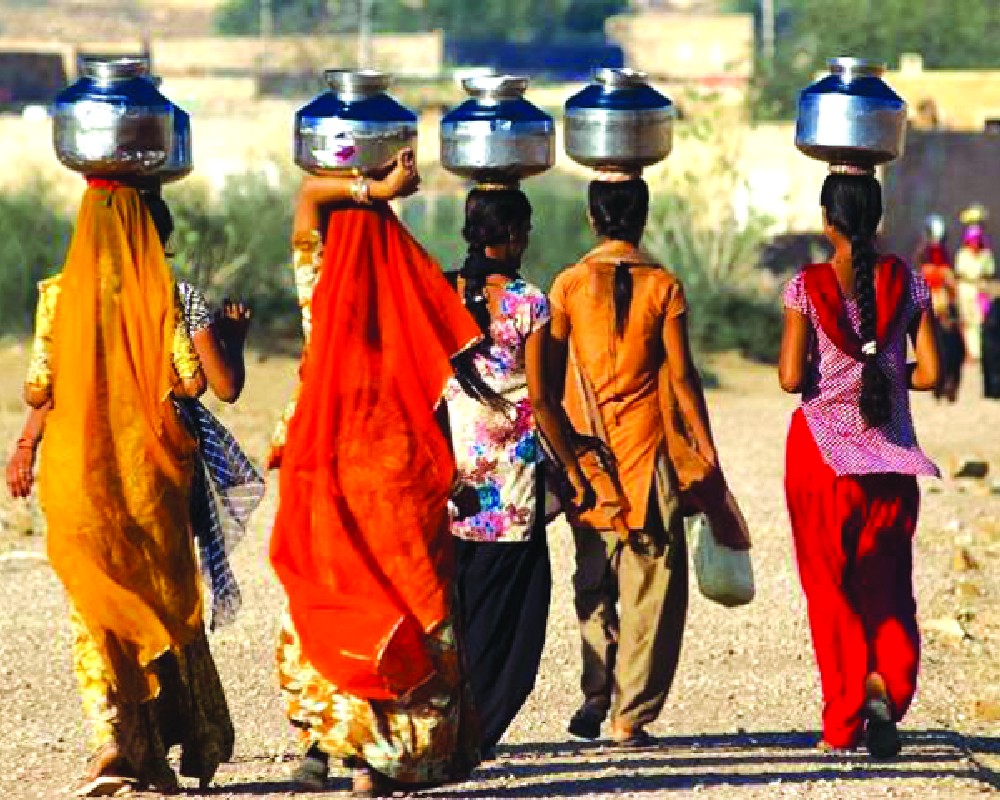
The water availability study done by the Central Water Commission using space inputs (2019) assessed the average annual per capita water availability for the years 2021 and 2031 as 1,486 cubic metres and 1,367 cubic metres respectively. Annual per-capita water availability of less than 1,700 cubic metres is considered a water-stressed condition, whereas annual per-capita water availability below 1,000 cubic metres is considered a water-scarcity condition. The country’s rivers run dry, aquifers deplete, and millions face seasonal scarcity, underscoring the urgency of sustainable practices.
So, we need to look into our countryside to search for water warriors beyond government programmes. The country has shown time and again that our society produces leaders from the grassroots level, from the freedom struggle to tree conservation through the world-famous Chipko Movement, to now “sow seed to get water” (pani bao pani pao) launched successfully in Uttarakhand by Mr Mohan Kandpal and others elsewhere in the country. This has become amply clear in the 2025 Water Awards announced by the Ministry of Jal Shakti, Government of India. These water warriors brought to fame this year have shown how a public movement can change the countryside scenario drastically.
This writer, while in the Planning Commission, had in 2010 assessed the great work done by Popat Pawar in the Hiware Bazar village in Ahmednagar district of Maharashtra, turning a ghost village into one bubbling with prosperity solely due to water harvesting in adjoining forests under the Joint Forest Management programme, resulting in huge agricultural and milk production.
In this context, water conservation awards serve as beacons of hope, spotlighting grassroots innovators, communities and institutions that transform despair into resilience. These examples celebrate individual and collective triumphs but also produce scalable models, fostering a culture of stewardship. The National Water Awards, recognising innovations, have galvanised action, proving that local ingenuity can recharge ecosystems and empower marginalised sections who have been facing acute water stress.
This year’s awards were announced and conferred by President Droupadi Murmu on November 18, 2025 at Vigyan Bhawan, New Delhi, and honoured 46 winners — a 30 per cent increase from prior years. These honours were backed by field
verifications from the Central Water Commission and the Central Ground Water Board.
At the heart of this narrative stands Mohan Chandra Kandpal, a 59-year-old chemistry teacher from Kande village in Uttarakhand’s Almora district, whose lifelong crusade earned him the Best Individual (North Zone) award. For 36 years, Kandpal has traversed the fragile Himalayan foothills, where deforestation and erratic monsoons have rendered ancient springs and traditional stone reservoirs dry. Fate struck him in 1990 when he observed the Riskan River’s tributaries dwindling amid drought coupled with soil erosion. He resolved to act and launched “Pani Bao-Pani Uggao” (Sow Water-Grow Water), a masterstroke that charged women and youth
into action, blending this rhetoric with indigenous community wisdom and mobilisation.
Kandpal’s strategy hinges on khals and chaals-shallow percolation pits that capture runoff, allowing rainwater to recharge aquifers. Between 1990 and 2012, he spearheaded the digging of thousands, coupled with afforestation drives planting over 100,000 saplings of native species like oak and rhododendron. People changed ploughing techniques in agricultural fields to till perpendicular to slopes, creating furrows that channel water deeper into the earth rather than letting it run off. This low-cost tweak, disseminated through farmer workshops, amplified recharge efficiency. By 2025, over 5,000 such structures dotted 40 villages, reviving 27 depleted sources in hamlets like Valna, Bitholi, Kande and Ganoli. Complementing this is the “Woh Pani Hoga” (That Water Will Be There) initiative, which has bolstered the Riskan River’s flow, turning seasonal streams perennial. It was purely a public programme, though MGNREGA funds might have been dovetailed.
Another well-known example is Dr Rajendra Singh, the original “Waterman of India”, whose 50-year odyssey in Rajasthan’s arid heartland earned the 2001 Ramon Magsaysay Award and the 2015 Stockholm Water Prize-the “Nobel of Water”. Singh revived over 1,000 villages by resurrecting more than 8,600 johads (earthen check dams) and bamboo drip systems in the Aravalli hills, and by targeting the parched Alwar district he started “Pani Panchayats” — village water parliaments-thus democratising resource governance. The results are visible: five rivers now flow perennially across 6,500 sq km, enabling afforestation of 1.5 million trees and the repopulation of ghost villages.
Yet another example is from Bihar’s flood-prone plains, where Kishore Jaiswal, a Munger-based activist, bagged the Best Individual (Eastern Zone) award for desilting the Ganga’s tributaries. He, with the NGO Jalsrot Vikas Sansthan, mobilised 20,000 volunteers to remove five lakh cubic metres of silt from the Chandan River, restoring flow to 100 villages.
In another example of social institutions, the Art of Living Social Projects received two awards for reviving more than 50 lakes in Karnataka and Tamil Nadu through yoga-integrated clean-ups, impacting one million lives. The Barmer district administration also bagged the rainwater harvesting award, which was received by the District Collector, Tina Dabi. If each block of the country does this, prosperity and progress with climatic adaptation will be at our doors and happiness on the faces of millions of rural masses. These people have shown, in a much better manner, how to tackle climate change in tandem with communities than the big CoPs of the UNFCCC.
The writer is a former Principal Secretary and Agriculture Production Commissioner, Government of Tripura; views are personal