Legal experts and leaders of some opposition-ruled states on Thursday expressed mixed views on the Supreme Court’s opinion on the Presidential Reference that no timelines can be prescribed for governors and the president in granting assent to bills passed by assemblies.
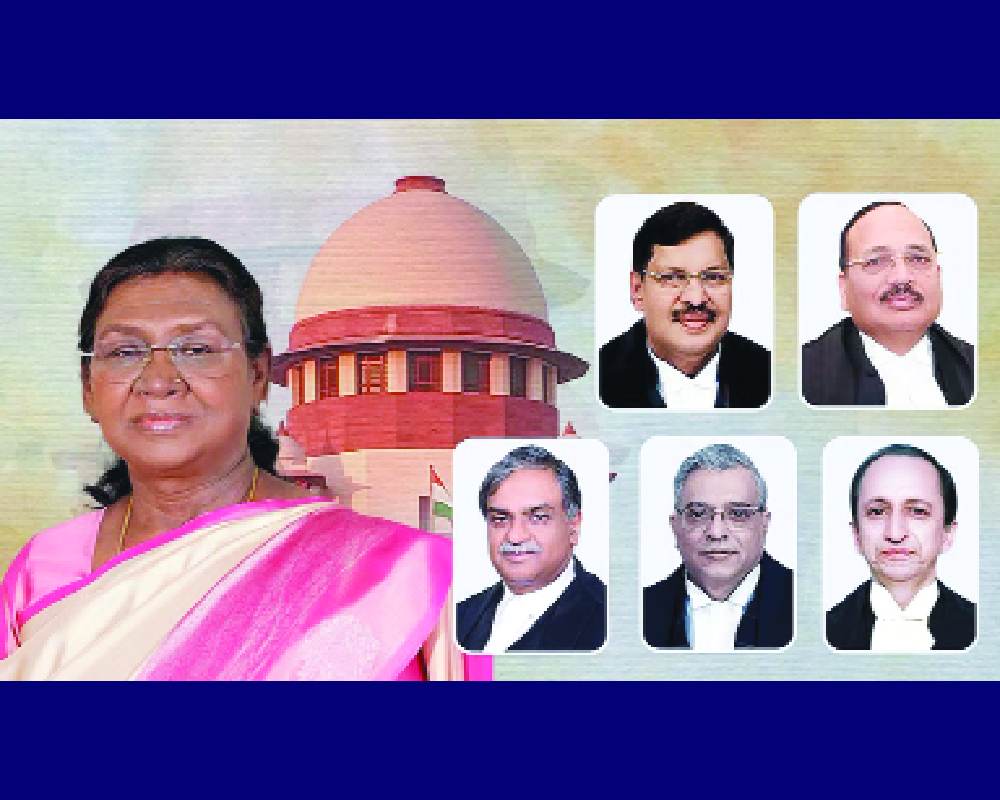
A five-judge Constitution bench headed by Chief Justice BR Gavai held that the court cannot impose any timelines on governors and the president to grant assent to bills passed by state assemblies but at the same time said the governors do not have “unfettered” powers to sit on the bills for “perpetuity”.
The Communist Party of India (Marxist) General Secretary, MA Baby, said the Supreme Court’s response to the Presidential Reference on timelines to grant assent to Bills was “deplorable and shocking”. In an X post, the CPI(M) general secretary said, “The Supreme Court’s answer in response to the Presidential Reference is deplorable and shocking. Courts should not hesitate to play a meaningful role in ensuring proper checks and balances between the Legislature, the Executive and the Judiciary.” Baby said that while on one hand the Supreme Court has said that timelines cannot be set for granting assent to bills, on the other, it said that the court can exercise a “limited power of judicial review to direct the governor to decide in a time-bound manner”.
“Now, who will decide what is a time-bound manner?!! Judiciary should not absolve itself of its constitutional responsibility,” Baby asked.
Reacting to the Supreme Court’s judgment, West Bengal Assembly Speaker Biman Banerjee said a bill loses significance when it remains stuck without clarity, adding that he “personally feels” that a fixed timeline should be laid down for governors to clear bills. He argued that keeping legislation pending indefinitely defeats the purpose of lawmaking and leaves elected governments in limbo. The ruling DMK in Tamil Nadu on Thursday termed the verdict of the Supreme Court on governors as a “good judgment” and that it would be useful in other cases involving the powers of the gubernatorial post. Senior DMK leader TKS Elangovan said that if the State assembly elected by the people of Tamil Nadu had passed a resolution, the governor has to accept it.
Communist Party of India (Marxist) general secretary M A Baby said the Supreme Court’s response to the Presidential Reference on timelines to grant assent to bills was “deplorable and shocking”. Reacting to the Supreme Court’s opinion, senior advocate Vikas Pahwa said the ruling effectively rolls back the “rigid timelines” of three months for the constitutional functionaries imposed in April by a two-judge bench of the Supreme Court.
“While the Supreme Court continues to guard against prolonged, unexplained and indefinite delays in clearing the bills, it duly respects the governor’s and president’s constitutional discretion — allowing more space for dialogue, rather than forcing every decision into a judicially mandated deadline,” he said. Terming the opinion as a “corrective intervention”, Pahwa said the April 8 verdict had sought to curb the “pocket veto” or permanent inaction by the governors “but, in doing so, arguably pushed the judiciary into micromanaging constitutional actors”.
He said the opinion of the Constitution bench restores a more balanced approach.
On the fate of the 10 Tamil Nadu legislations, which were granted deemed assent by the Supreme Court on April 8 by exercising its plenary power under Article 142, senior advocate Amit Anand Tiwari said all those bills have become laws and are already notified in the Gazette. “The opinion rendered in the Presidential Reference will have no impact on the Acts which have already been notified in pursuance of the judgment dated April 8, 2025,” he said. Justice J B Pardiwala-led bench on April 8 had granted deemed assent to 10 Tamil Nadu bills.
The bills, which have now become laws, included amendments to the Tamil Nadu Fisheries University Act, Tamil Nadu Veterinary and Animal Sciences University Act, Chennai University Act and Tamil Nadu Dr. Ambedkar Law University Act. Tiwari said the April 8 verdict in the Tamil Nadu case has attained finality. He referred to a judgment to buttress his point that the subsequent advisory opinion of the Supreme Court on a Presidential Reference cannot overturn the earlier judgment.
However, the Supreme Court’s opinion referred to the views of Justice Y V Chandrachud in a 1978 Presidential Reference case in which he had held that all the courts are bound by the view expressed by the Supreme Court “even in the exercise of its advisory jurisdiction under Article 143(1) of the Constitution”.