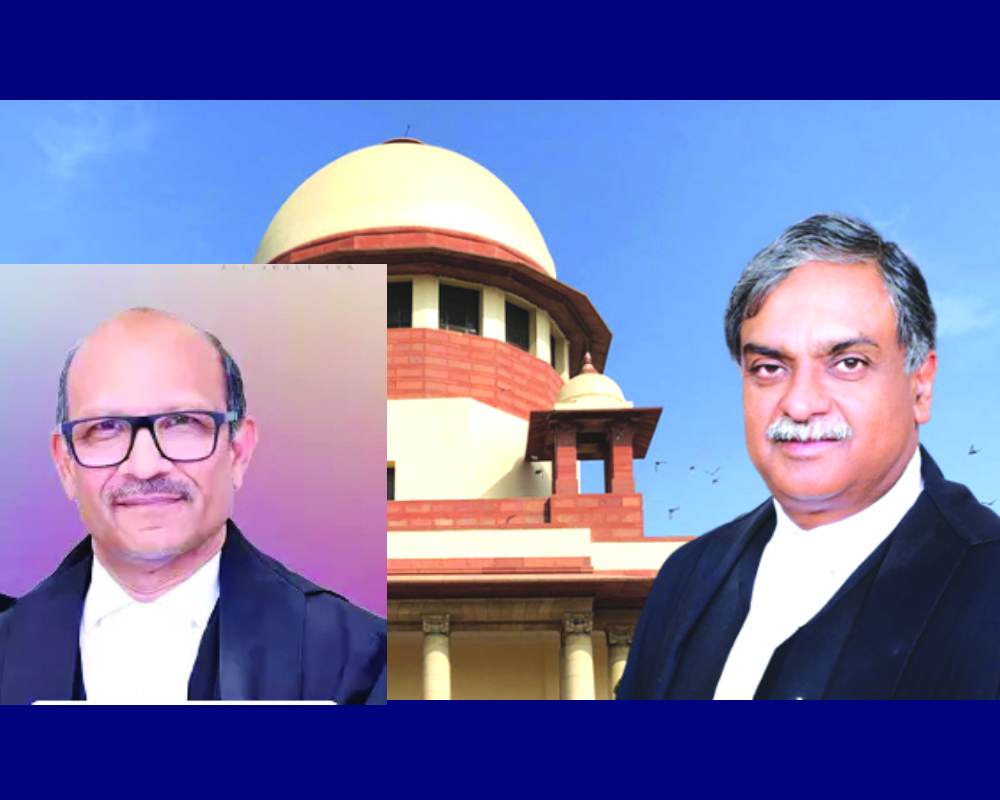
In a diverse judgment within weeks, the Supreme Court’s another bench on Tuesday held that One Time Settlement (OTS) with banks is not a ground for quashing criminal cases. Holding that economic offences undermine public interest far beyond the immediate financial loss to a bank, the apex court has restored criminal proceedings against M/s Sarvodaya Highways Ltd and its directors in a loan fraud case involving approximately Rs 52.5 crore. A Bench of Justice Vikram Nath and Justice Sandeep Mehta ruled that a one-time settlement (OTS) with the bank cannot justify quashing a prosecution where forged documents were allegedly used and a clear loss to the public exchequer is evident.
Meanwhile, in a curious development, another Bench comprising Justices JK Maheshwari and Vijay Bishnoi on November 19 allowed the fugitive Chetan-Nitish Sandesara brothers’ firms to deposit Rs 5,100 crore as OTS in the Registry by December 17 to avoid all cases, including criminal cases registered by various probe agencies. The apex court was agreeing to the Central Government, which submitted the OTS scheme, including withdrawing all cases in a sealed cover, on November 18. With this order Supreme Court has allowed fugitive Sandesara brothers and their Sterling Group to go scot-free from all criminal cases filed by CBI, ED, and Income Tax related to bank loan frauds by paying Rs 5,100 crore, which is only 1/3 of the dues.
On Tuesday, in a diverse order, a Bench of Justice Vikram Nath and Justice Sandeep Mehta set aside a 2022 judgment of the Punjab and Haryana High Court, which had quashed the CBI case after the company paid Rs 41 crore under an OTS with the State Bank of Bikaner and Jaipur (now SBI). Allowing the CBI’s appeal, the Court noted that the settlement amount was significantly lower than the actual liability and was accepted by the bank under compelling circumstances typical of recovery processes in NPA cases.
The case involved offences under Section 120B (criminal conspiracy) read with Sections 406(criminal breach of trust), 420(cheating), 467, 468,471(forgery, fabrication, etc) of the Indian Penal Code, 1860, and Section 13(2) read with 13(1)(d) of the Prevention of Corruption Act, 1988. Corruption case can’t be quashed on settlement. Referring to established precedents, the Bench observed that economic offences are not private disputes capable of compromise.
“There is are plethora of judgments of this Court, some of which we have referred to above, which categorically hold that in cases involving economic offences, it is not merely the Bank that stands defrauded, but society at large is also impacted.” The Court stressed that one-time settlements, by their very nature, do not represent full recovery. In this case, while the bank recovered around Rs 41 crore, the outstanding liability was approximately Rs 52 crore.
“One-time settlements are, as a rule, effected under circumstances where the Bank, under duress, is compelled to accept a lesser amount in order to secure the maximum possible recovery against the defaulting account. In this background, we feel that the High Court committed an error apparent in the eyes of the law by quashing the proceedings.” The Court also noted that precedents such as Gian Singh “expressly prohibits quashing of proceedings of a criminal case on strength of a compromise where loss to public exchequer is evident and the offences under the PC Act, 1988 are applied.
“Fabricated Documents, Collusion Found in Probe. The CBI had registered an FIR in 2015 based on a complaint alleging that the company obtained credit facilities by submitting fabricated work orders, manipulated revenue records, and false stock statements. An internal bank inquiry had declared the account an NPA and estimated a fraud of Rs 52.5 crore. After investigation, the agency filed a chargesheet against the company, its directors and the then branch manager for offences under IPC provisions related to cheating, forgery and criminal conspiracy, and under Section 13(1)(d) read with 13(2) of the Prevention of Corruption Act.
Prosecution sanction had been granted against the bank manager. The High Court had quashed the FIR and chargesheet under Section 482 CrPC on the ground of settlement, noting that the bank had received payment and closed recovery proceedings. The Supreme Court held this approach to be legally unsustainable. It noted that the High Court failed to consider vital aspects, including the alleged fabrication of documents, the involvement of a bank official, the application of the PC Act, and the deficit of over Rs 5 crore even after settlement. Restoring the chargesheet, the Court directed the trial court to proceed on the merits and clarified that none of its observations should prejudice the accused.