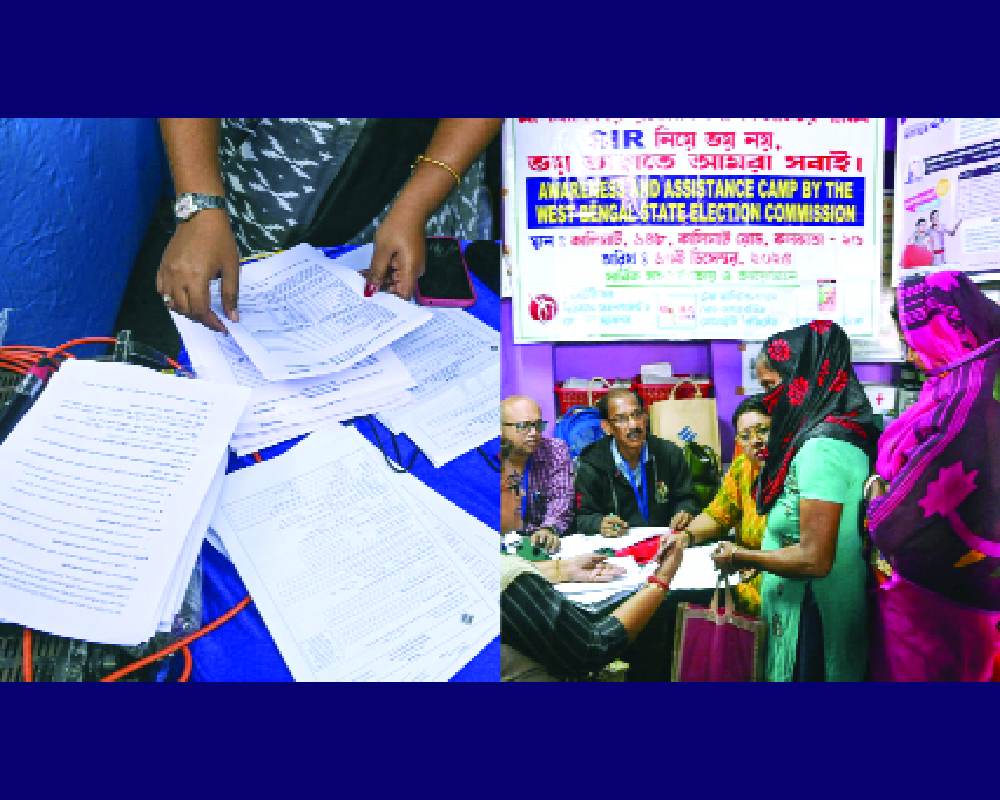
Forty-year-old Sumita Koley (name changed), a resident of the Chetla red-light area, has never voted. This year, she is determined to change that. She queued up on Wednesday at a Special Intensive Revision (SIR) assistance camp at Chetla area in south Kolkata, hoping to secure their place as voters.
Koley was among nearly 200 women who crowded the small club room at 29/A Rakhaldas Addya Road, a narrow stretch surrounded by slums and single-storey homes that have long been inhabited by sex workers.
The camp followed similar ones held a day earlier in Sonagachi, Asia’s largest red-light district, in north Kolkata. Watching the turnout, Swapna Gyne, an office-bearer of the NGO Amra Padatik, said the enthusiasm masks deep anxieties.
Around 3,500 sex workers earn their livelihood in Chetla, but nearly 30 per cent have stayed away from enrolment despite being Indian citizens, she said. “They have made new lives here; new relationships, whether those were accepted by the society or not. For years, they knew only the importance of Aadhaar cards, ration cards and the passbook of the Usha Multipurpose Cooperative Society of which they are members, Gyne said.
Now, for the SIR mapping, they are suddenly asked to trace parents they have not contacted in decades, she said. “Many of them fear humiliation if they go back to their old homes, which they left years ago. Some even fear physical assault,” Gyne said.
She stressed that Koley’s case is far from unique. Women aged between 20 and 60 face the same dilemma.
“Some have voter IDs and have voted before, even in the 2002 elections. But many have never voted and have no EPIC cards. They also lack school certificates or birth documents. We have requested the Election Commission to find alternatives if they meet the citizenship criteria. Where will they go if they are left out? This is their country,” Gyne said.
At the camp, the challenges surfaced repeatedly. Kaushalya Paswan, a young woman from Bihar’s Gaya district, broke down when a Booth Level Officer (BLO) asked her to produce her birth certificate or school leaving records.
“I am from Bihar, sir. My family severed ties with me. Those documents must be with them. How can I approach them? I don’t even have their numbers,” she pleaded.
An Assistant Electoral Registration Officer (AERO)-ranked official reassured her. “Don’t worry, but we need these proofs for including your name in the final rolls. We must also confirm that you are not enrolled in Bihar,” he said.
The AERO asked her to present her case at the public hearing after December 16. “We are here to assist, not disenfranchise. Our job is to show you the right way,” he said.
Uttam Maity of the Society for Human Development and Social Action, working for the sex workers alongside two other NGOs, said the process was being streamlined. “Some women are receiving enumeration forms, while others have been asked to return after December 16,” he explained.
Maity recalled that in 2007, following intervention by then Chief Electoral Officer Debashis Sen, many sex workers received voter IDs by producing passbooks from the Government-registered Usha Multipurpose Cooperative Society.