




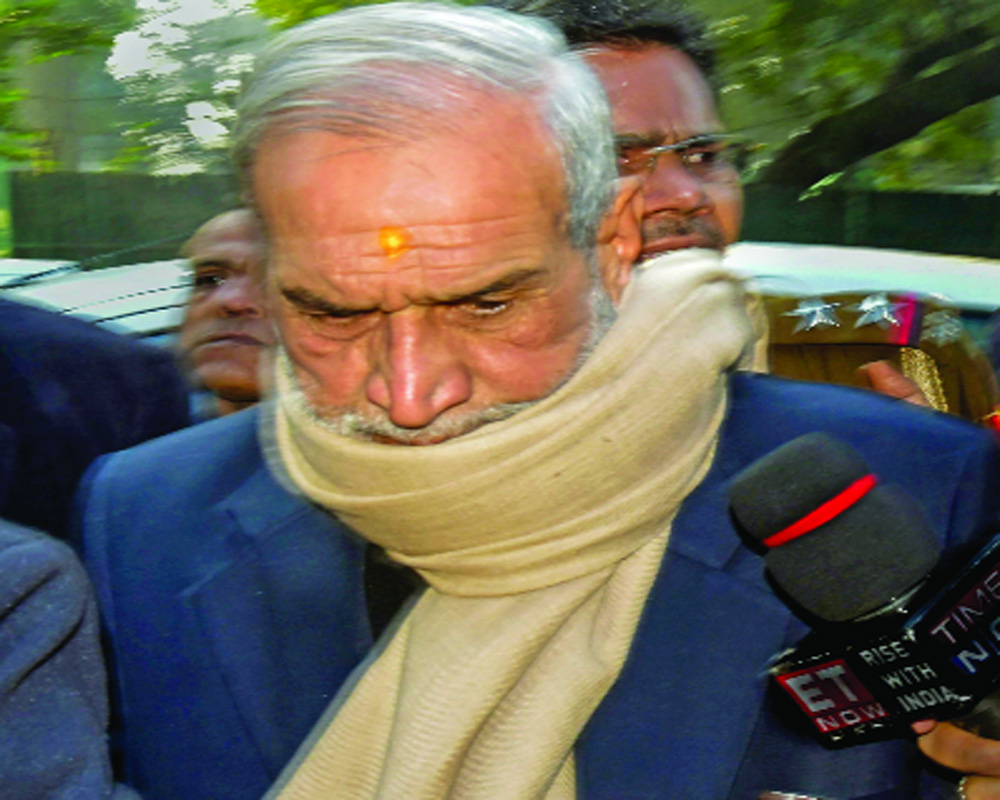
The prosecution has sought the death penalty for former Congress MP Sajjan Kumar who was convicted by a Delhi court last week over the killings of two Sikhs in the national capital during the 1984 anti-Sikh riots saying the crime was committed in a “brutal and diabolical mannerâ€. The prosecution said the case was “graver than the Nirbhaya case†of 2012 in a written submission filed before special judge Kaveri Baweja. “The present case is graver than the Nirbhaya case as in the Nirbhaya case, a young woman was targeted but in the present case, people of a particular community were targeted,†it said.
Arguments on the quantum of sentencing will take place on February 20 as the lawyers were on strike on Tuesday.
While describing the case as rare of the rarest, Additional Public prosecutor (APP) Manish Rawat in his written submissions has pressed for death penalty for the convict in view of the guidelines issued in Nirbhaya and other cases.
Asking the convict and the victims to file their written submissions, Special judge Kaveri Baweja has listed the matter for hearing arguments on sentence on February 21. The minimum punishment for murder is life imprisonment.
Senior advocate H S Phoolka, appearing for the complainant, supported the prosecution’s demand of death penalty and sought time to argue the matter.
The judge deferred the matter to February 21 after Kumar’s counsel sought time to argue the matter, saying lawyers were abstaining from work on Tuesday in protest of the Advocate Amendment Bill, 2025.
The prosecution said there was something uncommon in the case, arguing the “aggravated circumstances outweighed the mitigating circumstances†and the case fell in the “rarest of rare case†category. Kumar, along with the mob, targeted the particular community people without provocation, it added.
The prosecution argued four “helpless women†without any provocation were badly beaten and a young man aged about 18 and a man aged about 50 years showed no provocation but were burnt alive in front of their family members.
The murders of Jaswant Singh and Tarundeep Singh, said the prosecution, were committed in an “extremely brutal, diabolical manner so as to shock the collective conscience of the societyâ€. “The impact on the psychology of the survivor victims can be seen from their demeanor recorded during their testimonies, even after 39 years, they were inconsolably weeping. Serious bodily and mental harm were caused to such women... There was forced and traumatised displacement of all survivor victims,†it said.
The court was informed by the prosecution that the impact and magnitude of the crime was so enormous that it was a crime against community and involved genocide of the members of a particular community.
“The incident of this kind, break entire fibre of trust and harmony amongst communities, thereby, severely effecting the knitting and assimilation of different religious or social groups,†it added. Kumar was said to be a people representative, someone who supposed to help people but “he openly broke the rule of lawâ€, argued the prosecution. It pointed out Kumar was convicted for a similar crime.
Kumar is currently lodged in Tihar jail. Jaswant Singh and his son Tarundeep Singh were killed on November 1, 1984.
Though Punjabi Bagh Police Station registered the case, a special investigation team later took over the investigation. On December 16, 2021, the court framed charges against Kumar, finding a “prima facie†case against him.
The prosecution has alleged a huge mob, armed with deadly weapons, resorted to large-scale looting, arson and destruction of properties of Sikhs to avenge the assassination of former Prime Minister Indira Gandhi.
Kumar (79) is already serving life imprisonment in another anti-Sikh riots related case and the Supreme Court has refused to grant him bail. He has been in jail since December 31, 2018 when he surrendered after being convicted and awarded life imprisonment by the Delhi High Court in a case relating to 1984 anti-Sikh riots in Raj Nagar part-I area in Palam Colony in South West Delhi in which five Sikhs were killed on November 1-2, 1984, and a gurdwara was burnt down in Raj Nagar part II.