Ranchi, early 2022.
In a cramped room of St. Michael Blind School—where light struggled to reach dusty corners— a young mentor and a passionate beatboxer named Harsh Soni began teaching beatboxing to a handful of visually impaired students. With no formal training, no special equipment—just a mobile phone and an unshakable belief—he tried something most deemed impossible. He taught sound to those who couldn’t see it. And while the world slept, their spirits started dancing.
These students weren’t just blind—they came from some of Jharkhand’s most economically disadvantaged and tribal communities. Music classes weren’t a part of any curriculum, and future prospects were often dictated by survival, not dreams. Harsh, a corporate software developer by day and a ardent musician by night, defied this script. He would leave office, rehearse under streetlamps, and spend hours teaching rhythms to those who had never even heard the word “beatbox.”
Harsh’s early days were defined by struggle.
He himself started everything from scratch. He learnt beatboxing through YouTube, mimicking sounds, mastering breath control, and slowly building an artform that was still rare in his city. He faced constant scepticism—from family, peers, even school authorities. “This will never work,” they said. His only response was persistence. His only companion: hope. By the time he entered college, Harsh was no longer just a student, he had become a name “Void_throb” - his new identity. Through social media, Harsh began putting out content that gained attention for its uniqueness and raw talent and created waves across Ranchi. He performed in hundreds of stage shows, worked with brands like Realme and OLA, and even featured in a reality show with Prince Narula. While everyone saw him as a rising beatbox star, very few knew the secret he carried — behind the scenes. Harsh was also doing a corporate job and balancing both lives wasn’t easy, but he did it with unmatched dedication. For Harsh, success was never just about personal glory. He believed in the magic of art and always dreamt of creating revolution through music.
By mid-2022, that fragile classroom experiment transformed into something larger—a movement. What began with four or five students swelling with curiosity became a full-blown self-sustaining culture. One day, Harsh arrived to an empty classroom. Alarmed, he searched the hostel, only to find students beatboxing in their rooms—many untouched by formal instruction but teaching each other. Over a dozen had chosen rhythm over silence, entirely by heart. That was the day Harsh realized he wasn’t just teaching music—he was igniting revolution.
In 2024, the world started to listen. Harsh’s videos—casually shot on a phone—featuring a blind kid’s beatbox choir went viral, racking up hundreds of thousands of views along with the help of Neon Pigeon. That choir wasn’t just unique—it was the first blind beatbox choir in the world with 35 kids aged between 8–19 years, which was a Santhali reprised version of Vande Mataram.
But recognition came with resistance. Within the school, jealousy and internal politics flared. Some teachers felt threatened. Without explanation and on the basis of false allegations, Harsh was quietly removed. His name vanished from records. But not from hearts. His students kept calling. Kept waiting.
Those who are still in touch with him through electronic mediums still contact him for guidance, online classes and most importantly not giving up hope on the purpose they initiated.
Then came the leap: A journey into deeper silence.
Later that year, Harsh began working with mute and hard-of-hearing children at Kshitish Deaf and Dumb School, Ranchi. Imagine — teaching an art form based entirely on sound to those who live in silence. No tutorials, no roadmap, no prior examples in the world. Just faith, patience, and endless love. To most, the idea was impossible. But Harsh didn’t see impossibility — he saw potential. He used vibrations, visual metronomes, breath pulses, and raw patience. He went beyond science. He taught music, where no sound existed.
A senior teacher once told him, “You are trying to grow flowers on rock.” Harsh simply smiled. Months later, that same teacher stood in tears as the deaf and mute students performed in rhythm, without sign language—communicating entirely through synchronized beats. The deaf and mute children now had a voice, a voice through rhythm, a new language of belonging.
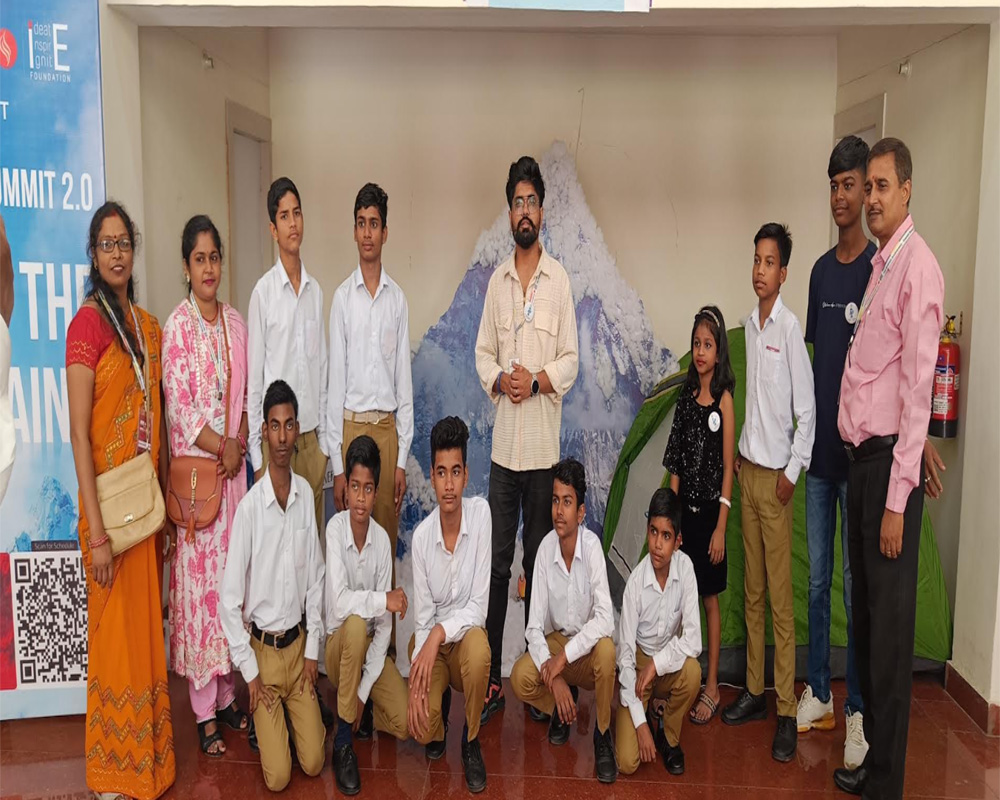
Everest Summit, Aug 2024.
On a high-altitude stage where air thins and emotions swell, Harsh’s choir of mute beatboxers and his band Mixed Fruit Jamm performed side by side. The crowd cheered, unaware of who they were. Only after their identities were revealed did the audience gasp—and then rise in thunderous ovation.
It was history in the making: India’s first-ever live act where visually impaired and hearing-impaired children communicated through music alone. Delegates from across India, including high-ranking officials from Jharkhand, witnessed the moment—sponsored and supported by Cyber Peace Foundation, Digi Crow, and the i3 Foundation.
Later that year, at Sofar Sounds Ranchi 2024, another milestone was set. Harsh’s band, Mixed Fruit Jamm, featuring blind singers and deaf and mute beatboxers, performed a fully original track. In that electrifying set, something previously unseen happened: a communication bridge was built between the visually impaired and the deaf and mute—not with words, but through music. Art then became a language and Beatbox became a therapy.
This revolutionary success led to the birth of dBoid
Under the banner dBoid—where ‘d’ stands for Deaf and Dumb, ‘B’ for Blind, and ‘oid’ echoing Harsh’s stage name reflecting that even a void can throb with rhythm—a new kind of artform is emerging. One that dismantles assumptions, humanizes inclusion, and proves that empathy, when armed with rhythm, can move mountains. dBoid is not just a project, it is a movement.
Inspired by international inclusive initiatives—from Ghana’s musical therapy programs to Liverpool’s Na Laga’at theater—dBoid is unique in its scope and its soul. It doesn’t just spotlight differently abled performers. It reinvents performance itself.
Why dBoid matters:
· It proves that deaf, mute, or blind children can create, lead, and inspire through music.
· It challenges disability stereotypes not with slogans, but with soul.
· It redefines inclusion not as charity, but as innovation.
· It offers a replicable therapeutic model that can reach millions of marginalized children.
· It doesn't seek sympathy—it seeks to showcase untapped, raw talent to the world.
Harsh envisions of spreading dBoid globally, creating a chain where specially-abled children could learn beatboxing and even use it as a career skill because dBoid is all about “giving a voice to the voiceless”. As dBoid prepares to release a new original track featuring both choirs and beatboxers, the only barrier is no longer belief—but resources. These children have earned standing ovations in studios, mountaintops, and across social media. Now, they need platforms, funding, and recognition to reach the ears still closed to their sound.
Because dBoid is not just a choir.
It’s a blueprint.
It’s proof that when silence finds rhythm—children don’t just speak. They roar.
With over six years in broadcast journalism, Yashaswi Singh has anchored prime-time news, produced shows, and hosted over 100 episodes of Chitrahaar during her work with Samachar Plus, Alok Bharti, Doordarshan, and Akashwani.