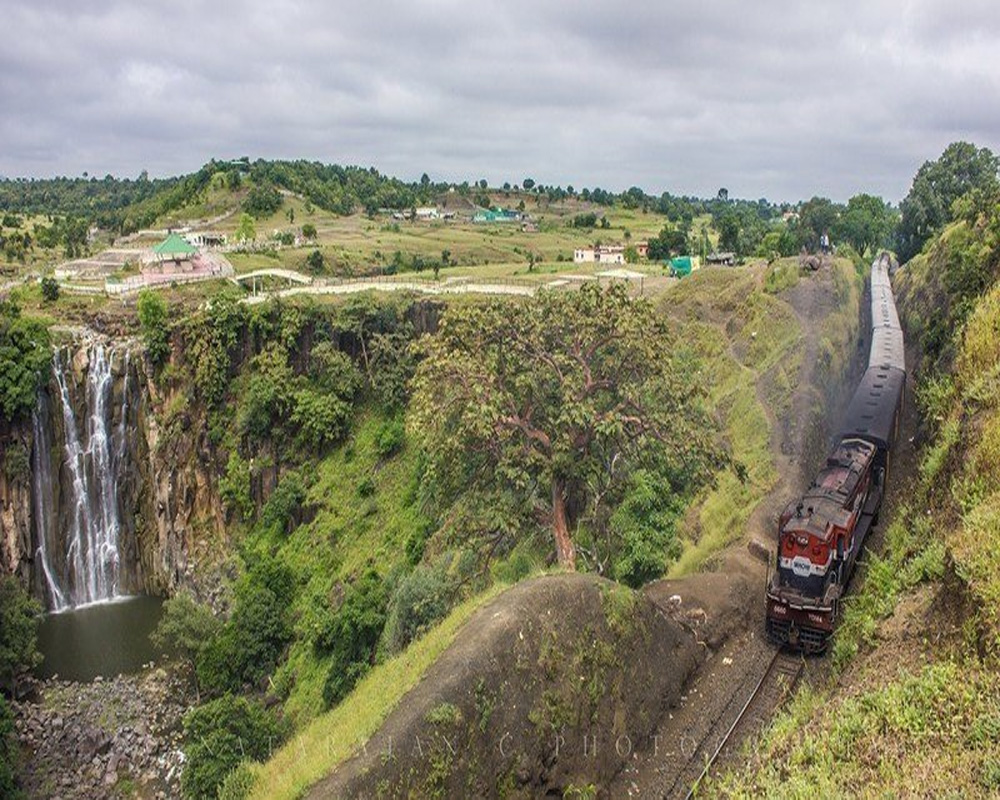
Hidden deep within the green folds of Madhya Pradesh’s Choral Valley lies a railway line that defies modern convention. It doesn’t rush, it meanders. It doesn’t just transport, it tells stories. The Patalpani-Kalakund Heritage Train, operating on Western Railway’s only heritage railway section in the Ratlam Division, is more than a mode of travel — it is a journey into India’s past, wrapped in history, culture, and nature.
On December 25, 2018, this 9.5-kilometre stretch was officially declared a Heritage Section by Indian Railways. That same day, the whistle of a refurbished diesel locomotive echoed through the hills, marking not just the inauguration of a train service, but the rebirth of a 150-year-old legacy.
The roots of this railway line go back to the late 19th century. Tukoji Rao Holkar II, the visionary ruler of the Holkar State, first proposed a railway link between Indore and Khandwa to boost trade and connectivity. The approval from the British colonial Government, however, took nearly six years. With funding secured via a `1 crore loan at 4.5 percent interest — a significant sum for the time — construction began in 1870 and was completed in eight years.
This meter-gauge line eventually became a key part of the North-South rail corridor, connecting Jaipur and Secunderabad. Its operation continued for over a century, until India’s modernisation efforts led to a shift towards broad gauge conversions in the early 2000s. In 2008, when the Central Government sanctioned the conversion of the Ratlam — Dr Ambedkar Nagar — Khandwa section to broad gauge, railway officials took a decisive step — to preserve the Patalpani-Kalakund segment as a dedicated heritage corridor.
At first glance, the distance may seem unremarkable. But what it lacks in length, it makes up in sheer visual and structural spectacle. The Patalpani-Kalakund section is a marvel of colonial engineering. Along its short route, it features four hand-dug tunnels, 41 bridges — including six major ones — and over 24 sharp curves that snake along hill slopes and forest ridges. The route climbs at an average gradient of 1:55, with the steepest segment at 1:40. The curved sections span about 6.5 km of the total track — a challenge for any train and a delight for photographers and engineering enthusiasts.
These features were not only remarkable when first built, but remain so today. While many other narrow and meter-gauge lines have been dismantled, this preserved stretch allows visitors to experience what rail travel in colonial and pre-independence India felt like.
Following seasonal closures during peak summer due to low tourist footfall and harsh Weather, the heritage train resumed operations in July 2025. From July 26 onwards, it is running on a fixed schedule:
- Train 52965 departs from Patalpani at 11:05 AM and reaches Kalakund by 1:05 PM
- Train 52966 returns from Kalakund at 3:34 PM, arriving at Patalpani by 4:30 PM
The train comprises two AC Chair Car coaches (C1 and C2) and three Non-AC Chair Car coaches (D1, D2 and D3), offering a nostalgic experience for every kind of traveller. The fares are surprisingly affordable: `270 for the AC journey and just `20 for Non-AC — a deliberate attempt by the railways to make heritage accessible to all.
A key addition to the heritage experience has been the AC Vista dome coaches, introduced by the Ratlam Division. These panoramic cars feature large glass windows, rooftop viewing panels and trail-end windows that provide uninterrupted views of the rugged landscape.
The coaches are decorated with vintage-themed PVC interiors and offer clean, modern toilet facilities — a nod to passenger comfort without compromising the old-world charm. From the moment the train pulls into the station, its artfully painted exteriors and nostalgic appeal begin to draw crowds. Tourists, railway enthusiasts, and locals alike are often seen clicking selfies, taking videos and simply soaking in the atmosphere.
More than just a train journey, this heritage ride is a gateway to some of Madhya Pradesh’s most captivating natural and cultural sites.
Highlights of the route
- Patalpani Waterfall, a dramatic cascade particularly impressive during the monsoon.
- Tantya Bhil Mama Temple, a shrine to the tribal freedom fighter often regarded as India’s Robin Hood.
- Choral River views and check dam sites ideal for quiet reflection and photography.
- The Kalakund Trekking Trail, for those who prefer to stretch their legs after the ride.
Kalakund itself is a small, rustic station surrounded by tribal villages, ancient temples and thick forests rich with flora and fauna. The region’s tribal heritage is evident in the architecture, festivals, and lifestyle — giving tourists a glimpse into rural life untouched by urban sprawl.
The area also serves as an ideal film shooting location, thanks to its cinematic backdrops and colonial-era railway infrastructure. From Bollywood film crews to documentary filmmakers, the line has piqued considerable interest.
For Indian Railways, this initiative is more than nostalgia — it’s a celebration of engineering and social history. It highlights the importance of preserving India’s diverse railway legacies in a rapidly changing transportation landscape.
According to railway officials, plans are underway to further promote the heritage section through collaborations with travel agencies, school excursion programs, and cultural tourism drives.
“We’re not just running a train. We’re reviving a story — of visionaries like Holkar, of engineers who carved railroads through hills and of communities who lived and thrived along these tracks,” a senior Ratlam Division officer shared.
In a world increasingly defined by speed, efficiency and digital interfaces, the Patalpani-Kalakund Heritage Train stands as a rare escape — a return to the analog world of steam and steel, of whistling engines and waving flags. For some, it’s a scenic ride. For others, a sentimental one. But for all who board it, this train promises one thing: an unforgettable passage through time, terrain and tradition. Whether you are a history buff, nature lover or simply looking for a day away from the routine, this journey invites you to slow down — and discover a timeless charm riding the rails of central India.