Nestled in the lap of the majestic snow peaked Himalayas, Uttarakhand is a land where natural splendor, ancient history, and vibrant culture blend seamlessly. Known as Devbhumi, the Land of the Gods, it is home to sacred shrines in Badrinath and Kedarnath, and is where the holy Ganga and Yamuna rivers originate, whose picturesque routes converge at the revered towns of Haridwar and Rishikesh. From the snow-clad peaks of Nanda Devi to the misty slopes of Mussoorie, from the serene lakes of Nainital to the lush valleys of Kumaon and Garhwal, its geography offers breathtaking views that have long drawn travelers and pilgrims alike. The state’s rich heritage is reflected in its traditional wooden architecture, folk music, and festivals that celebrate harmony with nature. Completing the sensory experience is Uttarakhand’s simple yet intricate and flavorful cuisine-marked by unique dishes like kafuli (made from leafy greens) bhatt ki churkani (made with black soybean), and bal mithai (made with roasted khoya and poppy seeds) — that embodies the simplicity and warmth of its mountain life.
The high ridges, deep green valleys, and glacier — born rivers of Uttarakhand make a landscape fit for picture postcards and dictates a way of life; here the contrasts of its landscape and climate constrains crops, fuel, and mobility, making its cuisine an instrument of survival as well as celebration. The terraces line the mountainside in stepped rows, each season determining what may be sown and what must be stored. In the kitchens of the hills there is an economy of heat and time: slow fires, measured additions of water, roasted grains for longevity, and dairy preserved as ghee and khoya. Such adaptations refine local technique — roasting to deepen aroma and deter pests, coarse grinding to speed cooking, and tempering with local seeds to lift simple textures. From these constraints rise the state’s characteristic tastes — bitter greens are transformed into silky stews, dal (lentils) into smoky pastes, millets pressed into dense rotis, sweets that celebrate surplus-tastes that define the region’s exotic and unique palette.
The story of the region begins long before Uttarakhand was carved out from Uttar Pradesh and became the 27th State of the Indian Union on 9 November, 2000. In the early centuries, the hills were dotted by tribal polities and small chiefdoms linked across passes by seasonal trade in salt, wool, and metal. Monetary and inscriptional evidence shows that the Kuninda, also known as Kulinda, was an early Himalayan kingdom that existed from the 2nd century CE to the 3rd century CE. The kingdom finds mention in the Mahabharata and its people were known for their hardiness and warrior skills. Its coins show Indo-Greek influence and were the earliest that featured symbols of goddess Lakshmi and Buddhist stupas. By the early medieval period, a powerful regional polity arose under the Katyuri house, which by many accounts exercised sway from roughly the 7th or 8th century until the 11th or early 12th century; the Katyuri capitals at Joshimath and later Baijnath became focal points for temple patronage and valley integration. After the Katyuri decline, the polity fragmented into numerous smaller principalities and fortified settlements, a process that over the 12th to 14th centuries produced the political patchwork that would become Garhwal and Kumaon. In Garhwal, Kanak Pal, a prince from Malwa, is credited in chronicles with establishing what became the Panwar dynasty. Born of the ancient Parmar clan, the Panwar (that belonged to the Rajput clan) carried forward a legacy of courage and statecraft that spanned almost a thousand years. Their sovereignty stood firm until 1803, when the Gorkha conquest brought a new chapter only to subsequently come under British influence. The Chand dynasty, on the other hand, first established its capital in Champawat and later moved to Almora, building administrative and cultural institutions that connected the hill trade routes with markets beyond the mountains. These dynastic formations structured agrarian patronage, temple building, and the seasonal flows of pilgrims and traders-and the pattern of conflict and commerce through medieval centuries established methods of production and preservation that were carried into the modern age.
The later 18th and early 19th centuries brought convulsive change across the hills. Nepali forces, often referred to broadly as Gorkha armies, moved west from the Kathmandu valley and by 1791 had annexed large parts of Kumaon; by the early years of the 19th century, Garhwal too came under Nepali control in a period remembered locally for harsh rule and a focus on resource extraction. The Anglo-Nepalese conflict of 1814-1816 ended this chapter: British East India Company campaigns under generals such as David Ochterlony liberated Garhwal and Kumaon from Nepali occupation, and the subsequent Treaty of Sugauli (signed 4 March 1816) fixed new boundaries, after which the British exercised political authority in the plains and a degree of administrative oversight in the hills. In the decades that followed, colonial governance introduced new revenue regimes, opened certain roads and later rail links in the plains, and altered market access in ways that would shift the economics of hill agriculture and craft. It was during this time that Haridwar and Rishikesh began to become popular as pilgrimage and trade towns, while the British founded hill stations such as Mussoorie and Nainital, introducing tourism and elite schools and residences to the region as an extension of colonial leisure and health retreat. These changes brought both opportunity and burden: trade in certain commodities expanded, but colonial accounting and infrastructural priorities often constrained local autonomy and distorted a fragile ecological system, and the well established seasonal patterns of trade across passes had to adjust to the new political realities.
Trans-Himalayan routes connected the Uttarakhand valleys to Tibet and Nepal, carrying salt, borax, wool, and dried meat in one direction and grains, sugar, and metal goods in the other. A network of mule tracks and seasonal passes enabled not only ritual movement to shrines but also commercial flows that enriched towns such as Almora, Champawat, Haridwar, and Rishikesh. Markets grew along the rivers and pilgrim towns where merchants exchanged hill produce for plains goods. These market centres served as conduits for culinary exchange. Rice, sugar, and refined ingredients moved upward when conditions permitted, while millets, pulses, and medicinal herbs moved downward. Years and frequent movement and contact of traders and pilgrims, helped shape tastes and enabled the occasional refinement that produced the urban sweets and confectionery distinct to the Kumaon towns and the temple towns of the plains.
Religious life is woven into this topography. The hills are called Devbhumi for a reason: rivers that originate here are worshipped, and temple circuits move through mountain passes into a sacred geography that draws pilgrims across seasons. The Char Dham shrines and innumerable local temples create a seasonal flow: pilgrims ascend in devotional waves, traders and caterers follow, and roadside kitchens and small bakeries evolve to meet their demands. Haridwar and Rishikesh, at the foothills, form the spiritual thresholds-hosting the Kumbh Mela, Ganga Aarti, and countless festivals where food becomes an extension of faith. Temple offerings and festival foods follow prescriptions of purity in many instances. Sattvic rations without onion and garlic are common in pilgrim kitchens, and this norm influences local culinary practice because a pilgrim’s need for easily digested, portable food creates a demand for such preparations. At the household level, ritual obligations structure the calendar. First grains are boiled and offered to deities before any seasoning is added; harvest festivals distribute both grains and sweets as devotion and thanksgiving; and the act of preserving-drying greens, making lentil powders, storing ghee-has a ceremonial as well as practical dimension. The interplay of spiritual practice and caloric necessity produces a cuisine that can be both very plain and nourishingly sustaining.
From that religious and economic terrain the region’s kitchen practices arise, and it is built around a small set of resilient crops and techniques. Mandua (finger millet) is central because it grows where wheat and rice are unable to. Its dense roti supply calcium and fibre and serve as the backbone of meals in higher altitudes. Gahat (horse gram) and Bhatt (black soybean) are pulses prized for their ability to be stored over a long period of time and concentrated protein. Jhangora (barnyard millet) augments porridge tradition and kheer. Dairy in forms of dahi (curd), mattha (whey), and ghee provide fat, flavor, and preservation. Tempering is characteristically local: jakhya seeds and mustard oil give a signature tempering and aroma while demanding little fuel. The techniques that recur across valleys are telling: roasting to extend shelf life and deepen taste, coarse grinding to reduce cooking times, slow simmering to extract maximum calories and gelatinize starches, and preservation methods such as drying and pressing that protect food through winter scarcity. These culinary protocols are not mere tradition but practical methods adapted to steep slopes and short seasons.
In Uttarakhand one most often hears of two major regional cuisines, Garhwali and Kumaoni. But beneath that duality lies an array of regional dishes tied to valleys, tribal groups and local ecologies. Garhwali cuisine tends to manifest in rugged, intensely earthy plates: greens and wild herbs dominate, pulses like gahat (horse gram) and urad (black gram) are roasted or ground, and tempering with jakhya seeds (wild mustard) is frequent. The flavor is delicate, the textures coarse yet nourishing. Kumaoni cuisine shares the same set of grains, pulses and dairy, but it leans more into sweetness, inventive use of Bhatt (black soybean), and rice-based dishes; its lentil stocks (ras or thhatwani) are lighter, and its sweets like Bal Mithai and Singori are more popular. In micro-cuisines such as Jaunsar-Bawar, Bajarwali or in the high Bhotia belts, local dishes depart further: mushrooms, stews adapted to carry long on trade routes, and foraged greens or herbs unknown elsewhere appear. These smaller cuisines may use slightly different leaves, spice blends or preservation techniques. What unites them is an economy of fuel, a minimalism in spice, and a focus on texture and nutrition; what distinguishes them is which pulses, grains or herbs each valley can sustain, and which sweets or seasonal tastes that community has developed over time.
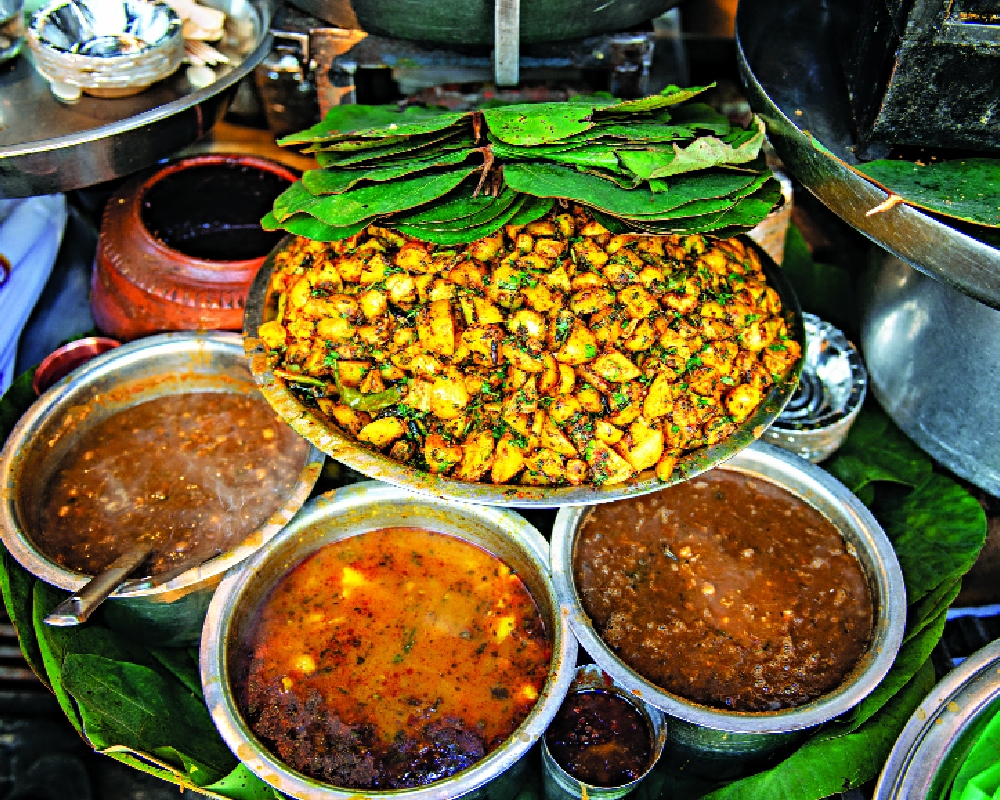
In Garhwal kitchens you see mornings break into cuisine perfected over generations and time. Kafuli is popular when winter arrives: a carefully curated dish of palak (spinach) and methee (fenugreek) mashed, simmered in iron with ghee, lessan (garlic), adrak (ginger) and a bit of rice paste so the curry holds warmth. Chainsoo is the preferred dish at dusk: urad (black gram) dal roasted till smoky, cracked into coarse powder, then stirred into a velvety paste over low fire until its aroma lingers in the hearth. Phanu comes at lunchtime or dinner: pulses like gahat, moong (mung bean) and urad soaked overnight, ground gently and stewed with mild tempering into a hearty binding stew. Aloo ke Gutke appears in twilight kitchens: potato cubes boiled, then tossed into hot mustard oil with jeera (cumin) or jakhya and red chili until edges gently crisp. Kandali ka Saag finds its way to the table when nettle leaves are gathered: boiled, drained, tempered into a green side. Jhangora ki Kheer closes cold evenings: jhangora millet cooked in milk with cardamom and nuts for a sweet, soothing finish.
In Kumaon the rhythm is gentler but no less bold. Bhatt ki Churkani graces family dinners: Bhatt mashed with garlic and soft spice into a deeply nutty curry. Dubuk (or Dubke) is warmth in a bowl on cold nights: Bhatt and rice merged into a soft mash that comforts both body and spirit. Baadi, made from mandua flour and hot water, becomes dumplings or thick porridge eaten for lunch or dinner, carried forward with ghee or curry. Rus or Thhatwani is served early: lentil stock lightly thickened with rice paste and poured over rice, light yet sustaining. And sweetness rules its own hours: Bal Mithai’s caramel khoya cubes rolled in sugar beads appear in markets and festivals; Singori’s khoya wrapped in maalu leaf cones is a fragrant treat; Arsa and Gulgula crisp in village kitchens, their sugary crackle echoing laughter and festive air. The Garhwali palate leans toward smoky greens and earthy restraint; the Kumaoni dish reveals the pulse of sweetness, ever capable of turning scarcity into delight.
Tourism today continues to shape these exchanges. Visitors who arrive for the peace of Rishikesh’s riverbanks or the mists of Mussoorie often encounter the cuisine as both discovery and souvenir: Kafuli served in homestays, Bal Mithai boxed in hill shops, and mandua biscuits reimagined by local entrepreneurs. What began as necessity has evolved into identity-an edible record of endurance and grace.
Uttarakhand’s food speaks softly but carries centuries of intelligence. It tells of a people who learned to thrive in difficult terrain, transforming modest harvests into meals of remarkable depth and nourishment. Every dish, from mandua roti to chainsoo, is shaped by patience and precision, with flavours built from necessity and perfected through care. This cuisine is not a remnant of the past. It is a living expression of balance where health, resourcefulness, and flavour coexist in harmony. To safeguard it is to honour a way of life that prized both strength and simplicity. Each seed of gahat and each spoon of ghee carries lessons that modern diets have forgotten. True sustenance depends as much on wisdom as on taste. As processed foods and quick fixes crowd our tables, Uttarakhand’s kitchens offer an antidote and a reminder that nourishment begins with respect for soil, season, and craft. The responsibility now lies with us. We must ensure that this inheritance does not fade into nostalgia but flourishes through practice. Let us teach the next generation not only how these dishes are made but why they matter, for their nutrition, their restraint, and their quiet generosity. To pass them on is to pass on a way of thinking that food is still be both heritage and health, and that every meal cooked in this spirit keeps the mountain’s grace alive. In sum — a civilisation carved in stone, sustained by trade, sanctified by faith and flavoured with simplicity.
(The writer is Secretary, Cuisine India Society)