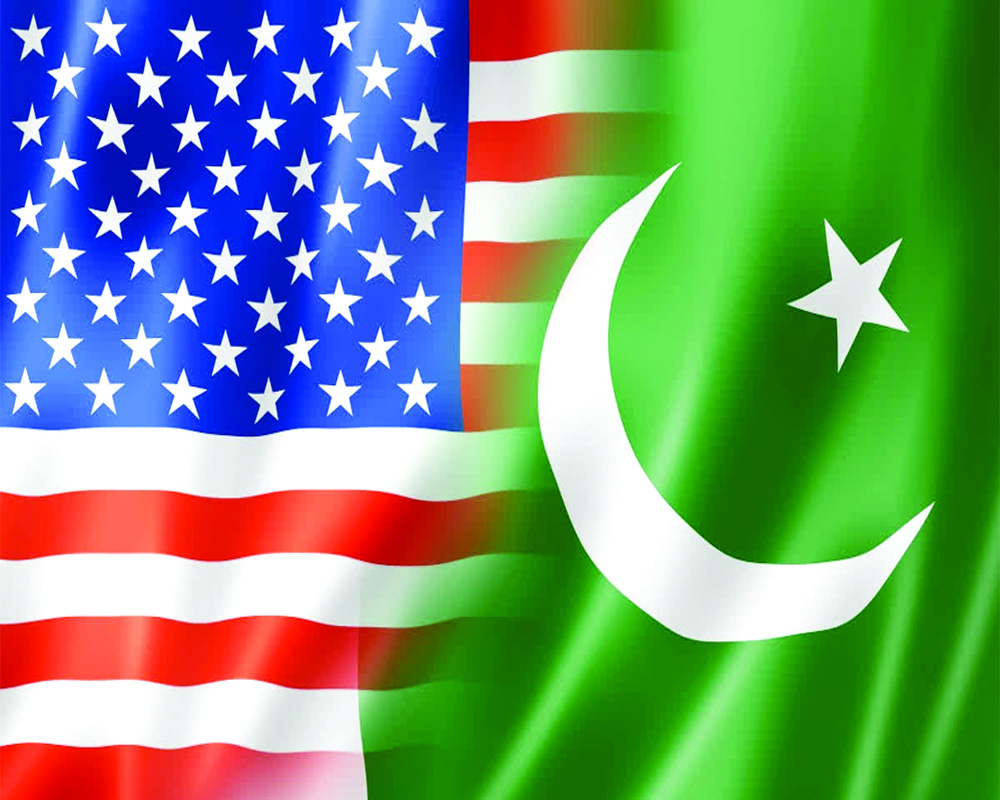
Today’s article for the Sunday Pioneer follows directly from the news that the United States has concluded a trade agreement with Shehbaz Shari, the Prime Minister of Pakistan. As part of his announcement of that agreement, POTUS Donald Trump decried India’s trade with Russia and Pakistan, and declared his enmity for BRICS and its trade agreements. Despite the evidence built over the past sixty years that trading blocs can be a tremendous force for peace, Trump seems to regard any international organisation that can form a strong trading unit, and thus a force for peace, as inherently against the interests of the United States of America.
How should we regard this? Many of my former and present colleagues regard peace as the most desirable condition for humanity, not just to survive, but to prosper, and to bring happiness to greater and greater numbers of human beings. Sarve Bhavantu Sukinaha! Professor Vishwanath D Karad, the founder of the university where I work, MIT World Peace University, has come to dedicate his life to helping create peace for all mankind.
President Trump’s initiative seems overtly opposed to that aim. But from another perspective, that is not the case. Just three months ago, in April 2025, Pakistan made the terrible mistake of backing terrorists to infiltrate Kashmir and commit the terrible atrocities at Pahalgam, for which India responded with Operation SINDOOR, a major slap in the face.
A wise person would regard Trump’s trade agreement as a means to prevent Pakistan from slipping deeper under the influence of China and its Belt and Road Initiative, very important from India and South Asia’s point of view. His prognostications on BRICS, and a declaration more against China than India, are again very desirable from a regional perspective. How history will judge this sequence of events remains to be seen. One thing is certain: through his MIT World Peace University, Professor Karad continually takes significant actions to help enliven the vision of peace in the minds of as many human beings as possible.
First, in 1983, he founded the governing charity, Maharashtra Academy of Engineering and Educational Research (MAEER), then the Maharashtra Institute of Technology, being awarded the UNESCO Chair for Human Rights, Democracy, Peace & Tolerance in 1998.
Karad’s efforts to create initiatives for peace, and to make as many people as possible aware of their importance led to his renaming MIT when it achieved University status. In 2017, it became MIT World Peace University with the stated aims of pursuing and popularising Science, Spirituality, Harmony and Peace, bringing these themes together.
His own inspiration has been drawn from world leading figures, Santa Dnyaneshwara, Swami Vivekananda and Albert Einstein: the first, a superhuman figure in the Marathi tradition whose Dyaneshwari translated and commented on Bhagawad Gita; the second, who brought world recognition of India’s immense tradition of all-inclusive wisdom, and who declared that in today’s 21st century scientific understanding of religion, integrating science and spirituality, would lead to cessation of conflicts and World Peace; and the third, whose mass-energy equivalence formula, E = mc2, started the first steps to a more integrated assessment of our material world of sense perception.
Meanwhile, Professor Karad began organising World Parliaments on Science, Philosophy and Religion, named after the 1893 event at the World’s Columbian Exposition in Chicago, where Swami Vivekananda achieved such prominence. Professor Karad’s World Parliaments have renewed Swami Vivekananda’s 19th-century vision of bringing peace to the world. The most recent, the 10th, was held from 3rd to 5th October, 2024, in MIT World Peace University’s World Peace Dome, on the Solapur Road in eastern Pune.
The MIT World Peace Dome, inaugurated in October 2018, containing its World Peace Prayer Hall and World Peace Library, is the largest in the world, bigger even than St Peter’s Cathedral in Rome.
The dome itself contains statues of founders, avatars and saints of all religions dedicated to peace; it is surrounded by statues of the greatest philosophers and scientists whose expositions and discoveries have led to our present understanding of the worlds of mind and matter; and what may underlie them. At the heart of the library on the ground floor is a statue of Philosopher, Saint Santa Dnyaneshwara in an enclosure surrounded by pictures of the physical centres of religions. The surrounding galleries contain pictures of artists, scientists and technologists whose achievements represent the highest accomplishments to which we humans can aspire. The overall structure celebrates the greatest values that we humans can present.
Peace is the essential foundation for the others to crystallise. Hence, the World Peace Dome points the way for us all to live life in fulfilment. fulfilment of our desires and aspirations, whether personal, professional, financial or spiritual. Next week's article will integrate the theme of Yoga with that of Peace, and reveal how the Antarangas create it.
Conflicts in today’s world — Briefly
- Conflict in Ukraine
- China and North Korea : Attitudes towards neighbours : Belt and Road Initiative .
India must counter
- Sudan and all across Africa: Terrorism
- Iran. National Policy of Sponsoring Terrorism: Hamas, Hezbollah, Houthis
- Israel. allowed the 2023 attack to take place: Starvation in Gaza
- United States: Adoption of a deliberately selfish approach to international relations
- M.I.T. — University Status (2017) : Renamed M.I.T. as M.I.T. World Peace University — Aims: Science . Spirituality. Harmony. Peace — Founding President
(The author is a MA Cantab, PhD at MIT, DSc Hon Causa, Professor Emeritus of Biology, MIT World Peace University)