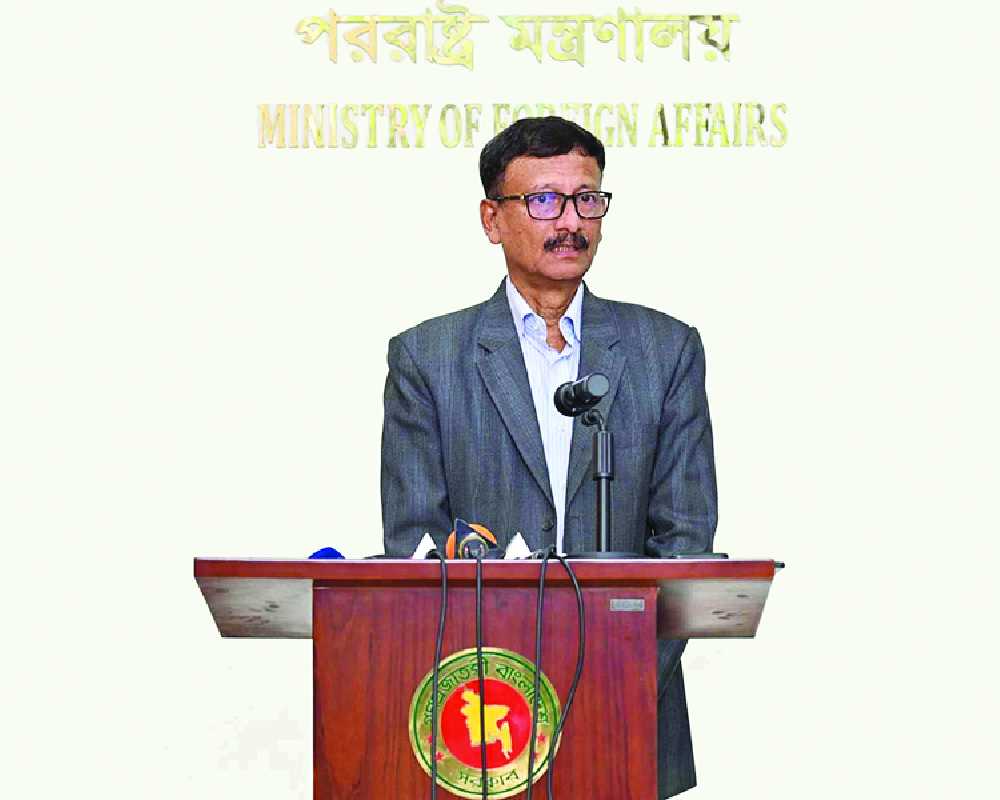
Bangladesh’s interim Government on Wednesday said it will continue diplomatic efforts to bring back from India deposed prime minister Sheikh Hasina, who has been convicted and sentenced in multiple cases. The 78-year-old Awami League leader has been living in India since she fled Bangladesh on August 5 last year in the face of the massive protests. “We will try to convince India to send her back to Dhaka,” Foreign Adviser Md Touhid Hossain was quoted as saying by the state-run BSS news agency. Touhid noted that Hasina’s repatriation ultimately depends on India’s decision.
On Saturday, External Affairs Minister S Jaishankar said Hasina came to India “in a certain circumstance and I think that circumstance clearly sort of is a factor in what happens to her. But again, that is something which she has to make up her mind.” Responding to reports suggesting possible third-country resettlement for the former premier, Touhid said he had only seen such claims in media coverage. “I did not receive any information through diplomatic channels,” he added. Touhid had earlier said Bangladesh was not ruling out a response from India.
On November 17, the International Crimes Tribunal sentenced Hasina and former Home Minister Asaduzzaman Khan Kamal to death for “crimes against humanity” committed during the July-August mass uprising last year. Following the court verdict, Bangladesh sent a letter to India seeking her extradition. India said it is examining a request by Bangladesh’s interim Government to extradite Hasina, asserting that New Delhi is committed to ensuring the best interests of the people of that country.
Hasina has said the judgment has been made by a “rigged tribunal established and presided over by an unelected Government with no democratic mandate”. On November 27, another court sentenced Hasina to 21 years in jail in three corruption cases related to irregularities in allocations of land in a Government housing project. On December 1, Hasina was convicted by a court which sentenced her to five years in jail and her niece, British parliamentarian Tulip Siddiq, to a two-year jail term in a land scam case.
2 advisers of interim government resign
Dhaka: Two student leaders turned advisers of the interim government in Bangladesh tendered their resignations on Wednesday ahead of the Election Commission's announcement of the schedule for the polls in February. The resignation by M Mahfuj Alam and Asif Mahmud Shojib Bhuyain comes in wake of the Election Commission's (EC) decision that no adviser can contest the polls while holding a position in the interim government. “Adviser for Information and Broadcasting M Mahfuj Alam and Adviser for Local Government, Rural Development & Cooperative and Youth & Sports Asif Mahmud Shojib Bhuyain have tendered their resignation letters at around 5 pm to the Chief Adviser Muhammad Yunus,” a statement from the chief adviser's office said.
Both Alam and Bhuyain were inducted as representatives of Students Against Discrimination (SAD), the organisation which led a violent street movement that toppled former prime minister Sheikh Hasina's government on August 5, 2024. “The nation will remember your leadership and contribution to the ‘revolution' (uprising) remaining at its frontline to free the nation from fascist (Awami League) rule,” the statement quoted Yunus as saying while accepting their resignation. “The nation will never forget what you gave to it in such a short time,” Yunus said.
Of the three SAD leaders appointed as advisers by Yunus, Nahid Islam quit in February to form the National Citizen Party (NCP), a political offshoot of the students' organisation. Bhuiyan earlier said he would resign to take part in upcoming elections, but Alam so far has made no comment in public about his future plans. However, neither of them have officially disclosed any link with NCP or any other political party.
The EC on Tuesday said Chief Election Commissioner AMM Nasir Uddin would announce the schedule for the upcoming polls in the next two days. The EC had earlier clarified that no adviser can contest the polls while holding a position in the interim government. Bangladesh's top electoral officials on Wednesday met President Mohammed Shahabuddin, who assured “optimum support and cooperation” to the Election Commission to conduct the February general elections in a "free, fair and meaningful" manner.