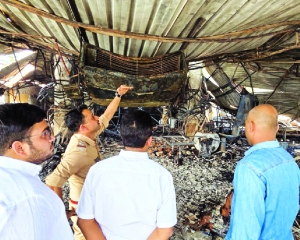
On the night of December 6, 2025, Birch — a trendy nightclub tucked near one of Goa’s busiest beaches — was buzzing with pulsating lights, music, and more than a hundred partygoers revelling at a “Bollywood Banger Night.” But at around 11:45 pm, the festive mood turned into pure terror. A sudden blast-believed to have been caused by indoor electrical firecrackers-triggered a chain reaction. Within seconds, flames shot across the club’s interior, igniting decorative materials and plunging the venue into chaos. Panic seized the crowd as thick smoke consumed the space. Patrons rushed towards a single, narrow exit-quickly turning it into a death trap. Flammable ornaments became towering torches. Those in the basement reportedly suffocated as smoke filled the air, while others were crushed in the desperate stampede.
After nearly two painstaking hours, firefighters finally managed to control the blaze. By then, 25 people-including young workers from various states and several tourists-had lost their lives. Over 50 were injured. Investigations soon confirmed the worst: the nightclub lacked basic fire safety clearances, had received demolition notices earlier, and had no functional fire exits. The tragedy was not a freak accident-it was a predictable catastrophe waiting to happen.
The Goa incident mirrors a long, troubling history of deadly fires across India. In recent years alone, a series of fatal incidents has shaken the nation: in Hyderabad, 17 people died when a three-storey commercial building caught fire. A month earlier, a hotel blaze in north Kolkata killed 14 guests. In 2024, an amusement arcade fire in Gujarat claimed 24 lives-mostly children.
And these incidents echo older tragedies that continue to haunt public memory: the Uphaar Cinema fire (1997), the Kumbakonam school blaze (2004), the AMRI Hospital catastrophe (2011), and the Puttingal Temple explosion (2016). Despite their varied settings-schools, hospitals, cinemas, hotels, nightclubs-the causes remain alarmingly similar: illegal structures, overcrowding, flammable interiors, blocked exits, and blatant flouting of safety norms. India’s fire disasters follow a familiar, deadly pattern: an ignition source, rapid flame spread, locked or obstructed exits, dysfunctional alarms, absence of trained personnel, and slow emergency response. The Goa tragedy fits this template all too closely.
India has fire safety laws, standards, and building codes-but their implementation is inconsistent and often compromised. Many establishments operate without valid fire safety certificates. Approvals are sometimes obtained through opaque processes, while others brazenly skip them altogether.
Common violations include:
- Non-functional alarms and sprinklers
- Out-of-date or inaccessible fire extinguishers
- Blocked exits used for storage
- Combustible interiors and illegal building extensions
- Untrained staff lacking basic emergency preparedness
Urban design issues worsen the problem. Narrow lanes, clogged streets, and the absence of hydrants frequently delay firefighting operations. In Goa, fire trucks reportedly had to stop 400 metres away due to the nightclub’s isolated layout, slowing rescue efforts at the most critical moment. Compounding this is public complacency. Rarely do people check for emergency exits, functioning alarms, or building certifications. Safety is often assumed-until tragedy exposes the truth.
Fire Safety Norms: Strong on Paper, Weak in Practice
India’s National Building Code and state fire laws prescribe detailed standards-multiple exits, smoke detectors, fire-resistant materials, routine audits, trained staff, and emergency ventilation systems. Such requirements are mandatory for public venues, especially enclosed spaces like malls, clubs, hotels, and auditoriums.
Yet many establishments treat these norms as optional. The Goa nightclub’s complete lack of permissions and use of combustible décor reflects a deeper national problem: the gap between what is mandated and what is practised. And that gap is often fatal.
A Growing Threat in a Rapidly Urbanising India
As India’s urban centres expand and nightlife, tourism, and hospitality industries boom, millions flock to indoor entertainment spaces daily. But regulation and infrastructure have not kept pace with this surge. The mismatch between expanding demand and stagnant safety standards has made such spaces increasingly vulnerable. If India aspires to be a global tourism hub and a modern economy, recurring fire disasters are an unacceptable stain on that ambition. They send a strong message-that human life is undervalued, and safety is negotiable.
What India Can Learn from Global Disaster Frameworks
India must shift from reacting to fires to preventing them. The Sendai Framework for Disaster Risk Reduction-a global blueprint for minimising disaster losses-offers a useful model. Its core principles can help India revamp its fire safety ecosystem.
- Understanding Risks Before They Turn Deadly Authorities must identify vulnerable buildings, illegal constructions, and high-risk zones. AI-enabled monitoring systems, heat sensors, and real-time smoke detection tools can help pre-empt fires. Public awareness must grow: people should know where exits are, learn basic firefighting skills, and report unsafe establishments. Regular fire drills in schools, offices, and public buildings must become routine. Strengthening Governance and Accountability Fire departments require better staffing, equipment, and legal powers. Audits should be transparent and accessible to the public. Violators-owners, contractors, and officials-must face strict penalties. Political or commercial influence should never override safety requirements.
- Investing in Safer Infrastructure and Cities Buildings should adopt modern sprinklers, alarms, fire-resistant materials, and safe architectural designs. Cities need wider access roads, hydrants, and clearly planned emergency lanes. Tourist hotspots with heavy footfall can benefit from dedicated safety monitoring units. Incentives such as insurance rebates can encourage compliance.
- Preparing for Emergencies and Rebuilding Better Emergency training for staff of public venues must be compulsory. Panic buttons, digital alert systems, and faster communication channels can drastically reduce response time. After any disaster, reconstruction must follow the “Build Back Better” principle-ensuring that the rebuilt structure eliminates previous weaknesses.
A Call for Urgency, Accountability, and Change
The Goa nightclub blaze is not just a tragic accident-it is a moral indictment of systemic negligence. Twenty-five lives, including young workers and an entire family of tourists from Delhi, were lost in a matter of minutes. Their deaths must stir the nation’s conscience and compel immediate reform. Fire disasters are not acts of fate. They are the consequences of choices-by business owners who ignore safety rules, by officials who fail to enforce them, and by a society that overlooks risks until it is too late.
As India moves towards a future of rapid development, its safety systems must evolve too. No nightclub, hotel, banquet hall, or public venue should ever become a site of avoidable carnage.
The Goa tragedy must serve as a turning point. If India embraces the principles of risk recognition, strong governance, safety investment, and preparedness, countless lives can be saved. The country must act now-because every day lost increases the chance of the next headline of preventable deaths and needless grief.Fire safety should not be treated as an afterthought. It should be a national priority. Lives depend on it.
The writer is the former Executive Director of the National Institute of Disaster Management, Ministry of Home Affairs, Government of India, and Director of the SAARC Disaster Management Centre; views are personal