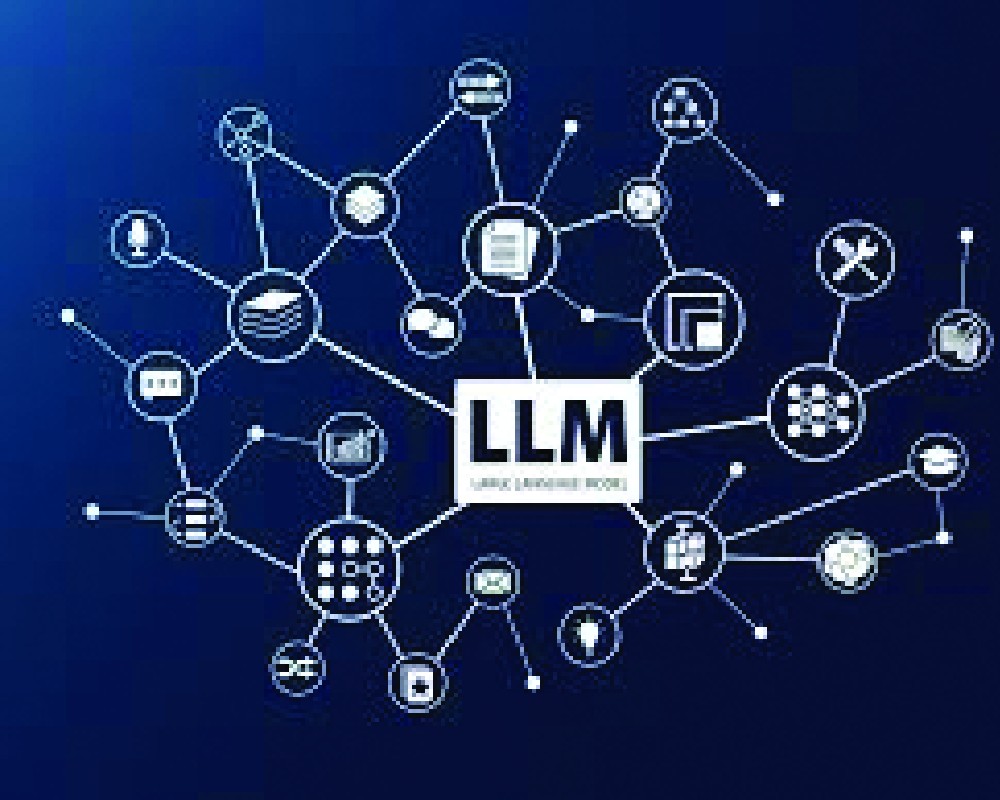
Artificial intelligence is reshaping global progress, and at the centre of this transformation is the Large Language Model, or LLM. Unlike a human mind, which begins with a thought and then searches for the right words, an LLM learns in the reverse direction. It reads billions of sentences across countless topics, discovers patterns in how humans communicate, and gradually forms a system that can respond in ways that resemble human reasoning. In simple terms, an LLM becomes a compressed version of humanity’s written knowledge.
This idea reflects a long-standing principle. Societies grow faster when knowledge is shared, reused, and expanded, instead of being rediscovered repeatedly. LLMs multiply our collective understanding by making knowledge instantly accessible and reusable. But the true foundation of this intelligence is language. Human civilisation stores everything that matters, including laws, culture, values, science, memories, and identity, inside language. When AI learns a language deeply, it also learns the
worldview behind that language. This makes language-based LLMs essential to any community that wishes to remain relevant in the AI era.
India faces a major challenge here. Public conversations about AI focus mainly on tools like image generators, video creation apps, filters, templates, and quick content systems. These tools represent only the visible layer of AI, the part people interact with. Underneath these tools sits the real engine-the LLM. It is the LLM that provides reasoning, knowledge, context, understanding, and logical structure. If a nation learns only to operate AI tools, it remains a user. If a nation builds the intelligence behind those tools, it becomes a leader. In the AI era, leadership
will belong to those who build foundational models, not those who merely use applications built by others.
This becomes particularly important for Indian languages. As the founder of the TamilAI project, I often face this question: if global systems like ChatGPT and Gemini already answer in Tamil, why should we build our own Tamil models?
It is a fair doubt, but the answer is crucial for India’s technological future.
While global systems can output Tamil text, the intelligence beneath those answers is shaped by English-heavy data and Western logical structures. These models learn mostly from English-speaking societies, absorb their patterns of thought, and then convert the final output into Tamil. The script is ours, but the mind behind the words is not. This results in Tamil expressed through a foreign cognitive framework-a translation rather than native reasoning.
It is Tamil translation of English reasoning, not Tamil reasoning itself.
For a language with the antiquity and depth of Tamil, this is not enough. A language that survives only at the output layer risks losing its natural worldview and its cultural logic. To protect a civilisation’s knowledge, the language must exist inside the intelligence layer itself. Only when an LLM learns Tamil at its core, including its grammatical logic, philosophical foundations, idioms, poetry, history, and cultural reasoning, can Tamil survive as a thinking system in the AI age.
This perspective is influencing global AI policy. Europe is building LLMs for European languages to protect cultural sovereignty. China has multiple national LLMs. Japan and Korea have government-funded language models. These countries recognise that without native-language AI, technological and cultural dependence becomes unavoidable.
India stands at a similar crossroads. Tamil, Hindi, Telugu, Kannada, Bengali, and other major Indian languages must have indigenous LLMs built from their own knowledge systems. Only then can India move from being a user of foreign technology to a creator of global intelligence.
TamilAI is one early step in that direction, but the larger mission is national. India has the talent, the vision, and the cultural depth to build its own AI foundations. If we invest in our languages and create our own LLMs, we can not only participate in the AI era but lead it with confidence. The future is wide open for nations that build their own intelligence, and India is ready to rise to that challenge.
The writer is the Tamil Nadu BJP State Secretary and the founder of Project Tamil AI and the Integral Humanism Foundation; views are personal