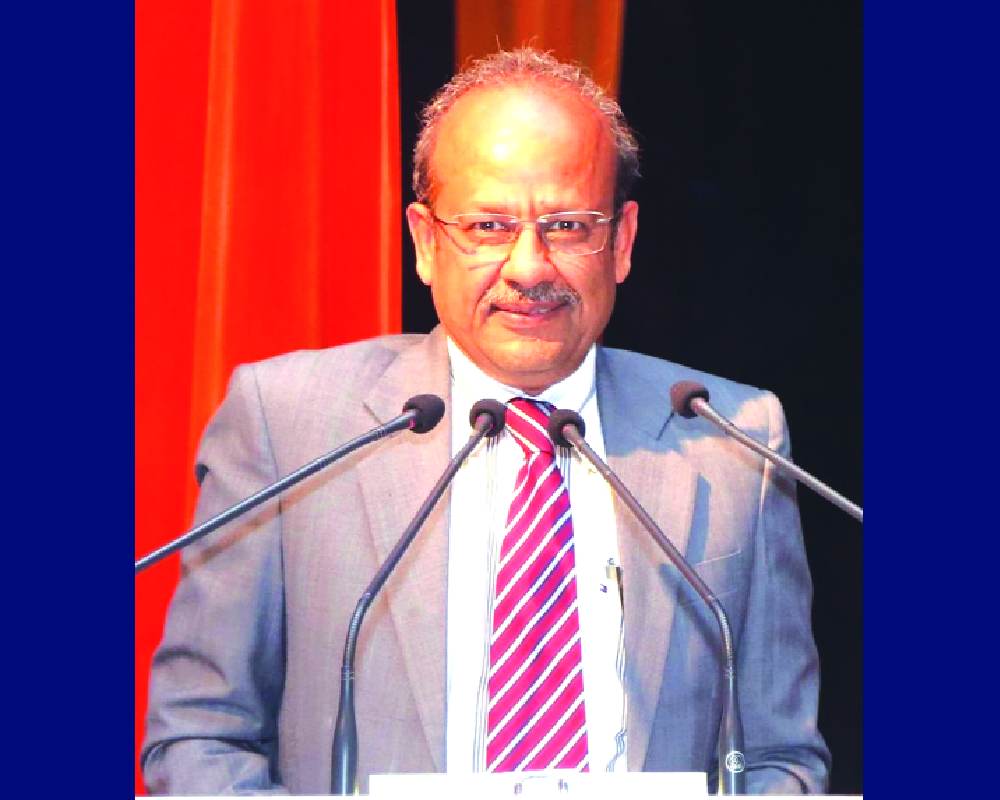
Supreme Court judge Justice Rajesh Bindal has underlined the need for strong arbitral institutions, stating that the country’s booming infrastructure sector requires expert involvement and problem-solving approaches to prevent disputes from stalling projects.
The Supreme Court judge was speaking at the 5th Biennial International Conference on Construction Law and Arbitration organised by the Society of Construction Law here on Friday evening, in collaboration with Khaitan and Co, Larsen and Toubro, JSA Advocates and Solicitors, among others. Justice Bindal said construction law is a highly specialised field.
He said the rapid growth of India’s infrastructure, including power, roads, metro, ports and dams, has naturally increased disputes.
“Activity is increasing, so the percentage of disputes will go up — some genuine, some creative. We should solve them at each stage, instead of taking the entire dispute to the end and stalling the project,” Justice Bindal said.
He endorsed institutional arbitration in construction disputes, to combat its current issues of inflated costs and delayed proceedings by ensuring the availability of technical experts, proper record-keeping, and structured case management.
He also stressed contract drafting as a key area for reducing disputes.
“The best form of agreement is where all relevant laws and terms are incorporated in a single document, avoiding overlaps and pathological clauses,” he said.
Justice Bindal warned about challenges posed by Artificial Intelligence (AI) in arbitration and litigation, including fabricated evidence, non-existent judgments, and confidentiality risks on open AI platforms.
Speaking at the event, Attorney General R Venkataramani called for dedicated legislation for the construction sector, underlining its current fragmented nature.
He urged law schools to play a larger role in shaping the future of construction law and regulatory frameworks.
Delhi High Court judge Justice Tejas Karia highlighted the rapid evolution and complexity of India’s infrastructure sector and emphasised the need for specialised dispute resolution frameworks.
“The future of construction disputes is clear. It will be faster, more data-driven and supported by technology. It will be less adversarial and more collaborative and rely on early resolution structures and enforcement.
If we build a dispute resolution system that is clear, predictable, economically enabled and globally trusted, we can position India as a hub for infrastructure arbitration,” he said.
Lalit Bhasin, president of the Society of Indian Law Firms, highlighted weaknesses in the current system, stating that litigation “has virtually failed” to resolve construction disputes and that arbitration has struggled because “we do not have good and strong arbitral institutions that would inspire confidence among the disputing parties.”
Stressing the need to revive India’s traditional approach to harmony, he said, “The only way out appears to be settling disputes within the arbitration framework, a pre-stage of consensual resolution.”
The event also saw the launch of a white paper issued by Khaitan and Co and SCL India.
The white paper, titled “Delay and Disruption under the Global Frameworks: A Framework for Structured Construction Dispute Resolution in India”, calls for the adoption of certain established standards along with stronger programme management and technology-driven evidence, to bring greater clarity, consistency and predictability to construction-related dispute resolution in India.