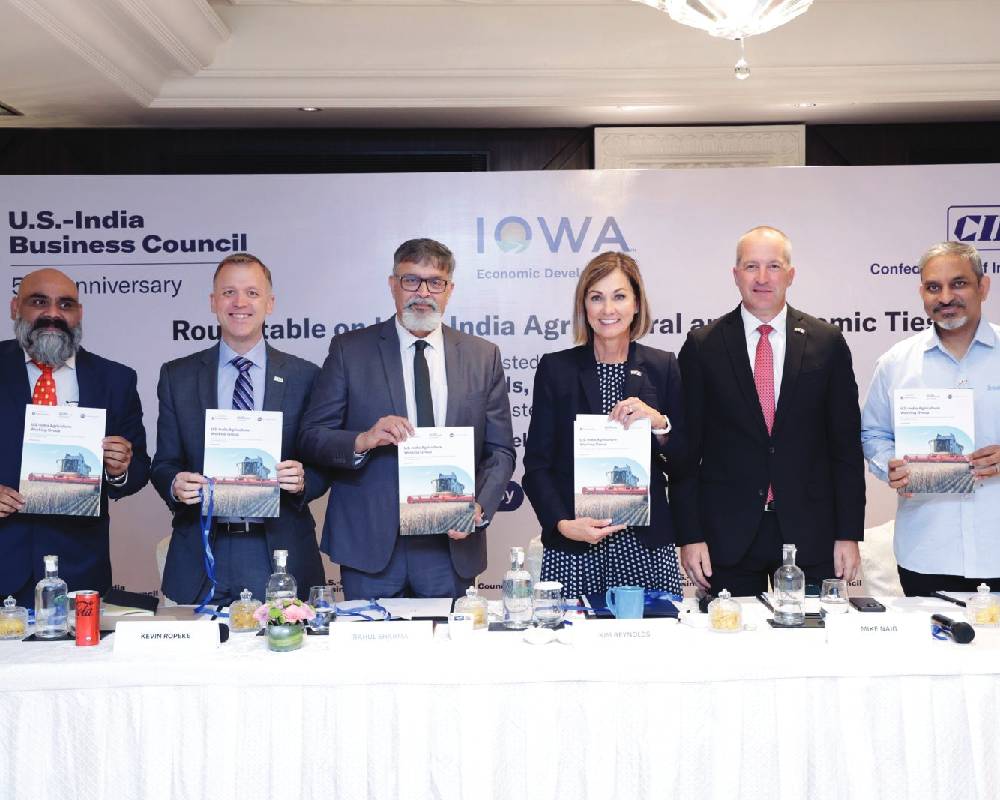
The US-India Business Council (USIBC) today formally launched the US-India Agriculture Working Group during a high-level roundtable held in New Delhi with Kim Reynolds, Governor of Iowa and her visiting delegation. The event marked a significant step forward in strengthening bilateral collaboration in agriculture, innovation, and sustainability. Hosted by USIBC, the roundtable underscored the Council’s commitment to deepening US-India cooperation in agriculture and allied sectors.
The newly established Working Group aims to serve as a dedicated platform to drive innovation, promote sustainable practices and expand trade between the two nations. Rahul Sharma, Managing Director of USIBC, highlighted the strategic importance of the initiative, stating, “The US-India Agriculture Working Group will be a catalyst for advancing innovation across sectors critical to our shared future, including renewable fuels, food security, and precision farming.”
Governor Reynolds, known for her leadership in agri-tech and sustainable farming in Iowa, reaffirmed the shared vision between India and Iowa. “This Working Group will provide a vital platform to strengthen bilateral cooperation and address global food security challenges,” she said. “Iowa is proud to contribute to this growing partnership through our shared commitment to agricultural innovation.”
The roundtable was held with support from the Confederation of Indian Industry (CII) and the U.S. Soybean Export Council (USSEC), with Grant Thornton serving as the knowledge partner for the Working Group. The initiative will focus on key areas such as regenerative agriculture, AI-powered farming solutions, and the strategic “4F” framework — Food, Feedstock, Fodder and Fuel. It also aims to promote policy alignment, boost investment opportunities, and foster cross-border partnerships to drive sustainable agricultural growth.
The launch of the US-India Agriculture Working Group reflects USIBC’s ongoing efforts to position agriculture as a central pillar of the US-India strategic partnership. By bringing together government officials, industry leaders, and academic experts, the initiative seeks to drive long-term innovation, support global food security, and build a resilient agricultural future for both nations.