Despite crores of rupees being spent on cleaning the Ganga under the Namami Gange programme, open defecation by slum dwellers along the banks of the holy river in various parts of Haridwar continues to contaminate the river. Lakhs of pilgrims from across the nation and abroad visit Haridwar for a holy dip in the Ganga, but the river continues to be contaminated due to open defecation.
The Namami Gange mission was launched to ensure the purity of the Ganga, and about Rs45,000 crore have been spent on it so far. Works under the project have brought about some improvement, but blatant gaps like open defecation along the banks of the Ganga in Haridwar still remain. The open defecation also contradicts the claims of the Uttarakhand Government.
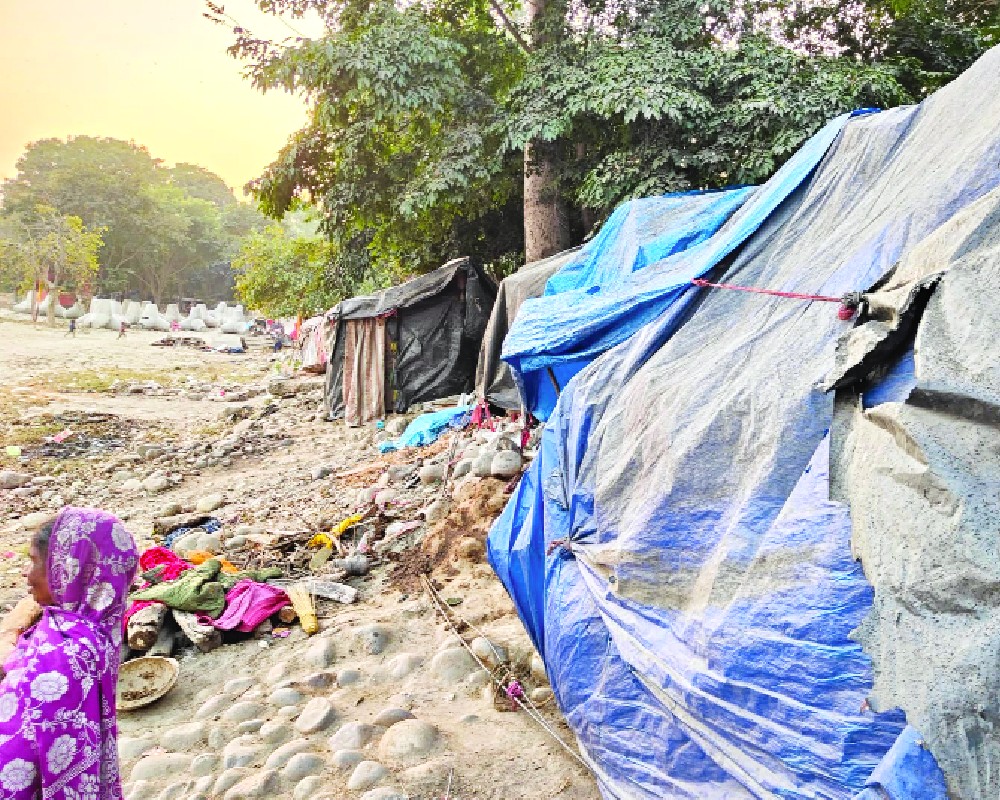
In 2017, the State Government had claimed that Uttarakhand was Open Defecation Free (ODF). Before this announcement was made, a considerable number of toilets were constructed under Namami Gange to prevent contamination along the Ganga. However, this correspondent visited various areas in Haridwar, including Chandighat, Laljiwala, Bairagi Camp and Bajriwala, among others, where residents of slums defecate in the open daily. There is a major shortage of toilets in these settlements, forcing the residents to defecate in the open. The situation is the worst in the Chandighat settlement. About 6,000 people reside in this area along the Nildhara bank, but there is not a single proper toilet in the area. With no other option, the majority of the residents of this slum defecate in the open near the Namami Gange Ghat, causing contamination of the Ganga and the city. The slum dwellers state that they have no toilets and hence defecate in the open, as they have no other option.
Sheela, who lives in a shanty in the Chandighat area, said that they have no toilet and that her family defecate in the open.
Another local said that she has been living in a hut near the Ganga since 1992 and that they use a public toilet when they have enough money to afford the facility.
Haridwar district magistrate Mayur Dixit said that most of these places are illegal settlements. These are encroachments on government land, and due to this, it is not possible to construct toilets in such locations. Any construction is illegal in a place where Government land has been encroached upon, he said.
The DM told The Pioneer the public toilets built near such places can be used by the residents, adding that the authorities are raising awareness among the locals to use such public facilities.
A fact check on Ganga — a holy river that originates in the Dev Bhumi but flows with a sordid tale of human neglect — flushing human waste and washing down multi-crore funding efforts by the Centre and State. Today, The Pioneer starts a campaign to wake up the authorities, stakeholders, and last but not least, the citizens, the most important link in the chain.