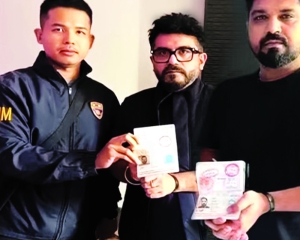
Delhi Police has arrested five people in connection with a large-scale social media investment fraud racket, uncovering a sophisticated network involving fake companies, mule accounts and active collusion of bank employees. The accused identified as Rahul Kumar (32), Ajay Sharma (32), Sonu Kumar (36), Kunal Sagar (28) and Mohit Dadhich (27) who allegedly lured investors through social media messaging application channels, promising high returns on fake investment schemes.
Searches at multiple locations led to a massive recovery: 14 SIM cards, 4 mobile phones, 2 laptops, 17 company seals, 11 debit cards, and several forged PAN and Aadhaar cards. Police also seized digital evidence, including Telegram chat logs, screenshots, and transaction records. So far, investigators have identified over 250 mule accounts and 50 bogus firms linked to the racket. The network included recruiters, document forgers, account operators, and corrupt bank employees.
According to the Central District Cyber Police, the accused lured people through Telegram channels with false promises of high returns. One woman lost `4.8 lakh after being convinced by a user named “Lalitha” to invest through a fake online scheme. Small initial profits were shown in her account to gain trust before the fraudsters disappeared with her money. “Cyber frauds are evolving with alarming speed. What makes this case different is the deep collusion between fraudsters and bank insiders,” said DCP (Central District) Nidhin Valsan.
“We are now tracing how these mule accounts were created and how the proceeds were layered to hide the money trail.” The investigation began after the woman filed a complaint in March 2025. Technical and financial tracing led them to an account in Karnataka Bank, opened in the name of a firm called AJ Technology. The account had been created using forged documents. Within two months, `2.5 crore had passed through it. The account holder, “Ajay Kumar”, turned out to be a fake identity. The real operator, Rahul Kumar, was arrested from Prem Nagar, Kirari.
Rahul told police he had been running the fake account using forged PAN and Aadhaar cards. He admitted to working with agents who arranged “mule” bank accounts for the fraudsters. Police say Rahul’s business partner, Ajay Sharma, a local cyber café owner, helped forge IDs and complete fake KYC verifications. Both men were arrested. Their network spread wider. Sonu Kumar, a skating trainer with knowledge of GST filings, was next to be caught. He had taught others how to use GST registrations to make the firms look legitimate. Another accused, Kunal Sagar, played a key role in procuring fake KYCs and opening over 20 mule accounts at Karnataka Bank’s RK Puram branch.
The investigation then pointed toward the bank itself. Evidence indicated that Mohit Dadhich, a Karnataka Bank official at the same branch, had helped open fraudulent accounts by ignoring KYC rules. He allegedly took commissions of up to 1.9 per cent per transaction. Dadhich was arrested, while another bank employee, identified as Abhishek, is absconding.
Investigators say the fraudsters used multiple accounts to layer transactions and move money beyond trace. Funds were routed through various banks before being withdrawn or converted to cryptocurrency.
Police have begun freezing linked accounts and forwarding evidence to the Reserve Bank of India and Karnataka Bank headquarters for regulatory action.
“Banking insiders played a crucial role in shielding these fraudulent accounts,” a senior officer said. “Without their help, such a scale of operation would not have been possible.”