In his work, Ram Madhav examines the crumbling Western order, the rise of new powers and how India can seize its moment in history, writes Kanishk Shekhar
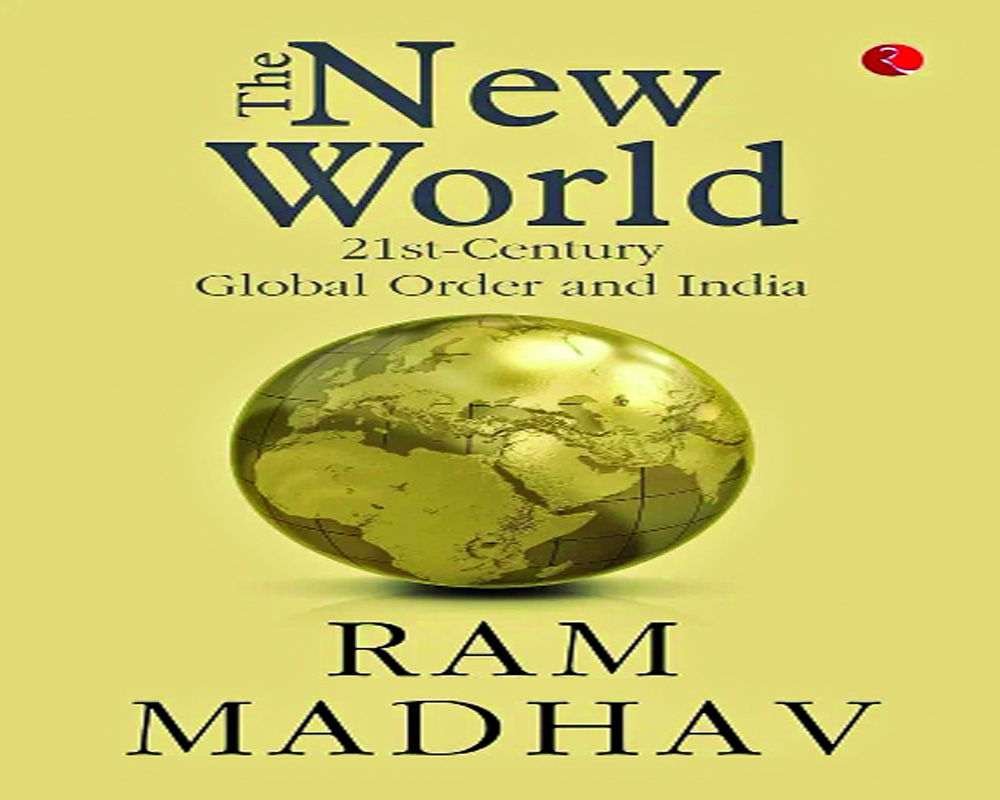
In his renowned work, ‘The Origins of Political Orders’, Francis Fukuyama writes that nations are not bound by their historical contexts. Nevertheless, in numerous instances, events that transpired thousands of years ago continue to significantly impact the political landscape of a country. The past provides crucial insights for the future, especially as the current geopolitical framework remains in a state of flux. This transitional period presents unique opportunities for India to assume a pivotal role in shaping what lies ahead. A thorough examination of the potential structure of the emerging world order and the contributions that rising powers like India can make is essential, which is exactly what Ram Madhav addresses in his latest book, ‘The New World — 21st Century Global Order & India’.
Ram Madhav continues to be a significant political figure who has been associated with the RSS & held the position of National General Secretary of the BJP. He is currently the President of the Delhi-based think tank ‘India Foundation’, a renowned strategic thinker & author writing on diverse domains. His most recent work aims to understand the current global order, characterised by the decline of the liberal Western order and the potential new structure that may arise.
The first chapter of the book explores the ascent and decline of ancient empires. It also explains the post-World War II emergence of a USA-led global order, which purports to uphold a ‘rule-based international order.’ However, this order began to deteriorate in the late 1990s, the downfall became increasingly evident during the Covid-19 pandemic, & is now on the verge of being supplanted. Madhav provides an in-depth analysis of the events and phenomena that contributed to the establishment of ‘Pax Americana’. He notes that the formation of NATO and the Warsaw Pact are indicative of the challenges that afflicted the new world order after the conclusion of the Second World War. While finding reasons that resulted in the weakening of multilateral institutions, the author rightly attributes it to the actions taken by the United States that overshadowed these entities. The Bretton Woods institutions (IMF, World Bank) advocated for globalisation; however, the US prioritised its narrow interests, which were at odds with the essence of true multilateralism. Madhav cites Nobel laureate Joseph Stiglitz, who stated, “Western countries have opened doors to eliminate trade barriers but have maintained their barriers, hindering developing nations from exporting agricultural products.”
Furthermore, during the 1960s and 70s, the US openly employed autocratic leaders as proxies to intervene in rival camps. It orchestrated coups and uprisings even against popular & elected leaders. Presently, the US is withdrawing from its prominent position. It exited Afghanistan in a rather disrespectful way, and in 2023, China succeeded in aligning one of its allies — Saudi Arabia — with its adversary — Iran. The decline of American influence results in a power vacuum, which subsequently motivates other nations to step in.
The chapter on China is remarkably significant. The ascent of China may inevitably lead to the world entering a Thucydides trap, where conflict between the dominant power (USA) and the rising power (China) becomes nearly unavoidable. This situation is already unfolding in sectors such as rare earth elements & semiconductor chip manufacturing, where the USA has placed Chinese firms on the sanctions list. Another significant theme emphasised in this book is the shift in the global order from unipolarity to multipolarity, accompanied by power imbalances. A more varied order is currently grappling with multiple contenders for leadership roles, including India, Russia, Europe, Turkey, Arab nations, Africa, and ASEAN.
Madhav dedicates an interesting chapter discussing the emergence of ‘Heteropolis’ — the non-state actors that exert significant influence on geopolitics. Starlink, owned by Elon Musk, helped Ukraine when its deputy PM reached out to him for help.
Starlink revitalised Ukraine’s communication infrastructure during the Russian onslaught. However, Musk declined Ukraine’s request to extend it over Crimea, citing it would be similar to ‘Russia’s Pearl Harbor movement.’ All this when Musk was not even remotely a part of the Government. It appears challenging to reclaim the sovereign authority of governments from the powerful lobbies of MNCs, Tech giants and NGOs. This chapter also details the influence of other non-state actors such as Soros, Oxfam, and the Gates Foundation.
The author has not confined the book solely to geopolitics; rather, it adopts a multi-disciplinary perspective. It also encompasses ecological, technological, and philosophical aspects. In chapter 8 — ‘Future Shock: The AI Era’ — Madhav warns about the dangers associated with unregulated AI, as it has the potential to exacerbate the societal divide between those who possess technology and those who do not. He references Sam Altman, the developer of ChatGPT, stating, “If AI is permitted to operate without control and regulation, then doomsday is not far off.” The author further cites the likes of Stephen Hawking & Nandan Nilekani, who have a profound understanding of technology, to underscore the threats that AI presents.
In subsequent chapters, the author emphasises two significant and opposing socio-political movements that are influencing the emerging order, Resurgent nationalism and wokeism. Wokeism, which has surfaced as a contemporary variant of Cultural Marxism, is characterised as a “disorganised collection of various disruptive ideas that advocate for anarchy.” The book delves into the origins of Cultural Marxism, tracing it back to the Frankfurt School in Germany and thinkers such as Gramsci. There is a notable backlash against wokeism & its cancel culture from prominent figures, including Steve Bannon, Vivek Ramaswamy, Tucker Carlson, Elon Musk, and others.
Madhav presents an optimistic perspective on India, praising initiatives such as SAGAR, the Neighbourhood First policy, and the overall foreign policy approach under PM Modi, which emphasises pragmatic realism and national interest. The ‘Panchamrit doctrine’, which highlights five fundamental pillars of foreign policy, has enabled India to cultivate more friendships in a world that continues to be in a state of change.
This book is not only thought-provoking but also exceptionally well-researched. Readers will come across citations and references from leading authorities on geopolitics on nearly every alternate page. It affirms that geopolitical orders are not permanent; they are constructed, nurtured, contested, and solidified through continuous efforts. Ram Madhav’s work serves as a comprehensive analysis of the increasing uncertainties in geopolitics, while also acting as a clarion call to India’s leadership. He provides a detailed intellectual framework for India’s ascent. Anyone interested in power dynamics and the influence of norms and values on the world, as well as their ongoing impact on our shared future, will find this book to be an engaging read. Students, researchers, diplomats, journalists, and ordinary individuals seeking to comprehend the intricate world we inhabit will greatly value this book.
Title: The New World: 21st-Century Global Order and India
Author: Ram Madhav
MRP: Rs 795
Page Extent: 408
Publisher: Rupa Publications
(Kanishk Shekhar is a columnist & also teaches students preparing for Civil Services Exam)