As an Indian-born Russian citizen who has made Russia his home for decades and now serves as a two-time elected legislator in the Kursk State under President Vladimir Putin’s United Russia Party, I occupy a rare vantage point. I am rooted in Indian heritage yet deeply committed to the Russian state and people. This dual identity allows me to see the India-Russia partnership not only through the lens of geopolitics and diplomacy but also through civilisational continuity, cultural warmth, and human connection.
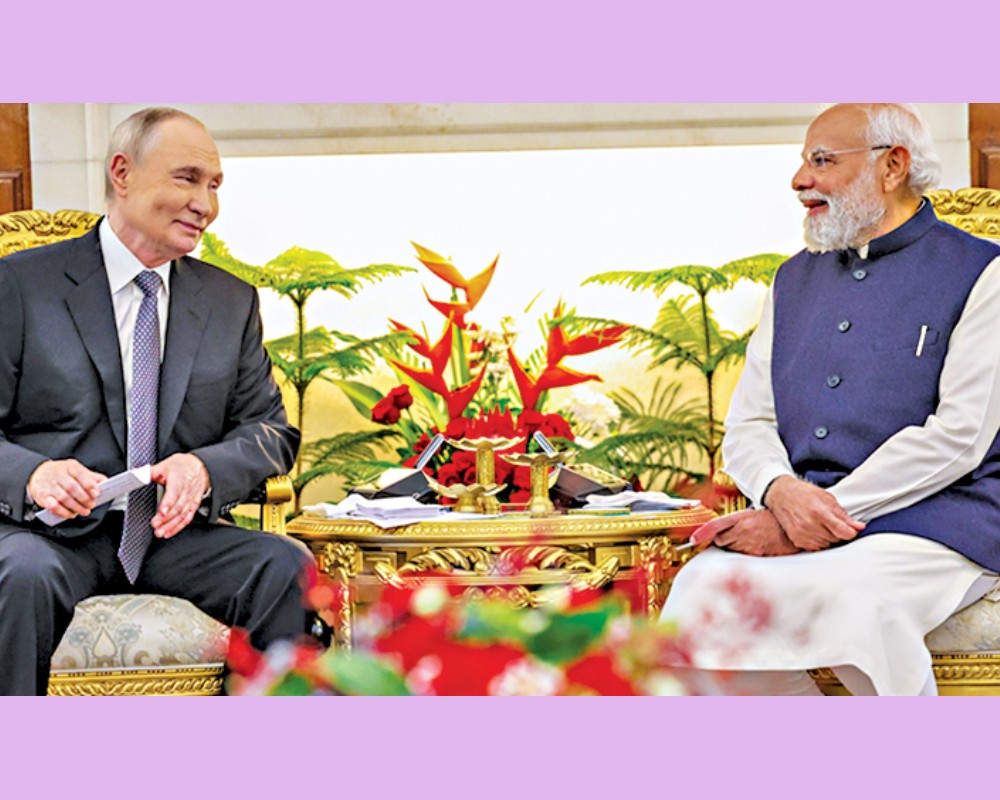
President Putin’s visit to India is a vivid reminder that the relationship between our two nations does not depend on fluctuating global winds. It is grounded in trust accumulated over decades and reinforced by genuine goodwill between the leaders guiding both countries today.
Despite global turbulence, shifting alliances, and emerging rivalries, the deep mutual respect between India and Russia remains one of the least disrupted relationships in modern international affairs.
One of the most compelling aspects of our bilateral relationship today is the personal chemistry between President Vladimir Putin and Prime Minister Narendra Modi. Personal diplomacy is often underestimated by those who view the world only through structural or strategic frameworks. But anyone who has witnessed these leaders together knows that personal warmth and trust can accelerate cooperation in ways that formal channels alone cannot.
I recall the recent Shanghai Cooperation Organisation summit in China, where both leaders travelled in the same car — an unusual gesture in diplomatic practice. Before that, Prime Minister Modi broke strict protocol by personally receiving President Putin at the airport, accompanying him to the red carpet. These are not mere symbolic acts. They reflect instinctive comfort and mutual respect cultivated over years. Their relationship predates their rise to the highest offices and is built on familiarity, clear communication, and confidence in each other’s intentions. Such gestures cannot be choreographed or fabricated.
They demonstrate genuine rapport between two leaders who understand their historical responsibility. This personal trust has tangible policy consequences: negotiations move faster, uncertainties shrink, and long-term projects gain continuity. In a time of global uncertainty, such a relationship is not just beneficial — it is essential.
A crucial aspect of our cooperation is defence. One example is the Su-57 fighter jet, which offers India a strategic advantage. The Su-57 is not only technologically advanced but also far more cost-effective than Western alternatives such as the French Rafale. For the price of one Rafale, India can acquire two Su-57s, significantly strengthening its defence capabilities. Moreover, the deal with Russia includes licenses for ‘local manufacturing, operation, and production in India’, supporting domestic defence production and self-reliance. Such agreements highlight how the India-Russia partnership goes beyond diplomacy into tangible national security benefits.
What makes the India-Russia relationship exceptional is that it is not dependent on any single pair of leaders. Our shared history stretches back nearly eight decades in its modern form, and even further in cultural and civilisational terms. India and Russia have never been adversaries—never fought a war, never clashed over territory or ideology, never confronted each other even indirectly. This absence of conflict is rare in international affairs. Many nations today struggle with difficult pasts: colonial legacies, border disputes, ideological confrontations. India and Russia, however, have maintained goodwill consistently, across generations and governments.
This friendship is enriched by historical stories that may be lesser-known but are deeply telling. During the Soviet period, one of the world’s most closed political environments — Stalin’s daughter, Svetlana, was allowed to travel to India and live there. Such permission was nearly impossible to obtain at the time. Her visit was not just a personal journey; it symbolised the trust and respect the USSR extended toward India.
Even earlier, philosophical exchanges between Mahatma Gandhi and Leo Tolstoy created intellectual bridges linking two great moral traditions. Russian painter Nicholas Roerich, who lived in the Himalayas, left a vast artistic legacy that continues to connect our nations. These examples show that India–Russia ties are rooted as much in civilisational exchange as in statecraft.
In the present day, one of the most significant people-to-people bridges between our nations is education. Nearly **one lakh Indian students** study in Russian universities, especially in medicine, engineering, and technical fields. This trend spans three generations. Families trust Russian education because graduates return well-trained, well-prepared, and often capable of clearing Indian qualifying examinations with confidence. As Russian policymakers, we are committed to making this experience even more supportive. Indian students enrich Russian cities culturally, while the knowledge they acquire strengthens India’s workforce.
Cultural diplomacy is another powerful pillar of this relationship, with Bollywood playing a key role. Indian cinema once enjoyed immense popularity in Russia. Raj Kapoor’s films, in particular, created a wave of affection that still resonates among older generations. The songs, storytelling, and emotion deeply connected with Russian audiences. Later, Amitabh Bachchan and Mithun Chakraborty carried this legacy forward.
In recent decades, however, Bollywood has shifted its focus elsewhere, and younger Russian audiences have gravitated toward Hollywood. But this need not be permanent. Russia remains visually stunning, with its snowfall, white nights, and the unmatched beauty of Saint Petersburg. These cinematic treasures are waiting to be rediscovered. With the Russian government actively promoting cultural engagement with India, the moment is ripe for Bollywood’s return. Such collaboration would strengthen cultural understanding and revive the emotional connection that once defined our soft diplomacy.
At the strategic level, India and Russia continue to cooperate in defence, energy, nuclear technology, trade, and increasingly in sectors such as digital technology, pharmaceuticals, and manufacturing. What sets this partnership apart is its consistency. It does not fluctuate with elections, leadership changes, or international pressure. It evolves steadily because it is underpinned by mutual respect.
As the global order becomes more complex, the India–Russia partnership is poised to play a stabilising role. Both countries have the capacity—and, more importantly, the desire—to build a world where cooperation outweighs confrontation.
As someone who carries both Indian heritage and Russian citizenship with pride, I believe deeply in the potential of this partnership. It is not just strategic or economic. It is emotional, historical, and human. It is a bond between civilisations, strengthened by people and guided by leaders who understand its importance.
The future of India–Russia relations, in my view, is bright—not because of treaties or agreements alone, but because of the trust that lives in the hearts of our peoples. That trust is our greatest asset—and the world would do well to pay attention to it.