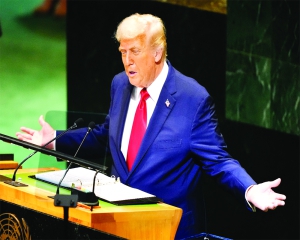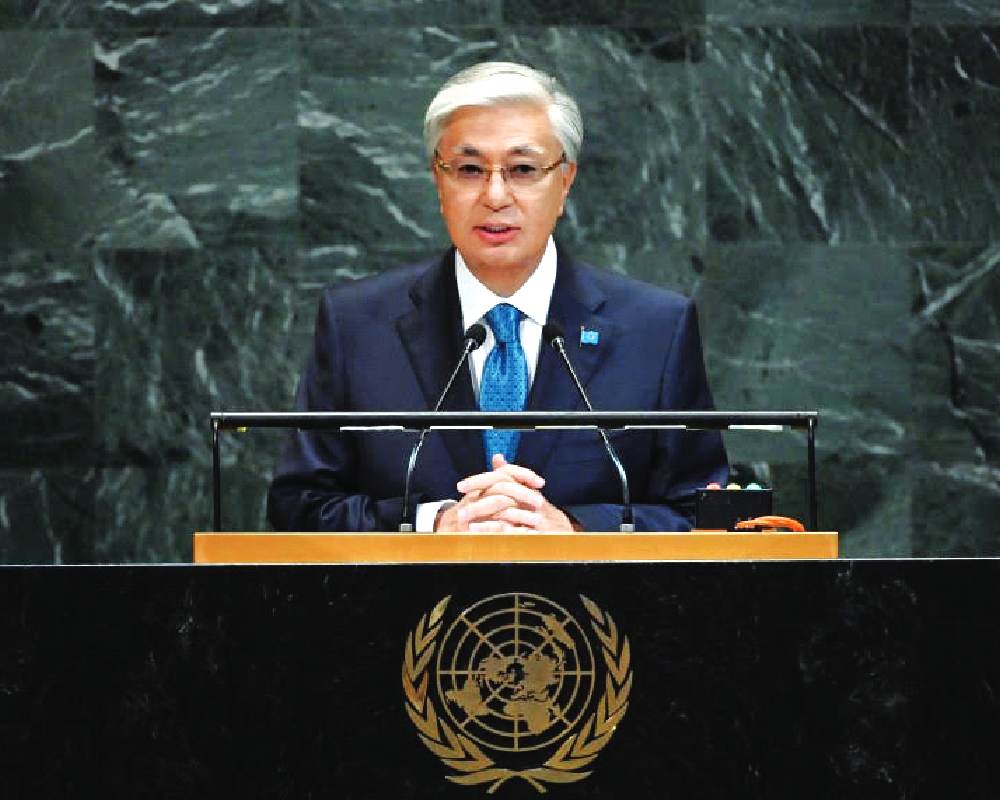
Kazakhstan’s President Kassym-Jomart Tokayev delivered a sweeping and visionary address at the 80th session of the United Nations General Assembly, calling for urgent reforms to the UN system, renewed global cooperation and stronger action on climate change, peacebuilding, and digital transformation.
In a time marked by deep geopolitical fractures and rising global tensions, President Tokayev urged world leaders to embrace diplomacy, trust, and shared responsibility. “The United Nations remains today a symbol of hope for millions around the globe,” he stated. “But we cannot turn a blind eye to the real crisis of trust in multilateral institutions.” Tokayev underscored that reforming the United Nations is no longer a matter of debate but an urgent imperative.
He called for the creation of a new, high-level group of professionals tasked with proposing concrete reforms to adapt the UN to today’s complex geopolitical landscape. A key focus of his speech was the reform of the UN Security Council. He advocated for the inclusion of major powers from Asia, Africa, and Latin America on a rotational basis and argued for a greater role for so-called “Middle Powers” in bridging divides when major powers are at odds.
“The voices of responsible Middle Powers must be amplified,” he said. “They can act as bridges within the UN when major powers are divided.” Reflecting on the devastating consequences of global conflicts, Tokayev warned that violations of international law have become normalized, eroding global stability. He highlighted the ongoing Ukraine crisis and the humanitarian catastrophe in Gaza, calling for peaceful resolutions and adherence to international humanitarian law. He reaffirmed Kazakhstan’s support for a two-state solution in the Middle East and praised diplomatic breakthroughs such as the normalization of ties between Azerbaijan and Armenia. “The psychology of animosity drags all involved in conflicts to the abyss,” Tokayev cautioned. “Political leadership must be rooted in mutual understanding and respect, not mutual suspicion and arrogance.” Kazakhstan, a long-time advocate of nuclear disarmament, offered to host a new dialogue on nuclear non-proliferation.
Tokayev emphasized the collapse of arms control treaties and called for high-level talks among nuclear states to reduce global risks. He also renewed Kazakhstan’s proposal to establish an International Agency for Biological Safety and Security, aimed at preventing misuse of biological research and promoting transparency. Climate change was a central theme in Tokayev’s address. He detailed the environmental degradation facing Central Asia, including the drying Caspian Sea and the melting glaciers of the Alatau mountains. Kazakhstan, he said, will host a Regional Ecological Summit in Astana in April 2026 and is actively leading regional environmental initiatives, including the preservation of the Aral Sea and a national campaign titled “Clean Kazakhstan.”
He proposed a UN resolution to designate April 22 as the International Day of Greening the Planet, encouraging a global movement toward sustainability. President Tokayev emphasised that Artificial Intelligence must serve humanity and called for global cooperation on AI governance.
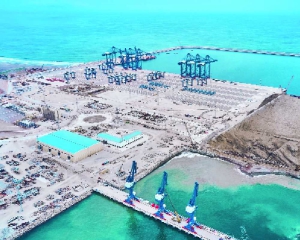
He welcomed the establishment of a UN-led Global Dialogue on AI and pledged Kazakhstan’s full participation. Domestically, he highlighted Kazakhstan’s rapid digital transformation, citing the country’s goal to become a fully digital power within three years. With 90% of public services already digitized and a national supercomputer launched, the country is preparing its youth for an AI-driven future. Touting over $400 billion in foreign investment since independence, Tokayev emphasized Kazakhstan’s open market principles and strategic role as a logistics hub between Asia and Europe. Ongoing investments in transport corridors, including the Belt and Road Initiative and Trans-Caspian routes, are positioning Kazakhstan at the heart of the global trade network. Agriculture and energy diversification, he said, will continue to fuel growth, with 2025’s GDP expected to grow over 6 per cent.
Concluding his address, Tokayev reaffirmed Kazakhstan’s commitment to being a “bridge-builder and peace-maker,” calling on world leaders to choose cooperation over confrontation and balance over domination. “We remain firmly on this path — deepening governance reforms at home while supporting global Governance abroad,” he said. “Kazakhstan stands ready to renew the promise of the United Nations as a beacon of peace, justice and cooperation.”