Assamese Cuisine: A Food Tapestry Par Excellence!

In the earliest recorded times, Assam was part of Kamarupa, a state that had its capital at Pragjyotishapura (now Guwahati). Ancient Kamarupa included, roughly, the Brahmaputra River valley, Bhutan, the Rangpur region (now in Bangladesh), and Cooch Bihar, in West Bengal state. King Narakasura and his son Bhagadatta were famous rulers of Kamarupa in the Mahabharata period (roughly 400 BCE to 200 CE). A Chinese traveller, Xuanzang in his travelogue Si-Yu-Ki (Record of the western regions), left a vivid account of the country and its people about 640 CE.
Assam was ruled by various dynasties — the Pala, Koch and Kachari — and there was constant warfare among the princes until the coming of the Ahom people in the 13th century. In the 15th century, the Ahom, who gave their name to the region, were the dominant power in upper Assam. Two centuries later they defeated the Koch, Kachari, and other local rulers to gain control of lower Assam up to Goalpara. Ahom power and prosperity reached its zenith during the rule of King Rudra Singh (reigned 1696-1714), before the kingdom was occupied by warriors from Myanmar in the late 18th century.
It is therefore quite evident that the region has deep historical and cultural roots — which also extend to the culinary sphere. It is indeed, the coming together of multiple influence points like the Ahom dynasty and neighbouring regions like Bengal, Myanmar and Bhutan. It has evolved through centuries, reflecting ancient traditions and contemporary culinary practices. Assamese food is rich in traditional dishes, blending flavours, ingredients, and history — the cuisine is characterised by the usage of less spices, deft cooking over fire, variety of meats like fish, chicken, pigeon and duck, along with strong flavours derived mainly from the endemic exotic fruits and vegetables that are either fresh, dried or fermented.
The staple grain of the state has been rice for the longest recorded time; the region’s fertile lands have been ideal for paddy cultivation, with the staple playing a significant role in the area’s history. I must mention that the earliest cultivation of rice in India dates back to around 3000 BC, with significant evidence of the grain found in the Indus Valley Civilization (3200-1500 BC) from sites like Mohenjo Daro and Lothal. In Assam, various forms of rice are consumed and include the soft ‘Komal’ rice, the sticky ‘Bora’ rice, aromatic ‘Joha’ rice, Black rice (Chak Hao) known for antioxidant properties, high nutrient density and low glycemic index, and the famous ‘Red’ rice. The list is strengthened by varieties like Ahu (autumn rice), Sali (winter rice) and Bao-dhaan (deep-water rice) — the last one known for its iron-rich content, and is grown organically in the low-lying, swampy and flood-prone areas. In India, red rice varieties have occupied a special position since time immemorial. In their respective treatises, the founding fathers of ancient Ayurveda — Susruta (c. 400 BC), Charaka (c. 700 BC), and Vagbhata (c. 700 AD) — refer to the medicinal value of shali, vrihi, and shastika rices, and list the rices according to their relative medicinal value, with the most useful type at the top of the list. Charaka, the author of Charaka Samhita, and other, later authorities classify the rakta shali or lohit shali rice (with red husk and grain) as the best; this variety is considered the most efficacious, and subdues the three deranged doshas. Black rice is considered to have originated in China from where it travelled to different parts of the continent. In China — it gained its nickname ‘forbidden rice’ because it was once restricted to Chinese emperors and royalty due to its rich taste and perceived benefits.
A rice dish from Assam, that immediately comes to my mind is ‘Poita Bhaat’ also called ‘Panta Bhaat’, which is consumed by many people in Assam; it is prepared by soaking and fermenting cooked rice overnight in water. It’s mainly popular in rural households — where this method is used to preserve the leftover rice and eaten as breakfast on the following morning along with salt, chilli,
oil, etc. This dish has immense health benefits as it is rich in probiotics and promotes gut health.
It is no surprise then, that it is one of the most popular dishes of the state, especially during the hot summer days.
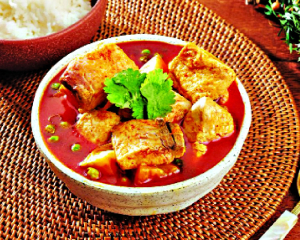
Chillies are consumed heavily in the tribal regions of lower Assam; they are added to the chutneys, dried fish and fermented foods — although they have become a darling of the culinary world in recent years, bhut jolokia (one of the hottest chillies in the world) has always had a revered place in the food systems of the many tribes of the north east. The heat quotient of the food differs from tribe to tribe, with the food of the Bodo and Mishing tribes of the state being spicier than others. Fish occupies a high position in Assamese cuisine and the ‘Masor Tenga’ is a classic and signature dish of the state. It’s a tangy fish curry, with ‘Mas’ meaning fish and ‘Tenga’ meaning sour in Assamese. This dish is a staple and is known for its refreshing and light flavour profile. Another favourite is ‘Patot Diya Maas’ (steamed fish wrapped in banana leaf) — the tiny fresh river fishes (like Boriyola or Dorikona) are used to prepare this dish; the cleaned fishes are mixed with aromatic herbs like coriander, cilantro/sawtooth coriander, chopped onions, chillies, salt and mustard oil, wrapped in banana leaves or aromatic turmeric leaves and steamed — a hint of aromatic lemon (like Gul Nemu) is also added for a burst of flavour.
A satisfying offering from the state includes the much-loved ‘Pitika’; it refers to a variety of mashed dishes, with Aloo Pitika being very popular. It is basically charred or boiled vegetables or fish mixed with green chilli, onion, chopped ginger, mustard oil, and coriander leaves. A variety of ingredients like potato, eggplant, pumpkin, red lentils, and even fish can be prepared into a Pitika. This dish retains the original flavour of the basic ingredient combined with the pungency of raw mustard oil and aromatics — it can be easily prepared and served with rice, making it a wholesome and tasty comfort food from the Assamese stable. ‘Dhekia Xaak’ is another flavour bomb; it uses Fiddlehead ferns, which are the furled fronds of a young fern, harvested for use as a vegetable. They are known for their unique, slightly nutty, and somewhat asparagus — like flavour and are considered a seasonal delicacy. It is a vegetable, which is commonly eaten in the hilly regions of India. Dhekia Xaak is a sign of spring’s arrival, and the Assamese love their Dhekia and cook it with tomatoes, dried shrimps, dried mangosteen and is mostly stir-fried!
‘Khar’ is a dark liquid, and one of the famous Assamese recipes, which is prepared by sun-drying banana peel, collecting ashes from the burnt peel, and filtering them with fresh water. The procedure may sound a bit complex, but ‘Khar’ is quite a popular recipe in Assam and is widely prepared in different cities in the state. The dish is often cooked with raw papaya, lentils, spices, and seasonings, all of which lend it a perfect flavour and the right amount of spiciness. Each tribe has its own method of preparing ‘Khar’ and the ingredients used in the recipe might also differ.
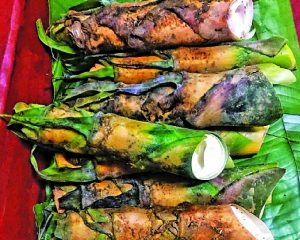
Assamese food has meat forms that are quite unique, with Pigeon and Duck being the stand-out features of the state’s cuisine. The first is a part of a dish called ‘Paror Mangsho’ or pigeon meat curry-pigeon meat usually makes your body warm and is perfect to eat in winter; it tastes best when eaten with Koldil (banana flower) which is a common side dish in the food of Assam. This dish combines the delicious texture of the banana flower-buds of the banana plant that are soaked and shredded for use in curries. The second, i.e., duck, is found in the famous ‘Haah Joha Kumura’ — a traditional duck curry made with tender duck meat, ash gourd, and a collection of aromatic spices — it is a crowd-favourite at Assamese feasts and festivals. The inimitable non-vegetarian spectrum of the state is also exhibited through ‘Til Diya Kukura Mangxo’-Assamese black sesame chicken curry; it is mildly spiced, and known for its balance, smoky and nutty flavour that comes from the toasted black sesame seeds. Distinctive features of the state’s cuisine are showcased through ‘Khorisa’ — fermented bamboo shoots, which have a tangy flavour, and used in vegetarian and fish curries. Similarly, ‘Pumpkin’ features in various curries and sweet dishes; all parts of it — like seeds, leaves, stem, flowers — are used showcasing its versatility-it is exhibited through ‘Ronga Lau Pitika’ (mashed pumpkin dish) and Pumpkin ‘Oambal’ (sweet-and-sour chutney made using tamarind, jaggery and chilli). Another flavourful delight is ‘Ou Khatta’ — a sweet-and-sour chutney made primarily with elephant apple (known as “Ou” in Assamese) and jaggery; the elephant apple is boiled, mashed, and then sautéed with mustard seeds in oil before jaggery is added. It’s a popular accompaniment to curries and rice in Assamese cuisine. The regional cuisine’s depth is clearly exhibited by ‘Pani Tenga’ — a staple in Assamese cuisine, made by fermenting mustard seeds with acidic extracts from mangosteen, tamarind, or lime juice. The mixture is kneaded into a dough, wrapped in banana leaves, and left to ferment in bamboo containers for one to two weeks. This traditional preparation method not only enhances the flavour and texture but also promotes the growth of beneficial bacteria. The state continues with its mouth-watering offerings through its sweet dishes like ‘Pitha’ — a traditional Assamese dessert made from rice or wheat flour. The sweet dumplings come in various shapes and sizes, often filled with jaggery, coconut, or sesame seeds, and of different kinds like Til Pitha, Teler Pitha and Pani Pitha. Grated coconut, cardamom powder and sugar or jaggery come together in the delicious ‘Narikol Laru’ (coconut ladoos); they are bite-sized and often served on special occasions. Regional favourites also include ‘Komolar Kheer’ — a creamy dessert made from oranges (komola), milk, sugar and rice — it’s enjoyed chilled, and is a classic flavour bomb. ‘Doi Sira Gur’ is a popular breakfast or snack devoured in the state — it is made using curd (doi), flattened rice (sira) and jaggery (gur), and is often enjoyed on special occasions and festivals like Bihu. The range of sweet dishes remains incomplete without mentioning the famous ‘Bokakhat Peda’ — a dish from the town of Bokakhat, known for its rich, creamy texture and delicious taste — it is made primarily from milk and sugar, and flavoured with cardamom and often garnished with nuts.
Assamese cuisine offers dishes that can satisfy diverse taste buds; it is a great example of food that is in harmony with the environment, and a nutrition base that is legendary in its own right. I believe that the legacy of this cuisine needs to be understood and popularised by the youth of our country — and they need to become its principal disseminators of information — ensuring that the cuisine’s delightful offerings are made known to our children and the future generation. I believe this will guarantee much greater consumption of Assamese food by the youth, majority of whom don’t even know about the existence of such mind-blowing food. Assam for me stands for a state whose cuisine has an — Absolutely Spectacular Salubrious and Appetizing Menu (ASSAM)!
(The writer is Secretary, Cuisine India Society. Views are personal)