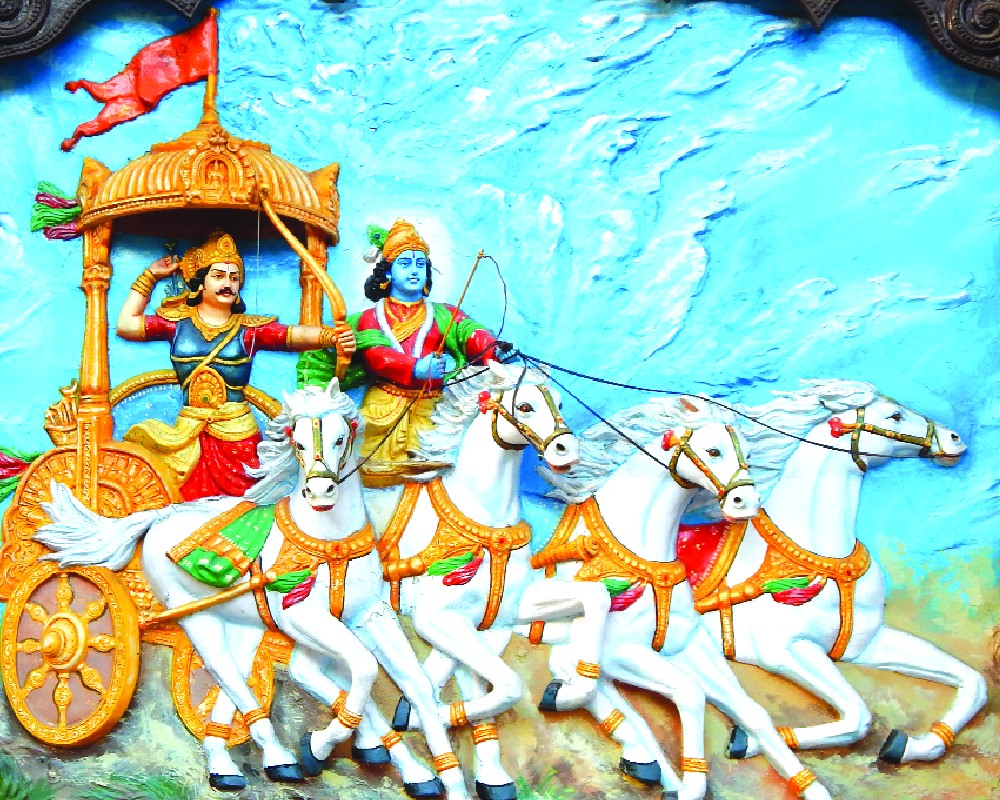
The Bhagavad Gita was inscribed on UNESCO’s Memory of the World Register in April this year. This recognition highlights its global significance. The Gita has been translated into all major languages of the world. The largest number of commentaries in various languages across the world have been written on the Gita itself.
The British scholar Charles Wilkins translated the Gita into English in 1785 as Bhagvat Geeta, or Dialogues of Krishna and Arjun. In 1787, AJ Parraud translated the Gita into French. In 1823, August Schlegel translated the Gita into German, and the German poet Friedrich Schlegel wrote a commentary on it. The distinguished British poet and journalist Edwin Arnold published a poetic English translation of the Gita in 1885, titled The Song Celestial: A Poetic Version of the Bhagavad Gita.
The American writer and philosopher RW Emerson wrote a famous poem centred on the Gita, called Brahma, in the nineteenth century. In the same century, the American poet and philosopher Henry David Thoreau, while commenting on the Gita, wrote that, compared to the Gita, world literature stands at a lower level. The American scholar Thomas J Hopkins, in his commentary on the Gita, praised its greatness. The English writer and philosopher Aldous Huxley, while writing the preface to Bhagavad Gita: The Song of God, translated by Swami Prabhavananda and Christopher Isherwood in 1944, described it as a great work. The list of the world’s scholars who have studied the Gita is very long.
In India, in the ninth century, Shankaracharya (788-820), while writing a commentary on the Gita, derived the principle of renunciation (sannyasa) from it. In the eleventh century, Ramanujacharya drew the element of devotion (bhakti) from the Gita and explained that knowledge is attained through devotion. In the thirteenth century, Saint Gyaneshwar composed the Gyaneshwari. In the sixteenth century, Eknath, and in the seventeenth century, Ramdas wrote commentaries on the Gita.
In the modern era, Rishi Arvind Ghosh presented his commentary by writing the book Essays on the Gita. The book The Bhagavad Gita as Viewed by Swami Vivekananda reveals how deeply Vivekananda was influenced by the Gita. The great Tamil poet and journalist Subramanya Bharati published a Tamil translation of the Gita. India’s former President Sarvapalli Radhakrishnan translated the Bhagavad Gita into English and wrote a commentary on it, stating that it is less a philosophical treatise and more a religious scripture. Bal Gangadhar Tilak, through his book Gita Rahasya, extracted the principle of Karma Yoga from the Gita. He wrote this book to provide a spiritual foundation for the Indian freedom struggle. Mahatma Gandhi wrote the book Gita Ki Mahima and called the Gita his mother. Vinoba Bhave translated every stanza of the Gita from Sanskrit into Marathi, in equal measure, as per the wish of his mother, Rukmini Devi. This work was named Gitai by Vinoba, which means Mother Gita. Kamalnayan Bajaj envisioned the construction of a memorial on Gitai. Thus, the conceptualisation of Gitai Mandir was the result of Kamalnayanji’s thinking.
The Bhoomipujan of this temple was performed by Vinobaji on November 4, 1964. It is worth mentioning that the occasion was graced by the presence of all three Bhave brothers, namely Vinobaji, Balkobaji and Shivaji. On November 4, 1969, the foundation stone of Gitai Mandir was laid by Khan Abdul Ghaffar Khan (Badshah Khan). Gitai Mandir was constructed on land covering 0.92 acres in Wardha, Maharashtra. Marathi shlokas of the Gitai, written by Vinobaji, were engraved on the rock slabs of this temple. This is the first project in India in which a complete Marathi scripture, Gitai, is engraved on rock slabs.
For inscribing 700 shlokas of 18 chapters of Gitai, 18 types of rock slabs were used. These rock slabs were brought from all four corners of the country, namely Chunar (Eastern Uttar Pradesh), Kolhapur (Maharashtra), Karoli (Madhya Pradesh), Bundi (Rajasthan) and Kuppam (Andhra Pradesh). Granite slabs were also brought from several places in Karnataka, Tamil Nadu and other areas. The parallel walkway was constructed using stones from Wardha, Tadoba and Saoner. Thus, the stones used in the construction of the Gitai Mandir firmly represent the unity of the nation.
The selection of rock slabs was based on the advice of specialists and proven experiments. They are least affected by possible weathering action, ensuring their durability in the future. While fixing the shape of the rocks, due consideration was given to the effects of rain, wind and sun. Each rock slab is 9 feet high, 2 feet wide and 1 foot thick, embedded 2 feet below ground level in concrete. The rocks have been kept naturally rough, symbolising the simplicity of the Sarvodaya programme and presenting a rural appearance.
One Gitai shloka is inscribed on each rock slab. These inscriptions are placed between 5 and 6 feet from the ground level, making them suitable for reading without obstructing movement. The size of the letters is large enough to be read easily from a distance of 8-10 feet. Care has been taken to maintain uniformity in the shape and size of all letters.
The temple encircled by these rock slabs has no traditional roof, floor or walls. There is a gap of 3 inches between consecutive rock slabs, allowing air and light to flow naturally. The shadows of the rock slabs change with the movement of the sun’s rays. In this way, the five elements-sky, sun, air, water and earth — are present in the temple, symbolising humanity’s natural connection with them. The rock slabs stand in a continuous row without interruption.
To enter the temple, steps are arranged in a tunnel-like form. Once inside, a visitor may move towards the left along a circular path to complete the circumambulation while reading the Gitai shlokas engraved on the slabs. Built of exposed concrete, the main entrance of the Mandir is unique in shape and size and is also a remarkable example of architecture (Vastukala). At the entrance stands a pillar in the shape of a Swastik, bearing Vinobaji’s words engraved in his own handwriting, expressing his emotional bond with Gitai. It reads:
“Gitai is my mother; I am her child. Whenever I fall down and cry, she lifts me up in her lap.”
Vinobaji’s messages to the world-Truth, Love and Compassion-are also engraved on the same pillar, along with the essence of the Gita in one word, Samyayog. The Gitai Mandir is not a traditional place of worship but a space for contemplation and meditation. The atmosphere of the temple is peaceful.
The Gitai Mandir reminds us of the wisdom of the Gita for living a meaningful and righteous life. The 700 shlokas of the 18 chapters of Gitai, inscribed on 18 types of rock slabs, offer philosophical, spiritual and practical guidance for navigating life’s challenges and attaining spiritual liberation. The Gitai Mandir emphasises the importance of performing one’s duty (dharma), acting selflessly, and remaining calm in both success and failure.