lalu Prasad Yadav’s conviction in the fodder scam is likely to impact Bihar politics deeply. So, is it the end of the road for the RJD chief and his dramatic political careerIJ Or, will he be able to make a comebackIJ Utpal Kumar looks at the past, present and future of the former Bihar Chief Minister and his brand of politics
(Bihar) has a claim to be the ancient heart of India. These days it is seen as the armpit... It has become a byword for the worst of India: Of widespread and inescapable poverty; of corrupt politicians indistinguishable from the mafia dons they patronise; of a caste-ridden social order that has retained the worst feudal cruelties; of terrorist attacks by groups of ‘Naxalite’ Maoists; of chronic misrule that has allowed infrastructure to crumble, the education and health systems to collapse, and law and order to evaporate.
— The Economist, February 19, 2004
Till 2005, for at least a decade and a half, if not more, Bihar was an ‘unliveable’ place. It appeared chaotic, lawless and ludicrously hazardous. To be here was “outright dangerous”, as Rajesh Chakrabarti says in his recent book, Bihar Breakthrough. In truth, however, the State had its own set of rules and regulations — the dos and don’ts of survival in lalu Prasad Yadav’s Bihar. There was a method in this madness, which most outsiders missed owing to their fixed notions of governance. No wonder, for an outsider a Mohammed Shahabuddin or a Pappu Yadav appeared as a hardcore criminal who deserved to be behind bars, but for most people in Bihar they were one of the indispensable ingredients for day-to-day survival. These gangsters needed lawlessness to thrive, and people needed these very unruly elements to endure this lawlessness.
In Siwan, ironically the land for Rajendra Prasad, the first President of independent India, Shahabuddin was a modern-day Robin Hood who would get work done for the poor. Among other things, he got the Siwan hospital renovated, built a stadium, a girls’ college and a town hall, besides ensuring there was a medical and an engineering college in the area. As the ‘messiah’ of the downtrodden, he would issue a fatwa to doctors to limit their fees to Rs 50 and set aside a day for free treatment for the poor, and such was his terror that very few medical practitioners would dare to disobey his diktat. Being extraconstitutional, he brought law in lawless Siwan. Similar was the case in Purnea, where Pappu Yadav ruled the roost. And his presence made the difference: The constituency would have almost 24 hours of power supply when he became MP for the first time — just because he allegedly threatened to burn down the power station if there was a power cut. Brought up in the neighbouring district of Katihar, I (like many others) would often wish for a Pappu Yadav-like don to become my MP or MlA. My district, unfortunately, despite being so close to Purnea or Kishanganj (the karmabhoomi of Mohammed Taslimuddin), never had a don to take up its cause!
It’s not as if no effort was made to curb crime in lalu’s Bihar. West Champaran, located in the northwestern corner of the State and home to Mahatma Gandhi’s first experiment with truth in India, had been the ‘Chambal of Bihar’ in the late 1980s and the 1990s, thanks to the presence of a number of dacoit gangs. Things had come to such a pass that an SP was put in there with the specific order to check the rampant dacoity in the area. This officer, in his attempt to curb crime, took an unusual step: He called up the heads of all major gangs and told them that traditional dacoity involved a lot of violence and risk for them. With wealthy families increasingly resorting to banking, dacoity was also turning into a venture of diminishing returns. It, therefore, made perfect sense, advised the police officer, to switch to kidnapping, which would force the families of the victim to mobilise funds themselves to secure the release of the kidnapped person. less violence and, if captured, even lesser punishment! In no time, the menace of dacoity was curbed and kidnapping became the most flourishing cottage industry in the State.
Amid all this, lalu never forgot to forward his ‘socialist’ agenda. Whenever people would seek a good, capitalist life,
lalu would come up with better, ‘socialist’ answers. “Why do we need cars,” he would ask, “when Bihar has no roadsIJ And the poor use (oil-burning) lanterns, so what will you do with electricityIJ” Similarly, when there were floods, he would exhort people to use this opportunity to fish from the comfort of one’s own bed! It was lalu’s world and these were his ways of dealing with issues plaguing the people and the State.
lalu had his way of promoting literary/ cultural activities as well. He discovered the modern-day Ramdhari Singh Dinkar, one of the country’s most renowned Hindi poets, in one Brahmanand Paswan and made him the Rajya Sabha MP. Paswan’s claim to fame was that he had penned lalu Chalisa on the lines of Hanuman Chalisa. Then, there was one Rambachan Rai, who had written an article in praise of the RJD chief. The Government introduced this piece of work in the Bihar Secondary School’s syllabus for Class VIII. For this ‘masterpiece’, he was made the chairman of the Hindi Pragati Samiti. Similarly, when one Amar Kumar Singh penned a biography of lalu Prasad, Gudri ka laal (Diamond from Tatters), he was appointed as the chairman of the Bihar Hindi Granth Academy. likewise, Shankar Prasad was made the chairman of the Sangeet Natak Academy. Prasad was a folk singer who had composed several songs in praise of lalu and his wife Rabri Devi, and which RJD workers would often use during their election campaigns.
lalu still looms large
Eight years down the line, Patna stands unrecognisable. And lalu appears to be a thing of the past. The dinosaurian past. Roads have improved and are crowded with all kinds of vehicles — from tiny Tata Nanos to large SUVs. After decades of lying low, wealth is now being flaunted openly and the city seems to have been bitten by the mall bug. One finds Dominos and McDonalds everywhere. last heard, a night bar has opened in the city. And women are finally on the roads, literally, well into the night, without fear of being harmed in any way.
The 1 Anne Marg, official residence of the Bihar Chief Minister, too is a transformed place now. “Earlier, during
lalu’s time, there used to be a mela-like milieu everyday. People would be seen coming and going even in the midnight. It would never appear like the official residence of the Chief Minister. It was more like the home of a big zamindar,” says a Patna-based journalist who is believed to be close to the current incumbent Nitish Kumar.
He then clarifies: “It’s not that people don’t come now. They do. But today it’s more professionally-operated. I remember laluji calling me up when his wife was Chief Minister and saying, ‘Why don’t you come hereIJ We have got fish from Munger, mutton from Nalanda... Come with your family.’ His relationship would be more informal. Nitishji has, over the years, made it formal... and professional. Now you find more of a corporate culture here, rather than zamindari.”
This ‘corporate’ culture is not without its side effects. Ajay Kumar, the editor of Bihar Times, reveals how this has impacted the State media. “lalu is often the villain of the piece, and not always for the wrong reasons. But as far as the media is concerned, lalu never directly tried to control it. He could never think of institutionalising the control wherein you would appear free, but in reality your freedom was conditional to financial/advertorial constraints. Newspapers would often be full of anti-lalu stories then. Not anymore. You don’t find much of anti-Nitish stories now,” says he.
Though the lalu era seems to be a thing of the past, he still looms large over people’s imagination. Shatrughan Prasad, a Patna-based intellectual, puts it straight when he says, “People here are unhappy with Nitish not because he has suddenly started performing badly. What they are wary of is that the Chief Minister, with his stringent anti-Narendra Modi stand, has opened the way for lalu and his brand of politics to make a comeback in Bihar. At least people here think so. For us, lalu is the area of concern, not Modi.”
Dream to nightmare
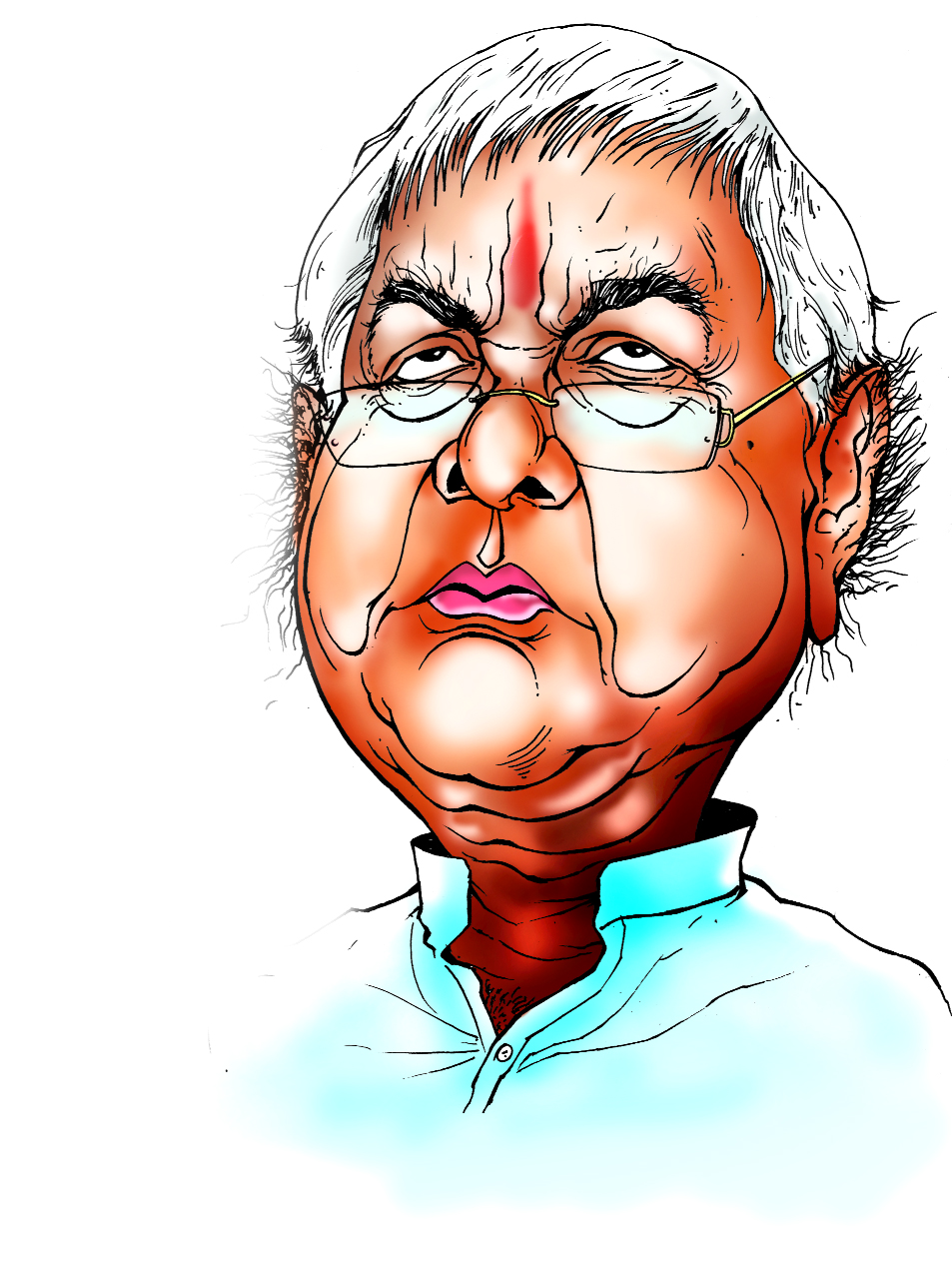
So, with lalu getting sentenced to five years in jail, a conviction that would effectively mean that he would lose his lok Sabha seat in Parliament, is it all over for him politicallyIJ Can he still make a comebackIJ And, most importantly, how could he manage to bring himself to such a pass from being a darling of both the masses and the classes in the early 1990sIJ
lalu, born in poverty, was the sixth child of a cowherd and the first in his family to be a graduate. So when he became Chief Minister in 1990, he symbolised the maturing of Indian democracy and also the empowerment of the downtrodden. Sankarshan Thakur, in his biography on the RJD chief, recounts how lalu would wear clean clothes and comb his hair neatly even when he took his buffaloes out to graze, for which he would often be taunted by the upper-caste babus. They didn’t think a low-born Yadav had the right to wear unsoiled clothes, or be so image-conscious as lalu was, particularly his obsession with the ‘Sadhana cut’ hairstyle. As the story goes, one day
when he was writing on a slate, a landlord commented: “This is Kalyuga. Now even the children of milkmen will learn to read and write!” Soon after lalu left the village for his studies in Patna. This single incident showcases the all-pervasive grip of the caste system in Bihar, as well as the allegorical importance of lalu’s political success in the State.
But lalu failed to go beyond symbolism. He gave swara (voice) to the poor, but couldn’t provide them swarg (heaven), as he would often promise in his public speeches. Then emerged the fodder scam. Thakur writes in Subaltern Sahib, “lalu Yadav lost his magic the day he said he was going to cling on to the chief ministership even if he were to be chargesheeted in the fodder scandal. That was the day lalu Yadav, Bihar’s great rosy-cheeked hope, exposed himself. He wasn’t there to deliver power to the people, he was there to keep it for himself.”
It had been a downward journey for him since then, except perhaps his tenure as Railway Minister in the mid-2000s when he transformed the Railways into a profit-making enterprise. Some may question his achievements at Rail Bhawan, but the fact remains that lalu was a different man there. A former member of the Railway Board says, “lalu never interfered with the day-to-day functioning of the Railways. All he did was to get a few competent men, and leave the work to them.”
This was a clear transformation in someone who would take the babus for granted in Patna. In Delhi, he would listen to them, trust them, and even go by their suggestions. The change, however, had come a bit too late, as lalu had already burnt the long rope people had provided him. Now, with his conviction in the fodder scam, it’s an uphill task for him to make a comeback, more so when he will be in jail for five years. His sons are not yet ready for succession. And, one is not sure if lalu can trust his party seniors like Raghuvansh Prasad and Abdul Bari Siddiqui. Worse, with lalu behind bars, his core M-Y constituency may slip to other parties.
Yet, Indian politics is unpredictable, more so in the Hindi heartland. It may, therefore, be too early to write the political obituary of lalu Prasad and his brand of politics, but the fact remains that people of Bihar no longer take his samosa idiom seriously: “Jab tak rahega samosa main aloo, tab tak rahega Bihar main lalu!” Maybe in this era of burgers, samosas are out of fashion. So is lalu. Maybe he was destined to fall Icarus-like. Maybe his very purpose in Indian politics was to provide swara to the poor. Now it’s on others to provide swarg.
HOPE SQUANDERED
1977 Gets elected as a member of the 6th lok Sabha on a Janata Party ticket at the age 29, becoming one of the youngest members of Parliament at that time
1990 Becomes the Chief Minister of Bihar; stops lK Advani's rath yatra, thus endearing himself to minorities
1991 Opens schools for shepherds called charwaha vidyalaya
1996 The fodder scam comes to fore. Crores of money from the State Government treasury given to non-existent companies for supply of fodder in districts like Chaibasa
1997 Surrenders before the CBI in connection with the fodder scam; makes Rabri Devi Chief Minister
2004 Serves as the Railway Minister of India from 2004 to 2009
2005 loses out to the JD(U)-BJP combine led by Nitish Kumar
2013 On October 3, the CBI court in Ranchi sentences him to five years' imprisonment in the 17-year-old fodder scam case